

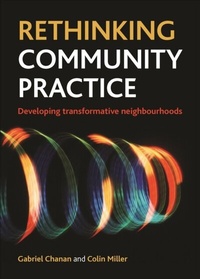
Rethinking Community Practice
Developing Transformative Neighbourhoods
1st Edition
Published on 27. February 2013
200 pages
978-1-4473-1434-9 (ISBN)
Description

As local communities and public services reel under the impact of global economic turmoil, it is vital to find more creative ways for the services to work together with those who depend on them and who also, as citizens, ultimately govern them. Community practice is the name for that growing part of the relationship by which service providers and local residents collaborate flexibly and economically to meet needs, boost community strengths and service effectiveness, and link participative and representative democracy. Combining re-examination of theory with practical tools and approaches, Chanan and Miller provide a new framework for local involvement strategy, for policy-makers and practitioners alike. They show how this innovative but still amorphous movement can become more coherent, both on the ground and in public policy: reforming community development, building new kinds of neighbourhood partnership, measuring outcomes objectively, and combining the best innovations of the past three decades into a new synthesis. This is an important new perspective for all local public service agencies, all practitioners working in communities, and academics and students concerned with these fields.
More details
Other editions
Additional editions

Book
02/2013
1st Edition
Policy Press
€38.50
Shipment within 15-20 days
Book
02/2013
1st Edition
Policy Press
€78.70
Shipment within 15-20 days

E-Book
02/2013
1st Edition
Policy Press
€47.99
Available for download
Content
- Intro
- Rethinking Community Practice
- Contents
- List of tables, figures and boxes
- Foreword
- 1. Introduction
- What is community practice?
- The community involvement trajectory
- From one-way provision to co-production
- The neighbourhood focus
- The basic unit: the community group
- Emergence of community practice
- Growth and setback
- Can neighbourhoods be transformed?
- Can community development lead?
- Terminological ground-clearing
- Towards a new synthesis
- 2. National policy on community involvement - the historical journey
- The journey so far
- The City Challenge incubator
- The Single Regeneration Budget breakthrough
- The Community Development Foundation lever
- New Labour
- Neighbourhood Renewal, Community Strategies and Local Strategic Partnerships
- Maturity, divergence and disruption
- Coalition government: from New Labour to big society32
- Footholds for the future
- 3. Community practice and the state
- The problem of scale
- Provision and participation
- The crystallisation of community development
- Community development as an occupation
- State use of community practice
- A schizoid tradition - or a skilled balancing act?
- The ambivalent effects of radicalism
- Fuzzy orthodoxy
- Democracy needs community practice but does not guarantee it
- 4. What happens in communities
- What good looks like
- Fundamental building blocks: community groups
- Productivity of the community sector
- Essential conditions for community groups
- Networks
- How people interact in groups
- How many community groups are there? How many should there be?
- How much volunteering?
- Reaching the uninvolved
- Sidelights from organisational theory
- Reality check: picturing interaction
- 5. Towards neighbourhood strategy
- Overcoming fragmentation
- A vision of sustainability
- Communities of interest and identity
- Economic context
- Regeneration
- Adapting to austerity
- Precedents and models
- Inside out and outside in the neighbourhood
- Joining up the community perspective
- Joining up the front line
- A holistic view with some holes in it
- Community and complexity
- Snakes and ladders
- 6. Building partnership
- Transformative neighbourhoods?
- Interlocking systems
- Neighbourhood partnerships: who drives?
- Teamwork and leadership
- Structure and coordination
- Supporting community groups
- Power in partnerships
- Pitfalls
- Does the big society theme help?
- Principles to take forward
- 7. Different perspectives
- Multiple pathways
- Story one: A political initiative
- Story two: A community health project
- Commentary
- 8. Outcomes and evidence
- The evidence imperative
- Cost and quality: the Conservative approach in the 1980s and 1990s
- Continuity and change under early New Labour
- The community practice response
- Generic community practice outcomes can be predicted
- Changing the community practice evaluation culture
- The indicators breakthrough
- Community influence and cohesion
- The relationship between community groups and local public bodies
- Sifting the responses
- Low baseline - high potential
- Building local evidence
- Cost benefits
- 9. Conclusion - strategy for community practice
- The policy chain
- Neighbourhoods at the centre
- Neighbourhood partnerships
- Principles for strategy
- From community development to community practice
- Community development leadership and change
- How much planning?
- Twelve pillars of strategy
- Restoring vision
- References
- Index
