

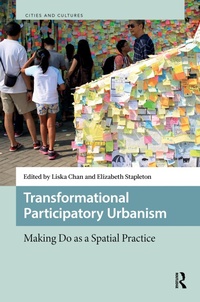
Transformational Participatory Urbanism
Making Do as Spatial Practice
Published on 16. April 2026
288 pages
978-1-040-84198-3 (ISBN)
Description

Transformational Participatory Urbanism explores making do as a critical spatial practice at the intersection of spatial justice and creative geography. Through cases from Hong Kong's Lennon Walls and San Francisco Bay mudflats to container-based sanitation in Haiti and Toronto's strip-mall parking lots, contributors show how people rework urban space under constraint-through adaptation, care, and resistance. Grounded in de Certeau, Levi-Strauss, Soja, and Haraway, the volume frames making do as urban bricolage: materially inventive, politically assertive, and speculative about more just futures.
Organised in three parts-Discourse, Process, and Engagement-the book ranges from theory to field practice. Essays examine self-build housing manuals in Mexico; tactics of market curation and participation; artistic interventions in Chinatown; gardening as reparative practice; mud and ruins as co-authors of landscape; sidewalk vernaculars; and maintenance as creative care. Engagement chapters consider sanitation knowledge transfer in Haiti, solidarity clinics in Athens, civic commons on private parking lots (plazaPOPS), and Taipei's Nanji Rice as commoning infrastructure. Together, these chapters foreground situated knowledge, minor tactics, and claims to spatial agency.
This book is written for scholars, practitioners, and advanced students in landscape architecture, urban design and planning, architecture, geography, and visual culture, as well as civic leaders, NGOs, and community organisers seeking low-cost, high-impact approaches to equitable place-making.
Organised in three parts-Discourse, Process, and Engagement-the book ranges from theory to field practice. Essays examine self-build housing manuals in Mexico; tactics of market curation and participation; artistic interventions in Chinatown; gardening as reparative practice; mud and ruins as co-authors of landscape; sidewalk vernaculars; and maintenance as creative care. Engagement chapters consider sanitation knowledge transfer in Haiti, solidarity clinics in Athens, civic commons on private parking lots (plazaPOPS), and Taipei's Nanji Rice as commoning infrastructure. Together, these chapters foreground situated knowledge, minor tactics, and claims to spatial agency.
This book is written for scholars, practitioners, and advanced students in landscape architecture, urban design and planning, architecture, geography, and visual culture, as well as civic leaders, NGOs, and community organisers seeking low-cost, high-impact approaches to equitable place-making.
More details
Series
Language
English
Place of publication
London
United Kingdom
Publishing group
Taylor & Francis Ltd
Target group
Professional and scholarly
Illustrations
1 Tables, black and white; 19 Halftones, black and white; 19 Illustrations, black and white
File size
7,41 MB
ISBN-13
978-1-040-84198-3 (9781040841983)
Copyright in bibliographic data and cover images is held by Nielsen Book Services Limited or by the publishers or by their respective licensors: all rights reserved.
Schweitzer Classification
Other editions
Additional editions
Liska Chan | Elizabeth Stapleton
Transformational Participatory Urbanism
Making Do as Spatial Practice
Book
approx. 04/2026
1st Edition
Amsterdam University Press
€201.50
Not yet published
Persons
Liska Chan is an Associate Professor of Landscape Architecture at the University of Oregon. Her research explores the invisible forces that shape landscapes-ecological, cultural, and historical-through critical cartography, sensory practice, and vernacular adaptation. Chan's work includes writing, land art, and collaborative projects that interrogate perception, spatial justice, and environmental change.
Elizabeth Stapleton is a designer, scholar, and educator whose work focuses on engaging underrepresented communities in public landscapes. With a background in ecology, her interdisciplinary work explores urban landscapes as social-ecological systems. Her years of experience on applied, community-focused parks planning projects informs and inspires her academic practice.
Elizabeth Stapleton is a designer, scholar, and educator whose work focuses on engaging underrepresented communities in public landscapes. With a background in ecology, her interdisciplinary work explores urban landscapes as social-ecological systems. Her years of experience on applied, community-focused parks planning projects informs and inspires her academic practice.
Content
1. Introduction: Urban Bricolage: Making Do as Spatial Practice (Liska Chan and Elizabeth Stapleton) Part I: Discourse 2. Making Do Towards a Theory of Practice (Gillian Jein) 3. Shared Margins, Shared Stories: Narratives of Social-Ecological Making Do in Urban Waterways (Elizabeth Stapleton) 4. Building Housing, Constructing Selves and Others: The Case of the Mexican Self-Building Manual since 1930 (Rodrigo Escandon Cesarman and Semine Long-Callesen) 5. Between Curation and Making Do: Participating in the Lives of Urban Markets (Ed Wall and Emma Colthurst) 6. Epoxy Art Group: Alternative Tactics for Artmaking in Chinatown (Jayne Cole Southard) Part II: Process 7. Digging for the Future: Garden as Artistic Practice (Raechel Root and Joseph M. Sussi) 8. Becoming of Mud and Ruins (Brett Milligan) 9. The Sidewalks Tell Stories (Gwendolyn Cohen) 10. Recovering Maintenance: Rapid Response and Slow Evolution (Michael Geffel) Part III: Engagement 11. Reversing the Flow: Reconsidering Sanitation Knowledge Transfer around the Globe (Kory Russel, Daniel Tillias, Sebastien Tilmans, and Sasha Kramer) 12. Making Do in Times of Crisis: Exploring the Architecture of Solidarity Clinics and Pharmacies in Athens (Elisavet Hasa) 13. Operating in the 'Grey Area': Creating Civic Commons on Private Parking Lots Along Toronto's Strip-Mall Main Streets (Brendan Stewart )14. Nanji Rice and Socio-Spatial Practices of Making Do (Jeffrey Hou)
