

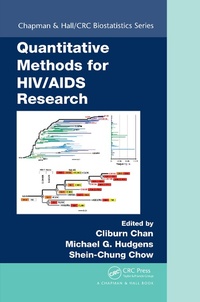
Quantitative Methods for HIV/AIDS Research
1st Edition
Published on 7. August 2017
308 pages
978-1-4987-3425-7 (ISBN)
Description

Quantitative Methods in HIV/AIDS Research provides a comprehensive discussion of modern statistical approaches for the analysis of HIV/AIDS data. The first section focuses on statistical issues in clinical trials and epidemiology that are unique to or particularly challenging in HIV/AIDS research; the second section focuses on the analysis of laboratory data used for immune monitoring, biomarker discovery and vaccine development; the final section focuses on statistical issues in the mathematical modeling of HIV/AIDS pathogenesis, treatment and epidemiology.
This book brings together a broad perspective of new quantitative methods in HIV/AIDS research, contributed by statisticians and mathematicians immersed in HIV research, many of whom are current or previous leaders of CFAR quantitative cores. It is the editors' hope that the work will inspire more statisticians, mathematicians and computer scientists to collaborate and contribute to the interdisciplinary challenges of understanding and addressing the AIDS pandemic.
This book brings together a broad perspective of new quantitative methods in HIV/AIDS research, contributed by statisticians and mathematicians immersed in HIV research, many of whom are current or previous leaders of CFAR quantitative cores. It is the editors' hope that the work will inspire more statisticians, mathematicians and computer scientists to collaborate and contribute to the interdisciplinary challenges of understanding and addressing the AIDS pandemic.
Reviews / Votes
"The book highlights statistical and mathematical work done in the quantitative cores of the Centers for AIDS Research (CFARs), a network of centers funded by the US National Institutes of Health, and gives a good sense of the breadth of quantitative issues involved in the varied research streams in HIV/AIDS. The level of the text varies between introductory overview and cutting-edge; some sections will be more useful for beginners in that area, others for experienced professionals with a challenging problem. Even having worked in HIV research for the bulk of my career, I learned something; simultaneously, I expect that someone new to the area would find it a useful introduction."~Nicole Bohme Carnegie, Montana State University
More details
Series
Language
English
Place of publication
Philadelphia, PA
United States
Publishing group
Taylor & Francis Inc
Target group
Professional and scholarly
Illustrations
27 s/w Zeichnungen, 24 s/w Tabellen, 13 s/w Photographien bzw. Rasterbilder
24 Tables, black and white; 27 Line drawings, black and white; 13 Halftones, black and white
File size
5,40 MB
ISBN-13
978-1-4987-3425-7 (9781498734257)
Copyright in bibliographic data and cover images is held by Nielsen Book Services Limited or by the publishers or by their respective licensors: all rights reserved.
Schweitzer Classification
Other editions
Additional editions
Cliburn Chan | Michael G. Hudgens | Shein-Chung Chow
Quantitative Methods for HIV/AIDS Research
Book
06/2020
1st Edition
Chapman & Hall/CRC
€61.89
Shipment within 15-20 days
Cliburn Chan | Michael G. Hudgens | Shein-Chung Chow
Quantitative Methods for HIV/AIDS Research
Book
08/2017
1st Edition
Chapman & Hall/CRC
€171.40
Shipment within 15-20 days
Persons
Cliburn Chan is an Associate Professor of Biostatistics and Bioifnroamtics and Statistical Science at Duke University, and is the Director of the Biostaatistisc and Computational Biology Core of the Duke Center for AIDS Research (CFAR). Dr. Chan is cross-trained in medicine and applied mathematics, and is focused on inter-disciplinary research in computational immunology and the development of methods for the analysis of single cell data. He teachers graduate classes in data science and computational statistics at Duke University.
Michael Hudgens is a Professor in the Department of Biostatistics at UNC-Chapel Hill and is Director of the Biostatistics Core of the UNC Center for AIDS Research (CFAR). He has experience in collaborative research and statistical methodology development related to studies of infectious diseases, primarily HIV. Professor Hudgens has co-authored more than 150 peer-reviewed papers in statistical journals such as Biometrika, Biometrics, JASA and JRSS-B as well as biomedical journals such as the New England Journal of Medicine, Lancet and Nature. He currently serves as an Associate Editor for Biometrics, JRSS-B, and JASA. He is an elected fellow of the American Statistical Association and has taught graduate level biostatistics courses at UNC for over ten years.
Shein-Chung Chow, PhD, is a professor in the Department of Biostatistics and Bioinformatics at Duke University School of Medicine. Dr. Chow is also an adjunct professor at Duke-National University of Singapore Graduate Medical School, an adjunct professor at North Carolina State University, and founding director of the Global Clinical Trial and Research Center in Tianjin, China. He is editor-in-chief of the Journal of Biopharmaceutical Statistics and editor-in-chief of the Chapman & Hall/CRC Biostatistics Series. He is the author or co-author of more than 250 papers and 24 books, including Adaptive Design Methods in Clinical Trials, Second Edition, Handbook of Adaptive Designs in Pharmaceutical and Clinical Development, and Controversial Statistical Issues in Clinical Trials. A fellow of the ASA and member of the ISI, Dr. Chow has received the ASA Chapter Service Recognition Award, the DIA Outstanding Service Award, and the ICSA Extraordinary Achievement Award.
Michael Hudgens is a Professor in the Department of Biostatistics at UNC-Chapel Hill and is Director of the Biostatistics Core of the UNC Center for AIDS Research (CFAR). He has experience in collaborative research and statistical methodology development related to studies of infectious diseases, primarily HIV. Professor Hudgens has co-authored more than 150 peer-reviewed papers in statistical journals such as Biometrika, Biometrics, JASA and JRSS-B as well as biomedical journals such as the New England Journal of Medicine, Lancet and Nature. He currently serves as an Associate Editor for Biometrics, JRSS-B, and JASA. He is an elected fellow of the American Statistical Association and has taught graduate level biostatistics courses at UNC for over ten years.
Shein-Chung Chow, PhD, is a professor in the Department of Biostatistics and Bioinformatics at Duke University School of Medicine. Dr. Chow is also an adjunct professor at Duke-National University of Singapore Graduate Medical School, an adjunct professor at North Carolina State University, and founding director of the Global Clinical Trial and Research Center in Tianjin, China. He is editor-in-chief of the Journal of Biopharmaceutical Statistics and editor-in-chief of the Chapman & Hall/CRC Biostatistics Series. He is the author or co-author of more than 250 papers and 24 books, including Adaptive Design Methods in Clinical Trials, Second Edition, Handbook of Adaptive Designs in Pharmaceutical and Clinical Development, and Controversial Statistical Issues in Clinical Trials. A fellow of the ASA and member of the ISI, Dr. Chow has received the ASA Chapter Service Recognition Award, the DIA Outstanding Service Award, and the ICSA Extraordinary Achievement Award.
Content
Contents
Preface
Contributors
Section I Quantitative Methods for Clinical Trials and Epidemiology
1. Statistical Issues in HIV Non-Inferiority Trials Mimi Kim
2. Sample Size for HIV-1 Vaccine Clinical Trials with Extremely Low Incidence Rate Shein-Chung Chow, Yuanyuan Kong, and Shih-Ting Chiu
3. Adaptive Clinical Trial Design Shein-Chung Chow and Fuyu Song
4. Generalizing Evidence from HIV Trials Using Inverse Probability of Sampling Weights Ashley L. Buchanan, Michael G. Hudgens, and Stephen R. Cole
5. Statistical Tests of Regularity among Groups with HIV Self-Test Data John Rice, Robert L. Strawderman, and Brent A. Johnson
Section II Quantitative Methods for Analysis of Laboratory Assays
6. Estimating Partial Correlations between Logged HIV RNA Measurements Subject to Detection Limits Robert H. Lyles
7. Quantitative Methods and Bayesian Models for Flow Cytometry Analysis in HIV/AIDS Research Lin Lin and Cliburn Chan
8. The Immunoglobulin Variable-Region Gene Repertoire and Its Analysis Thomas B. Kepler and Kaitlin Sawatzkiix
9. Probability-Scale Residuals in HIV/AIDS Research: Diagnostics and Inference Bryan E. Shepherd, Qi Liu, Valentine Wanga, Chun Li
Section III Quantitative Methods for Dynamical Models and Computer Simulations
10. Simulation Modeling of HIV Infection-From Individuals to Risk Groups and Entire Populations Georgiy Bobashev
11. Review of Statistical Methods for Within-Host HIV Dynamics in AIDS Studies Ningtao Wang and Hulin Wu
12. Precision in the Specification of Ordinary Differential Equations and Parameter Estimation in Modeling Biological Processes
Sarah E. Holte and Yajun Mei
Index
Preface
Contributors
Section I Quantitative Methods for Clinical Trials and Epidemiology
1. Statistical Issues in HIV Non-Inferiority Trials Mimi Kim
2. Sample Size for HIV-1 Vaccine Clinical Trials with Extremely Low Incidence Rate Shein-Chung Chow, Yuanyuan Kong, and Shih-Ting Chiu
3. Adaptive Clinical Trial Design Shein-Chung Chow and Fuyu Song
4. Generalizing Evidence from HIV Trials Using Inverse Probability of Sampling Weights Ashley L. Buchanan, Michael G. Hudgens, and Stephen R. Cole
5. Statistical Tests of Regularity among Groups with HIV Self-Test Data John Rice, Robert L. Strawderman, and Brent A. Johnson
Section II Quantitative Methods for Analysis of Laboratory Assays
6. Estimating Partial Correlations between Logged HIV RNA Measurements Subject to Detection Limits Robert H. Lyles
7. Quantitative Methods and Bayesian Models for Flow Cytometry Analysis in HIV/AIDS Research Lin Lin and Cliburn Chan
8. The Immunoglobulin Variable-Region Gene Repertoire and Its Analysis Thomas B. Kepler and Kaitlin Sawatzkiix
9. Probability-Scale Residuals in HIV/AIDS Research: Diagnostics and Inference Bryan E. Shepherd, Qi Liu, Valentine Wanga, Chun Li
Section III Quantitative Methods for Dynamical Models and Computer Simulations
10. Simulation Modeling of HIV Infection-From Individuals to Risk Groups and Entire Populations Georgiy Bobashev
11. Review of Statistical Methods for Within-Host HIV Dynamics in AIDS Studies Ningtao Wang and Hulin Wu
12. Precision in the Specification of Ordinary Differential Equations and Parameter Estimation in Modeling Biological Processes
Sarah E. Holte and Yajun Mei
Index
