

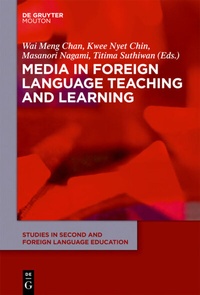
Media in Foreign Language Teaching and Learning
Description

While educators and educational psychologists debate the influence of media on learning, there can be little doubt that media is now an integral constituent of any educational context. In particular, computer and internet media, with their immense processing power and multimedia capabilities, can have significant bearing on learning processes and outcomes in today's learning environment. Such media, which are increasingly designed to be highly interactive and adaptable, can enable reflective, productive and communicative activities and have much potential for foreign language learning.
The book contains 16 papers which look at different forms of media and explore how these affect or can be used effectively in foreign language education. The first of three parts focuses on important theoretical and pedagogical issues in selecting and using media. In the second part, insightful empirical research findings are presented on the contributions of different forms of media in language teaching and learning, including their effect on learners' learning motivation. The third and concluding part of the book provides in-depth accounts of how media can be harnessed to drive innovative curricular practice as well as students' evaluations of these curricular projects.
More details
Other editions
Additional editions
Persons
Content
2 - Chapter 1 Media in foreign language teaching and learning: An introduction to the book [Seite 11]
3 - Part 1: Theoretical and pedagogical issues in the use of media [Seite 33]
3.1 - Chapter 2 Video clips, input processing and language learning [Seite 35]
3.2 - Chapter 3 Sounds comprehensible: Using media for listening comprehension in the language classroom [Seite 53]
3.3 - Chapter 4 Promises and perils of educational technology in foreign language curriculum and materials development [Seite 79]
3.4 - Chapter 5 Social media to motivate language learners from before admission to after graduation [Seite 97]
4 - Part 2: Empirical research on the role of media [Seite 117]
4.1 - Chapter 6 Classroom discourse as a re-mediating resource for foreign language learning [Seite 119]
4.2 - Chapter 7 Tasks as means to mediate between the classroom and the world beyond: Comparisons of language activities in three EFL classrooms for children [Seite 141]
4.3 - Chapter 8 Popular media as a motivational factor for foreign language learning: The example of the Korean [Seite 161]
4.4 - Chapter 9 Learning how to learn with media: A case of L2 group self-instruction [Seite 199]
4.5 - Chapter 10 Towards a typology of corrective feedback moves in an asynchronous distance language learning environment [Seite 227]
4.6 - Chapter 11 Effects of online cooperative evaluation and group rewards on high school students' argumentative writing attitudes and interaction behaviors [Seite 253]
4.7 - Chapter 12 Silence in foreign language education: Face-to-face and computermediated communication in the Japanese context [Seite 279]
5 - Part 3: Media in curricular practice [Seite 305]
5.1 - Chapter 13 Media and mediation - teachers, learners and learning environments [Seite 307]
5.2 - Chapter 14 Learning English from online advertisements: An electronic portfolio project [Seite 323]
5.3 - Chapter 15 Giving feedback on assignment writing to international students - the integration of voice and writing tools [Seite 365]
5.4 - Chapter 16 Media humour in the language classroom: Using newspaper cartoons for authentic input and creative output [Seite 393]
6 - Authors and their affiliations [Seite 423]
7 - Index [Seite 427]
