

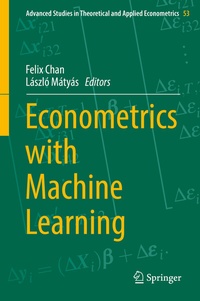
Econometrics with Machine Learning
1st Edition
Published on 7. September 2022
XXII, 371 pages
978-3-031-15149-1 (ISBN)
Description

This book helps and promotes the use of machine learning tools and techniques in econometrics and explains how machine learning can enhance and expand the econometrics toolbox in theory and in practice.
Throughout the volume, the authors raise and answer six questions: 1) What are the similarities between existing econometric and machine learning techniques? 2) To what extent can machine learning techniques assist econometric investigation? Specifically, how robust or stable is the prediction from machine learning algorithms given the ever-changing nature of human behavior? 3) Can machine learning techniques assist in testing statistical hypotheses and identifying causal relationships in 'big data? 4) How can existing econometric techniques be extended by incorporating machine learning concepts? 5) How can new econometric tools and approaches be elaborated on based on machine learning techniques? 6) Is it possible to develop machine learning techniques furtherand make them even more readily applicable in econometrics?
As the data structures in economic and financial data become more complex and models become more sophisticated, the book takes a multidisciplinary approach in developing both disciplines of machine learning and econometrics in conjunction, rather than in isolation. This volume is a must-read for scholars, researchers, students, policy-makers, and practitioners, who are using econometrics in theory or in practice.
Throughout the volume, the authors raise and answer six questions: 1) What are the similarities between existing econometric and machine learning techniques? 2) To what extent can machine learning techniques assist econometric investigation? Specifically, how robust or stable is the prediction from machine learning algorithms given the ever-changing nature of human behavior? 3) Can machine learning techniques assist in testing statistical hypotheses and identifying causal relationships in 'big data? 4) How can existing econometric techniques be extended by incorporating machine learning concepts? 5) How can new econometric tools and approaches be elaborated on based on machine learning techniques? 6) Is it possible to develop machine learning techniques furtherand make them even more readily applicable in econometrics?
As the data structures in economic and financial data become more complex and models become more sophisticated, the book takes a multidisciplinary approach in developing both disciplines of machine learning and econometrics in conjunction, rather than in isolation. This volume is a must-read for scholars, researchers, students, policy-makers, and practitioners, who are using econometrics in theory or in practice.
More details
Series
Language
English
Place of publication
Cham
Switzerland
Publishing group
Springer International Publishing
Target group
Professional and scholarly
Illustrations
XXII, 371 p. 49 illus., 36 illus. in color.
File size
9,02 MB
ISBN-13
978-3-031-15149-1 (9783031151491)
DOI
10.1007/978-3-031-15149-1
Schweitzer Classification
Other editions
Additional editions
Felix Chan | László Mátyás
Econometrics with Machine Learning
Book
09/2022
Springer
€181.89
Shipment within 15-20 days
Persons
László Mátyás
is a University Professor at the Department of Economics and Business at the Central European University (CEU - Budapest, Hungary and Vienna, Austria). He (co)authored and (co)edited several high impact publications in econometrics, mostly in the field of panel data. Earlier, among others, he worked as Senior Lecturer at Monash University (Melbourne, Australia), was the founding Director of the Institute for Economic Analysis (Budapest, Hungary), and also served as Provost of CEU. Matyas serves as a co-editor of the Springer book series "Advanced Studies in Theoretical and Applied Econometrics".
Felix Chan is an Associate Professor at Curtin University and an elected Fellow of the Modelling and Simulation Society of Australia and New Zealand (MSSANZ). He serves as the Deputy Head, School of Accounting, Economics and Finance and was the Director of Centre for Research in Applied Economics (CRAE) between 2017 and 2022.Associate Professor Chan had also served as an external consultant to the Commonwealth Grant Commission (CGC), Department of Treasury Western Australia and Chamber of Commerce and Industry (WA) on issues surrounding forecasting, data analytics and mathematical modelling.
Felix Chan is an Associate Professor at Curtin University and an elected Fellow of the Modelling and Simulation Society of Australia and New Zealand (MSSANZ). He serves as the Deputy Head, School of Accounting, Economics and Finance and was the Director of Centre for Research in Applied Economics (CRAE) between 2017 and 2022.Associate Professor Chan had also served as an external consultant to the Commonwealth Grant Commission (CGC), Department of Treasury Western Australia and Chamber of Commerce and Industry (WA) on issues surrounding forecasting, data analytics and mathematical modelling.
Content
Linear Econometric Models with Machine Learning.- Nonlinear Econometric Models with Machine Learning.- The Use of Machine Learning in Treatment Effect Estimation.-Forecasting with Machine Learning Methods.-Causal Estimation of Treatment Effects From Observational Health Care Data Using Machine Learning Methods.- Econometrics of Networks with Machine Learning.- Fairness in Machine Learning and Econometrics.- Graphical Models and their Interactions with Machine Learning in the Context of Economics and Finance.- Poverty, Inequality and Development Studies with Machine Learning.- Machine Learning for Asset Pricing.
