

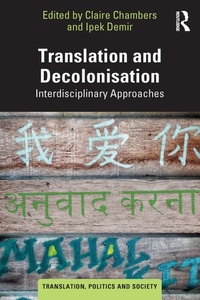
Translation and Decolonisation
Interdisciplinary Approaches
1st Edition
Published on 31. May 2024
244 pages
978-1-040-02831-5 (ISBN)
Description

Translation and Decolonisation: Interdisciplinary Approaches offers compelling explorations of the pivotal role that translation plays in the complex and necessarily incomplete process of decolonisation. In a world where translation has historically been a tool of empire and colonisation, this collection shines the spotlight on the potential for translation to be a driving force in decolonial resistance. The book bridges the divide between translation studies and the decolonial turn in the social sciences and humanities, revealing the ways in which translation can challenge colonial imaginaries, institutions, and practice, and how translation opens up South-to-South conversations. It brings together scholars from diverse disciplines and fields, including sociology, literature, languages, migration, politics, anthropology, and more, offering interdisciplinary approaches and perspectives. By examining both the theoretical and practical aspects of this intersection, the chapters of this agenda-setting collection explore the impact of translation on decolonisation and highlight the need to decolonise translation studies itself. The book illuminates the transformative power of translation in transcending linguistic, cultural, and political boundaries.
Reviews / Votes
This book is a major contribution to the growing interest in the power relations inherent in translation practice. The distinguished contributors, working across a wide range of languages and disciplines, share exciting ideas not only about translation and colonisation, but also about the role of translation in decolonisation today.- Susan Bassnett FRSL, FIL, Professor Emerita of Comparative Literature, University of Warwick and the President, British Comparative Literature Association
Translation-the act of dwelling in between, indeed of testing the limits of in-betweenness-has been the subject of a growing body of scholarship loosely named "Translation Studies." Yet, as the chapters in this book make clear, the problematic of translation traverses a wide spectrum of disciplines from literary studies to sociology. It infuses debates on coloniality and postcolonialism and increasingly figures in projects of decolonisation. This volume is a vibrant contribution to these many attempts at grasping the elusive yet essential workings of translation and translatability. Their attention on decolonisation is especially welcome in a world marked by seemingly irreducible conflicts and genocidal wars.
--Vicente L. Rafael, Professor of History and Southeast Asian Studies, University of Washington, Seattle
Translation and Decolonisation frames an urgent charge to the humanities and social science disciplines engaged in translation studies: to participate in active intervention and reparation of colonial injustice. The chapters map established and emerging concepts including reparative translation and activist interpretation, contesting the hegemony of global English and the Western institutional spaces in which translation studies was founded. This volume breaks new ground by placing decolonial and postcolonial traditions in productive dialogue and establishing the Global South as the current epicenter of contemporary translation theory.
-Isabel C. Gomez, author of Cannibal Translation: Literary Reciprocity in Contemporary Latin America (Northwestern University Press, 2023)
A vital and vibrant collection that places translation at the very heart of decolonisation struggles around the world. Leading scholars and translators offer challenging and illuminating insights into the theory of practice of translation on a divided planet beset by the troubling legacies of colonisation.
-Michael Cronin, Trinity College Dublin
More details
Series
Edition
1. Auflage
Language
English
Place of publication
London
United Kingdom
Publishing group
Taylor & Francis Ltd
Target group
College/higher education
Product notice
Reflowable
File size
2,02 MB
ISBN-13
978-1-040-02831-5 (9781040028315)
Copyright in bibliographic data and cover images is held by Nielsen Book Services Limited or by the publishers or by their respective licensors: all rights reserved.
Schweitzer Classification
Other editions
Additional editions
Book
05/2024
1st Edition
Routledge
€61.30
Shipment within 10-20 days
Book
05/2024
1st Edition
Routledge
€206.40
Shipment within 10-20 days
Persons
Claire Chambers is Professor of Global Literature at the University of York, where she teaches twentieth- and twenty-first-century writing in English from South Asia, the Perso-Arab world, and their diasporas. Her books include Imagining Muslims in South Asia and the Diaspora, Britain Through Muslim Eyes, and Making Sense of Contemporary British Muslim Novels.
Ipek Demir is Professor of Diaspora Studies and Director of the Centre for Ethnicity and Racism Studies (CERS) at the University of Leeds. Her publications span race, diaspora, migration, decoloniality, and interdisciplinarity. Her research has been funded by the EU, ESRC, and AHRC. She is also the author of Diaspora as Translation and Decolonisation (2022).
Ipek Demir is Professor of Diaspora Studies and Director of the Centre for Ethnicity and Racism Studies (CERS) at the University of Leeds. Her publications span race, diaspora, migration, decoloniality, and interdisciplinarity. Her research has been funded by the EU, ESRC, and AHRC. She is also the author of Diaspora as Translation and Decolonisation (2022).
Content
Acknowledgements
Claire Chambers and Ipek Demir, Introduction: Translation in the Service of (De)colonisation
1: Gayatri Chakravorty Spivak, Translating into English
2: Kathryn Batchelor, Decolonial and Postcolonial Perspectives on Translation: Compatibilities and Contradictions
3: Paul F. Bandia, Reparative Translation, Decoloniality, Metacoloniality
4: Tejaswini Niranjana, Feminism and Translation in India
5: Abdelmajid Hannoum, On Translation Ideology
6: Claire Chambers, Forked Tongues: Translation and (De)colonisation in Two Global Novels by Contemporary Women Writers
7: Sara de Jong, Armed with Words: (De)colonising Translation in the US-led NATO war in Afghanistan (2001-2021)
8: Encarnacion Gutierrez Rodriguez, Translation as Decolonial Method: On the (Un)Translatability of Human Rights Demands and the Coloniality of Migration in Refugee Protest in Germany
9: Haider Shahbaz, Fahmida Riaz's Awaz: Translation and Solidarities in the Global South
10: Peiyu Yang, Translating the Other: Ghassan Kanafani's Travelogue ... And Then Arose Asia
11: Gargi Binju, Writing Diasporic In-Betweenness: South Asians in Colonial and Postcolonial East Africa in the Novels of M. G. Vassanji
12: Maureen Freely, Translation as Activism, Translators as Activists
13: Ngugi wa Thiong'o, Finding Our Way: Dialogue Among Our Languages Is the Way to the Unity of African Peoples
Claire Chambers and Ipek Demir, Introduction: Translation in the Service of (De)colonisation
1: Gayatri Chakravorty Spivak, Translating into English
2: Kathryn Batchelor, Decolonial and Postcolonial Perspectives on Translation: Compatibilities and Contradictions
3: Paul F. Bandia, Reparative Translation, Decoloniality, Metacoloniality
4: Tejaswini Niranjana, Feminism and Translation in India
5: Abdelmajid Hannoum, On Translation Ideology
6: Claire Chambers, Forked Tongues: Translation and (De)colonisation in Two Global Novels by Contemporary Women Writers
7: Sara de Jong, Armed with Words: (De)colonising Translation in the US-led NATO war in Afghanistan (2001-2021)
8: Encarnacion Gutierrez Rodriguez, Translation as Decolonial Method: On the (Un)Translatability of Human Rights Demands and the Coloniality of Migration in Refugee Protest in Germany
9: Haider Shahbaz, Fahmida Riaz's Awaz: Translation and Solidarities in the Global South
10: Peiyu Yang, Translating the Other: Ghassan Kanafani's Travelogue ... And Then Arose Asia
11: Gargi Binju, Writing Diasporic In-Betweenness: South Asians in Colonial and Postcolonial East Africa in the Novels of M. G. Vassanji
12: Maureen Freely, Translation as Activism, Translators as Activists
13: Ngugi wa Thiong'o, Finding Our Way: Dialogue Among Our Languages Is the Way to the Unity of African Peoples
