

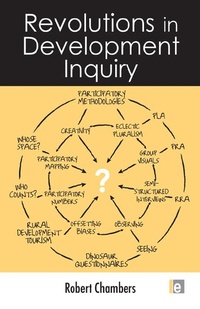
Revolutions in Development Inquiry
1st Edition
Published on 4. May 2012
256 pages
978-1-136-55811-5 (ISBN)
Description

Robert Chambers returns with a new book that reviews, together for the first time, some of the revolutionary changes in the methodologies and methods of development inquiry that have occurred in the past forty years, and reflects on their transformative potential for the future.
This book breaks new ground by describing and analysing the evolution of a sequence of approaches. Starting with the dinosaurs of large-scale multi-subject questionnaire surveys, and the biased visits and perceptions of rural development tourism and urban-based professionals, there follows a look at the explosive proliferation of methodologies and methods of recent years. These include rapid rural appraisal (RRA) participatory rural appraisal (PRA) and dramatic developments in the still largely unrecognized fields of participatory numbers and statistics, and of participatory mapping and GIS. Chambers shows how these can empower local people and provide rigorous and valid substitutes for some more traditional methods of inquiry. Also presented is a repertoire for offsetting the biases of the urban trap, which has become so serious for officials and aid agency staff. Importantly, Chambers points out that we are now in a different space, methodologically, from a few years ago. He makes the case that participatory methodologies, evolved through creative and eclectic pluralism, can be a transformative wave for the future as drivers of personal, professional and institutional change. This book is for all who are concerned with development, regardless of profession, discipline or organization, who seek to be abreast of the revolutionary breakthroughs in approaches and methods of inquiry of recent years, and what Chambers calls their 'unlimited potentials'. Published with IDS.
This book breaks new ground by describing and analysing the evolution of a sequence of approaches. Starting with the dinosaurs of large-scale multi-subject questionnaire surveys, and the biased visits and perceptions of rural development tourism and urban-based professionals, there follows a look at the explosive proliferation of methodologies and methods of recent years. These include rapid rural appraisal (RRA) participatory rural appraisal (PRA) and dramatic developments in the still largely unrecognized fields of participatory numbers and statistics, and of participatory mapping and GIS. Chambers shows how these can empower local people and provide rigorous and valid substitutes for some more traditional methods of inquiry. Also presented is a repertoire for offsetting the biases of the urban trap, which has become so serious for officials and aid agency staff. Importantly, Chambers points out that we are now in a different space, methodologically, from a few years ago. He makes the case that participatory methodologies, evolved through creative and eclectic pluralism, can be a transformative wave for the future as drivers of personal, professional and institutional change. This book is for all who are concerned with development, regardless of profession, discipline or organization, who seek to be abreast of the revolutionary breakthroughs in approaches and methods of inquiry of recent years, and what Chambers calls their 'unlimited potentials'. Published with IDS.
Reviews / Votes
'This is a book that should be read and practised by everyone involved in international development today.'Michael Edwards, director, Governance and Civil Society, The Ford Foundation
'To fully appreciate what permanent curiosity means, read this book. The creativity in participatory methods it can give rise to is laid out with deep, personal insight. This historical landscape offers perpetual horizons for those committed to innovative development practices that truly empower.'
Alan Fowler, development analysis and writer, honorary professor, Centre for Civil Society, University of KwaZulu Natal
'A must-read for all development practitioners and theorists. It reminds us once again, as Robert Chambers has done for three decades, that development is about people, why it defies simple technocratic 'solutions', and that we need to approach this challenge with humility.'
Sakiko Fukuda-Parr, professor of international affairs, The New School
'For over 20 years, Robert Chambers has been leading a quiet revolution in development practice, and this wonderful book brings together all his wisdom in one place for the very first time. This is a book that should be read and practised by everyone involved in international development today.'
Michael Edwards, director, Governance and Civil Society, The Ford Foundation
'Written in informal style, it is also quite a personal account of experiencing these developments, focusing on the family of approaches including agroecosystem analysis. It is useful to have much of this material in one place, and will be an important reference for all categories of development practitioners.'
LEISA (Low External Input and Sustainable Agriculture) Magazine
'Anyone who really wants to work at the grassroots will find it fascinating'
John Connell, Geographical Education, 2009.
'Chambers has produced a very readable, engaging work that illuminates and praises the march of new ideas in what he calls 'development inquiry', without succumbing to hagiographic account of inevitable, and ever-better, improvements.'
Edward R. Carr, Progress in Development Studies.
More details
Edition
1. Auflage
Language
English
Place of publication
London
United Kingdom
Publishing group
Taylor & Francis Ltd
Target group
Professional and scholarly
Product notice
Reflowable
File size
0,78 MB
ISBN-13
978-1-136-55811-5 (9781136558115)
Copyright in bibliographic data and cover images is held by Nielsen Book Services Limited or by the publishers or by their respective licensors: all rights reserved.
Schweitzer Classification
Other editions
Additional editions
Robert Chambers
Revolutions in Development Inquiry
Book
09/2008
1st Edition
Earthscan Ltd
€54.30
Shipment within 3-4 weeks
Robert Chambers
Revolutions in Development Inquiry
Book
09/2008
1st Edition
Earthscan Ltd
€206.50
Shipment within 3-4 weeks
Person
Robert Chambers is a research associate at the Institute of Development Studies, University of Sussex and the author of Participatory Workshops (2002) and Ideas for Development (2005).
Content
The Provocation: Dinosaurs. Rural Development Tourism: Poverty Unperceived. Microenvironments: Observing the Unobserved. Rapid Rural Appraisal: Origins, Rationale and Repertoire. PRA: Pathways, Practice and Principles. Who Counts? Participation and Numbers. Whose Space? Mapping, Power and Ethics. Traps and Liberations. Participatory Methodologies: Drivers for Change. Index
