

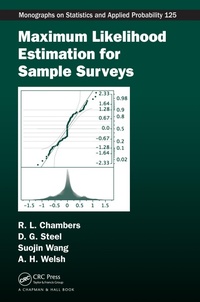
Maximum Likelihood Estimation for Sample Surveys
Published on 2. May 2012
391 pages
978-1-040-20867-0 (ISBN)
Description

Sample surveys provide data used by researchers in a large range of disciplines to analyze important relationships using well-established and widely used likelihood methods. The methods used to select samples often result in the sample differing in important ways from the target population and standard application of likelihood methods can lead to
Reviews / Votes
"This book makes a strong contribution to the model-based approach. ... This book is the first thorough, self-contained development of the likelihood theory on sample survey data. ... The authors demonstrate application of their maximum likelihood method in many important estimation problems. ... the maximum likelihood approach presented in this book allows for further scientific discoveries and further new results when dealing with complex statistical data."-Imbi Traat, International Statistical Review (2013), 81, 2
"The authors masterfully accomplish their goal and present us with an excellent and well-written book on model-based analysis for sample surveys. For the models with a mathematically tractable likelihood function, the authors develop the theory to the point ready for numerical implementation; for the mathematical intractable case, they also establish a conceptual procedure that allows future numerical research and implementation. ... the book has something for just about every applied statistician and practitioner whose work is related to sampling survey design and analysis. ... elegant presentation of the theory and clarity of writing make it easy to read. ... a valuable theoretical contribution to the area of survey sampling and provides a thoughtful basis for further applied research. ... I also recommend this book as a key reference for graduate students in applied statistics and related areas."
-Cheng Peng, Mathematical Reviews, May 2013
"This sinewy and satisfying book presents a thorough development of the use of likelihood techniques for the analysis of sample survey data, that is, for model-based analysis. ... the authors have taken care to lace the presentation with generous explanations, drawing connections between the content and familiar examples in thoughtful ways, and occasionally providing guidance from their own experience. I particularly enjoyed the use of a stratified population to explain the difference between aggregated and disaggregated estimation. Here, and in similar places, the book shines. ... well organized ... [and] extremely well edited ..."
-Andrew Robinson, Australian & New Zealand Journal of Statistics, 2013
More details
Series
Language
English
Place of publication
London
United Kingdom
Publishing group
Taylor & Francis Ltd
Target group
Professional and scholarly
File size
1,51 MB
ISBN-13
978-1-040-20867-0 (9781040208670)
Copyright in bibliographic data and cover images is held by Nielsen Book Services Limited or by the publishers or by their respective licensors: all rights reserved.
Schweitzer Classification
Other editions
Additional editions
Raymond L. Chambers | David G. Steel | Suojin Wang
Maximum Likelihood Estimation for Sample Surveys
Book
05/2012
1st Edition
Chapman & Hall/CRC
€232.70
Shipment within 15-20 days
Persons
Raymond L. Chambers, David G. Steel, Suojin Wang, Alan Welsh
Content
Introduction. Maximum likelihood theory for sample surveys. Alternative likelihood-based methods for sample survey data. Populations with independent units. Regression models. Clustered populations. Informative nonresponse. Maximum likelihood in other complicated situations.
