

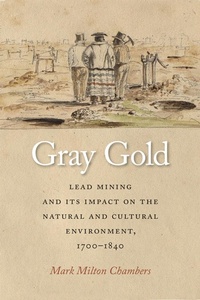
Gray Gold
Description

Winner of the Clark C. Spence Award from the Mining History Association!
While the histories of gold, silver, and copper mining and smelting are well studied, lead has not received much scholarly attention despite a long history of both Native American and European desire for the ore. Over time, native peoples made lead ornaments in molds; French and American settlers used lead to form musket balls; red lead became an important production element for flint and crystal production; and white lead was used in making paint until the mid-twentieth century.
Gray Gold aims to broaden understandings of early colonial and Native American history by turning attention to the ways that mining-and its scientific, technological, economic, cultural, and environmental features-shaped intercultural interactions and developments in the New World. Backed by remarkable original sources such as firsthand mining accounts, letters, and surveys, Mark Chambers's study demonstrates how early mining techniques affected the culture clash between Native Americans and Europeans all the while tracking the impact increased mining had on the environment of what would become the states of Illinois and Missouri. Chambers traces the evolution of lead mining and smelting technology through pre-contact America, to the amalgamation of aboriginal processes with French colonial development, through Spain's short occupation to the Louisiana Purchase and ultimately the technology transfer from Europe to an efficient and year-round standard of practice after American assumption. Additionally, while slavery in early American industry has been touched on in iron manufacturing and coal mining scholarship, the lead mining context sheds new light on the history of that grievous institution.
Gray Gold adds significantly to the understanding of lead mining and the economic and industrial history of the United States. Chambers makes important contributions to the fields of United States history, Native American and frontier history, mining and environmental history, and the history of science and technology.
More details
Other editions
Additional editions
Person
Mark Chambers teaches in the Department of History and the Department of Africana Studies, Stony Brook University (SUNY).
