

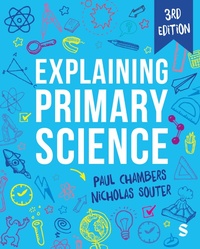
Explaining Primary Science
3rd Edition
Published on 3. April 2024
448 pages
978-1-5296-7905-2 (ISBN)
Description

Successful science teaching in primary schools requires a careful understanding of key scientific knowledge. This book covers all the major areas of science relevant for beginning primary school teachers, explaining key concepts from the ground up, helping trainees and recently qualified teachers develop into confident science educators.
This new edition comes with:
An exploration of scientific misconceptions on key topics
How to take action to protect the environment through primary science teaching
A newly streamlined focus prioritising essential primary school subject knowledge
Links to national curricula for England and Scotland
Videos of useful science experiments and demonstrations for the primary classroom
This new edition comes with:
An exploration of scientific misconceptions on key topics
How to take action to protect the environment through primary science teaching
A newly streamlined focus prioritising essential primary school subject knowledge
Links to national curricula for England and Scotland
Videos of useful science experiments and demonstrations for the primary classroom
More details
Edition
Third Edition
Language
English
Place of publication
London
United Kingdom
Publishing group
Sage Publications Ltd (Digital)
Target group
College/higher education
Professional and scholarly
Product notice
Reflowable
File size
39,86 MB
ISBN-13
978-1-5296-7905-2 (9781529679052)
Copyright in bibliographic data and cover images is held by Nielsen Book Services Limited or by the publishers or by their respective licensors: all rights reserved.
Schweitzer Classification
Other editions
Additional editions
Paul Chambers | Nicholas Souter
Explaining Primary Science
Book
04/2024
3rd Edition
SAGE Publications Ltd
€108.80
Shipment within 3-4 weeks
Paul Chambers | Nicholas Souter
Explaining Primary Science
Book
04/2024
3rd Edition
SAGE Publications Ltd
€170.90
Shipment within 3-4 weeks
Persons
Paul Chambers worked in industry prior to attending Jordanhill College of Education where he qualified as a physics and mathematics teacher. He then taught in a number of schools and was head of physics for over fourteen years. Whilst at school he was seconded on a number of occasions as staff trainer in physics and science. He was appointed lecturer in physics education (Initial Teacher Education) at the University of Strathclyde in 1999 and senior lecturer in 2003. He was also head of department for STEM education from 2003-2005 and a member of the Physics Qualifications Development Team which produced the new physics curricula in Scotland. He is the author of over ten school texts, from upper primary through to upper secondary, and has contributed to national examinations in physics as a marker, setter and vetter.
More recently he has been developing science materials and CPD for primary schools and is co-ordinator for all STEM activities at the School of Education at the University of Strathclyde. He has taught on teacher education courses in Egypt and Malawi and was External Examiner for PGCE Science at an English university. He is also an accredited provider of primary science CPD for the Scottish Schools Education Research Centre (SSERC), and serves on the ASE's Primary Science editorial board.
Nicholas (Nicky) Souter's early years were spent exploring woodland, peat bogs, lochs, and the local Campsie Fells taking in their natural history.
His first formal science lesson in 'the big school' included being told that the universe includes matter and energy. That elegant and intriguing starting point was the hook that set him on a lifelong journey of sharing science, its processes and philosophies, with school pupils and teachers. He possesses undergraduate and postgraduate qualifications in life science and in education, is a Chartered Science Teacher and a Fellow of the Royal Society of Biology. Nicky has held teaching, leadership, and examining roles in secondary and higher education. Academic life at the University of Strathclyde included teaching, research, consultancy, and authorship, having contributed to more than 25 books, several of which offered supportive advice to life science teaching at all levels of the school curriculum. Following retirement consultancy, providing primary science CPD and citizen science projects keep him engaged in science and science education.
Nicky asserts 'secure learning is built upon first-hand direct experiences'.
More recently he has been developing science materials and CPD for primary schools and is co-ordinator for all STEM activities at the School of Education at the University of Strathclyde. He has taught on teacher education courses in Egypt and Malawi and was External Examiner for PGCE Science at an English university. He is also an accredited provider of primary science CPD for the Scottish Schools Education Research Centre (SSERC), and serves on the ASE's Primary Science editorial board.
Nicholas (Nicky) Souter's early years were spent exploring woodland, peat bogs, lochs, and the local Campsie Fells taking in their natural history.
His first formal science lesson in 'the big school' included being told that the universe includes matter and energy. That elegant and intriguing starting point was the hook that set him on a lifelong journey of sharing science, its processes and philosophies, with school pupils and teachers. He possesses undergraduate and postgraduate qualifications in life science and in education, is a Chartered Science Teacher and a Fellow of the Royal Society of Biology. Nicky has held teaching, leadership, and examining roles in secondary and higher education. Academic life at the University of Strathclyde included teaching, research, consultancy, and authorship, having contributed to more than 25 books, several of which offered supportive advice to life science teaching at all levels of the school curriculum. Following retirement consultancy, providing primary science CPD and citizen science projects keep him engaged in science and science education.
Nicky asserts 'secure learning is built upon first-hand direct experiences'.
Content
Introduction: Teaching primary science today
Chapter 1: Biodiversity
Chapter 2: Ecosystems
Chapter 3: Microorganisms and Cells
Chapter 4: Plants
Chapter 5: Animals
Chapter 6: Variations and Adaptation
Chapter 7: Animal Behaviour
Chapter 8: Types of Matter
Chapter 9: Properties and Uses of Matter
Chapter 10: Materials from the Earth
Chapter 11: Chemical Changes
Chapter 12: Water and its Uses
Chapter 13: Space
Chapter 14: Energy
Chapter 15: Electricity
Chapter 16: Light
Chapter 17: Sound
Chapter 18: Forces
Chapter 19: Gravity and Weight
Chapter 1: Biodiversity
Chapter 2: Ecosystems
Chapter 3: Microorganisms and Cells
Chapter 4: Plants
Chapter 5: Animals
Chapter 6: Variations and Adaptation
Chapter 7: Animal Behaviour
Chapter 8: Types of Matter
Chapter 9: Properties and Uses of Matter
Chapter 10: Materials from the Earth
Chapter 11: Chemical Changes
Chapter 12: Water and its Uses
Chapter 13: Space
Chapter 14: Energy
Chapter 15: Electricity
Chapter 16: Light
Chapter 17: Sound
Chapter 18: Forces
Chapter 19: Gravity and Weight
