

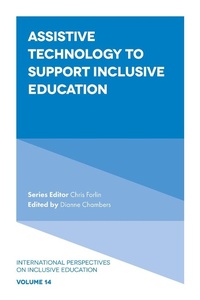
Assistive Technology to Support Inclusive Education
Published on 25. September 2020
264 pages
978-1-78769-519-1 (ISBN)
Description

In this edited collection, experienced practitioners discuss how a range of existing and emerging assistive technology devices and services are used across a variety of international settings to support the inclusion of students with disabilities.
This book details authentic examples of best practice, including identification and implementation of appropriate tools, the use of aided communication devices, modified seating equipment, computers and tablets, robotics, costs, outcomes, and services among others. It showcases a spectrum of promising and positive results in reducing exclusion, thereby supporting teachers to improve learning outcomes for students with disabilities.
By providing an excellent and current overview of assistive technology and the use of the technology in the classroom, this book is an insightful read for those who work with technology and the inclusion of students with disabilities. The authors demonstrate how specialists, teachers, parents and students can work together using technology to ensure inclusive education is a realistic goal for all.
This book details authentic examples of best practice, including identification and implementation of appropriate tools, the use of aided communication devices, modified seating equipment, computers and tablets, robotics, costs, outcomes, and services among others. It showcases a spectrum of promising and positive results in reducing exclusion, thereby supporting teachers to improve learning outcomes for students with disabilities.
By providing an excellent and current overview of assistive technology and the use of the technology in the classroom, this book is an insightful read for those who work with technology and the inclusion of students with disabilities. The authors demonstrate how specialists, teachers, parents and students can work together using technology to ensure inclusive education is a realistic goal for all.
More details
Series
Language
English
Place of publication
Bingley
United Kingdom
Target group
Professional and scholarly
File size
5,20 MB
ISBN-13
978-1-78769-519-1 (9781787695191)
Copyright in bibliographic data and cover images is held by Nielsen Book Services Limited or by the publishers or by their respective licensors: all rights reserved.
Schweitzer Classification
Other editions
Additional editions
Dianne Chambers | Chris Forlin
Assistive Technology to Support Inclusive Education
Book
09/2020
Emerald Publishing Limited
€142.30
Shipment within 10-20 days
Persons
Dianne Chambers is an Associate Professor at the University of Notre Dame Australia, Fremantle, where she coordinates Research and Special Education. She publishes widely in the field of special and inclusive education.
Content
Chapter 1. Assistive Technology Supporting Inclusive Education: Dianne Chambers
Chapter 2. The SETT Framework: Joy Smiley Zabala
Chapter 3. Low-Tech Assistive Technology to Support Students with Disability in Low Income Countries: Vaibhav Jadhav, Dianne Chambers & Dipak Tatpuje
Chapter 4. Emily Bouck & Rajiv Satsangi
Chapter 5. Aided Communication Systems: Alex M. Alexandra Da Fonte, Miriam C. Boesch & Katie Clous
Chapter 6. Tablet devices for Students with Disability in the Inclusive Classroom: Terry Cumming & Iva Strnadov
Chapter 7. Assistive Technology Costs and Outcomes: Natasha Layton, Melyssa Gardy & Rachael McDonal
Chapter 8. Designing Inclusive STEM Learning Experiences for Adolescents with Autism Spectrum Disorder: Cory A. Bennett, Jenn Gallup, Dianne Chambers & Beverly Ray
Chapter 9. Enhancing Learning and Development of Young Children with Disabilities with Assistive Technology: Deborah Tamakloe
Chapter 10. Getting Around: Rachael McDonald
Chapter 11. Implementation of Assistive Technology in Inclusive Classrooms: Anya Evmenova
Chapter 12. Remote Assistive Technology Services: Gayl Bowser
Chapter 13. Assistive Technology in the Kingdom of Saudi Arabia: Khalid Abu-Alghayth
Chapter 2. The SETT Framework: Joy Smiley Zabala
Chapter 3. Low-Tech Assistive Technology to Support Students with Disability in Low Income Countries: Vaibhav Jadhav, Dianne Chambers & Dipak Tatpuje
Chapter 4. Emily Bouck & Rajiv Satsangi
Chapter 5. Aided Communication Systems: Alex M. Alexandra Da Fonte, Miriam C. Boesch & Katie Clous
Chapter 6. Tablet devices for Students with Disability in the Inclusive Classroom: Terry Cumming & Iva Strnadov
Chapter 7. Assistive Technology Costs and Outcomes: Natasha Layton, Melyssa Gardy & Rachael McDonal
Chapter 8. Designing Inclusive STEM Learning Experiences for Adolescents with Autism Spectrum Disorder: Cory A. Bennett, Jenn Gallup, Dianne Chambers & Beverly Ray
Chapter 9. Enhancing Learning and Development of Young Children with Disabilities with Assistive Technology: Deborah Tamakloe
Chapter 10. Getting Around: Rachael McDonald
Chapter 11. Implementation of Assistive Technology in Inclusive Classrooms: Anya Evmenova
Chapter 12. Remote Assistive Technology Services: Gayl Bowser
Chapter 13. Assistive Technology in the Kingdom of Saudi Arabia: Khalid Abu-Alghayth
