

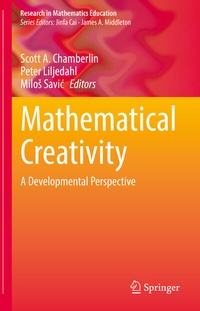
Mathematical Creativity
Description

Many books provide the former (2) foci, but omit the final discussion of the research in relation to developmental needs of learners in the domain of mathematics. Currently, educators are expected to implement best practices and illustrate how their adopted approaches are supported by research. The authors and editors of this book have invested significant effort in merging theory with practice to further this field and develop it for future generations of mathematics learners, teachers and researchers.
More details
Other editions
Additional editions
Persons
Peter Liljedahl is a mathematics educator and professor at Simon Fraser University. Many of his scholarly efforts in recent years have pertained to teacher education, mathematical modeling, mathematical affect and Flow, as well as mathematical creativity. In particular, Peter deeply understands the intricacies of creativity in mathematics as well as the pragmatic effects on student learning. Peter is a former co-editor in the Research in Mathematics series, having worked with Patricio Felmer and Boris Koichu, on a recent (2019) book entitled, Problem Solving in Mathematics Instruction and Teacher Professional Development.
Milos Savic is a mathematics educator and associate professor at the University of Oklahoma. His recent efforts in developing the Creativity in Progress Reflections with the Creativity Research Group (CRG) that will be utilized in this publication. The CRG is known in the mathematical creativity field as leaders in the tertiary level, including in proof-based courses. Their recent National Science Foundation grant has generated substantial understanding about mathematical identity and creativity at the calculus level.
