

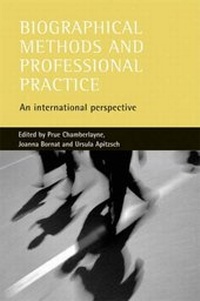
Biographical methods and professional practice
An international perspective
1st Edition
Published on 10. March 2004
352 pages
978-1-84742-587-4 (ISBN)
Description

This book uses a range of interpretive approaches to reveal the dynamics of service users' and professionals' individual experiences and life-worlds. From their research the contributors show how biographical methods can improve theoretical understanding of professional practice, as well as enrich the learning and development of professionals, and promote more meaningful and creative practitioner - service user relationships.
The book:
? reviews applications of biographical methods in both policy and practice in a range of professional contexts, from health and social care to education and employment;
? explores the impact of social change in three main arenas - transformation from Eastern to Western types of society in Europe, major shifts in social and welfare principles, experiences of immigration and of new cultural diversities - on professional practice;
? critically evaluates subjective and reflexive processes in interactions between researchers, practitioners and users of services;
? considers the institutional arrangements and cultural contexts which support effective and sensitive interventions;
? draws on actual projects and tracks reflection, progress and outcomes.
With contributions from leading international experts, it provides a valuable comparative perspective. Researchers, policy analysts and practitioners, postgraduate students, teachers and trainers will find this book a stimulating read.
The book:
? reviews applications of biographical methods in both policy and practice in a range of professional contexts, from health and social care to education and employment;
? explores the impact of social change in three main arenas - transformation from Eastern to Western types of society in Europe, major shifts in social and welfare principles, experiences of immigration and of new cultural diversities - on professional practice;
? critically evaluates subjective and reflexive processes in interactions between researchers, practitioners and users of services;
? considers the institutional arrangements and cultural contexts which support effective and sensitive interventions;
? draws on actual projects and tracks reflection, progress and outcomes.
With contributions from leading international experts, it provides a valuable comparative perspective. Researchers, policy analysts and practitioners, postgraduate students, teachers and trainers will find this book a stimulating read.
Reviews / Votes
"The editors have performed a major task drawing together such a rich range of biographically informed research on a variety of professional contexts across differing national contexts ... very useful companion to P. Chamberlayne, M. Rustin and T. Wengraf (eds) (2002), Biography and Exclusion in Europe, Bristol: The Policy Press." Journal of Social Policy " ... this is a carefully written book that offers well-framed arguments for applying biographical methods to research and practice. ... The book should be kept close at hand and its chapters considered and recognised as situations arise." European Journal of Social Work "By now, the 'biographical turn' in the social sciences is widely acknowledged but its impact in the main has been upon academics rather than professional practitioners. Biographical methods and professional practice makes an important and worthwhile contribution by demonstrating that the biographical perspective can be focused fruitfully upon applied, social policy issues both for research and for practice in the field." Robert Miller, Department of Sociology and Social Policy, Queen's University BelfastMore details
Edition
First Edition
Language
English
Place of publication
Bristol
United Kingdom
Publishing group
Bristol University Press
Target group
Professional and scholarly
Illustrations
Not illustrated
ISBN-13
978-1-84742-587-4 (9781847425874)
DOI
https://doi.org/10.51952/9781847425874
Copyright in bibliographic data and cover images is held by Nielsen Book Services Limited or by the publishers or by their respective licensors: all rights reserved.
Schweitzer Classification
Other editions
Additional editions
Prue Chamberlayne | Joanna Bornat | Ursula Apitzsch
Biographical methods and professional practice
An international perspective
Book
03/2004
1st Edition
Policy Press
€92.90
Article not available at the moment
Prue Chamberlayne | Joanna Bornat | Ursula Apitzsch
Biographical methods and professional practice
An international perspective
Book
03/2004
1st Edition
Policy Press
€42.70
Shipment within 15-20 days
Persons
Prue Chamberlayne is a Senior Research Fellow and Joanna Bornat is Professor of Oral History, both in the School of Health and Social Welfare, The Open University. Ursula Apitzsch is Professor in Sociology and Political Science at the J.W. Goethe University, Germany.
Content
Introduction ~ Ursula Apitzsch, Joanna Bornat and Prue Chamberlayne; Part One: Putting the subject into policy and practice: Biographical methods and social policy in European perspective ~ Prue Chamberlayne; Balancing precarious work, entrepreneurship and a new gendered professionalism in migrant self-employment ~ Ursula Apitzsch; Considerations on the biographical embeddedness of ethnic entrepreneurship ~ Maria Kontos; Ethnic entrepreneurship as innovation ~ Feiwel Kupferberg;
Part Two: Subjectivity in context: The social subject in biographical interpretive methods: emotional, mute, creative, divided ~ Andrew Cooper; A socially and historically contextualised psychoanalytic perspective: Holocaust survival and suffering ~ Daniel Bar-On; Professional choices between private and state positions in Russia's transformation ~ Victoria Semenova; Maintaining a sense of individual autonomy under conditions of constraint: a study of East German managers ~ Ulrike Nagel;
Part Three: Self-awareness in research and practice: Biographical reflections on the problem of changing violent men ~ David Gadd; The biographical turn in health studies ~ Wendy Rickard; Ethical aspects of biographical interviewing and analysis ~ Kaja Kazmierska; Ghost writers: using biographical methods across languages ~ Bogusia Temple;
Part Four: Recognising trajectories of disempowerment: 'Bucking and kicking': race, gender and embodied resistance in healthcare ~ Yasmin Gunaratnam; Biography as empowering practice: lessons from research ~ Joanna Bornat and Jan Walmsley; 'It's in the way that you use it': biography as a tool in professional social work ~ Riitta Kylloenen; Interpreting the needs of homeless men: interviewing in context ~ Karin Schluecker;
Part Five: Biographical resources in education and training: In quest of teachers' professional identity: the life story as a methodological tool ~ Marie-Francoise Chanfrault-Duchet; Narratives, community organisations and pedagogy ~ Rosemary Du Plessis, Jane Higgins and Belinda Mortlock; Doctors on an edge: a cultural psychology of learning and health ~ Linden West; Intercultural perspectives and professional practice in the university: what's new in Germany ~ Lena Inowlocki, Maria Teresa Herrera Vivar and Felicia Herrschaft
Part Two: Subjectivity in context: The social subject in biographical interpretive methods: emotional, mute, creative, divided ~ Andrew Cooper; A socially and historically contextualised psychoanalytic perspective: Holocaust survival and suffering ~ Daniel Bar-On; Professional choices between private and state positions in Russia's transformation ~ Victoria Semenova; Maintaining a sense of individual autonomy under conditions of constraint: a study of East German managers ~ Ulrike Nagel;
Part Three: Self-awareness in research and practice: Biographical reflections on the problem of changing violent men ~ David Gadd; The biographical turn in health studies ~ Wendy Rickard; Ethical aspects of biographical interviewing and analysis ~ Kaja Kazmierska; Ghost writers: using biographical methods across languages ~ Bogusia Temple;
Part Four: Recognising trajectories of disempowerment: 'Bucking and kicking': race, gender and embodied resistance in healthcare ~ Yasmin Gunaratnam; Biography as empowering practice: lessons from research ~ Joanna Bornat and Jan Walmsley; 'It's in the way that you use it': biography as a tool in professional social work ~ Riitta Kylloenen; Interpreting the needs of homeless men: interviewing in context ~ Karin Schluecker;
Part Five: Biographical resources in education and training: In quest of teachers' professional identity: the life story as a methodological tool ~ Marie-Francoise Chanfrault-Duchet; Narratives, community organisations and pedagogy ~ Rosemary Du Plessis, Jane Higgins and Belinda Mortlock; Doctors on an edge: a cultural psychology of learning and health ~ Linden West; Intercultural perspectives and professional practice in the university: what's new in Germany ~ Lena Inowlocki, Maria Teresa Herrera Vivar and Felicia Herrschaft
