

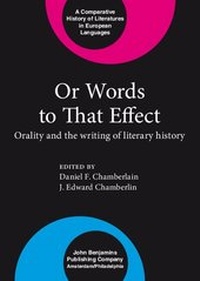
Or Words to That Effect
Orality and the writing of literary history
1st Edition
Published on 15. January 2016
VI, 312 pages
978-90-272-6780-1 (ISBN)
Description

This volume raises questions about why oral celebrations of language receive so little attention in published literary histories when they are simultaneously recognized as fundamental to our understanding of literature. It aims to prompt debate regarding the transformations needed for literary historians to provide a more balanced and fuller appreciation of what we call literature, one that acknowledges the interdependence of oral storytelling and written expression, whether in print, pictorial, or digital form. Rather than offering a summary of current theories or prescribing solutions, this volume brings together distinguished scholars, conventional literary historians, and oral performer-practitioners from regions as diverse as South Africa, the Canadian Arctic, the Roma communities of Eastern Europe and the music industry of the American West in a conversation that engages the reader directly with the problems that they have encountered and the questions that they have explored in their work with orality and with literary history.
More details
Other editions
Additional editions
Daniel F. Chamberlain | J. Edward Chamberlin
Or Words to That Effect
Orality and the writing of literary history
Book
01/2016
John Benjamins Publishing Co
€137.80
Shipment within 10-15 days
Persons
Content
- Intro
- OR WORDS TO THAT EFFECT
- Editorial page
- Title page
- LCC data
- Table of contents
- Introduction
- Preliminaries
- Histories of Literature and the Question of Comparative Oral Literary History
- Levelling the Orality-Literacy Playing Field
- I Introduction
- Towards a Hyphenated I: an Oralate-Literate Experience
- II Marcel Jousse's Laboratory of Awareness
- The Law of Im-pression: Mimism
- The Laws of Ex-pression
- Oral Style and Jousse's Oral-style Theory
- III Leveling the Oral-literate Playing Field Through Awareness of the Oral-literate Continuum
- . an agreement concerning what the object under discussion actually is
- . a common language in which to build questions and answers
- Oral Tradition and Oral-Style Tradition
- Oral-style Texts
- Didactics and Aesthetics in Mnemonic Society
- Oral-Style Mnemotechnical Terminology: Towards a Mnemo-Stylistics
- Presenting Oral-style Texts on the Page: Rhythmography
- IV Conclusion
- Modes of Discourse, Modes of Rationality
- Discourse and Rationality
- The Place of Narrative
- What Is a Story?
- Rationality and Modes of Discourse
- A Discourse Model of Reasoning
- Conclusion
- Performing Writing and Singing Silence in the Anglo-Saxon Riddle Tradition
- In The Storyteller's House
- The Game of the Little Secrets or How to Learn (and to Teach) Mechanisms of Orality
- Learning the Mechanisms of Orality
- Literary Canon and Orality
- An Example of the Relationship between Writing and Orality: Lope de Vega and the Oral Tradition of the Moroccan Sephardim
- Second Example: Literary Texts and the Terrorist Attacks of March 11, 2004 in Madrid
- Conclusion
- Significant Spaces Between
- A Lesson in Silence, #1
- Coming to Voice
- A Lesson in Silence, #2
- Silent Connections
- A Lesson in Silence, #3
- Silence and Experiential Knowledge
- A Lesson in Silence, #4
- The Story of Story and a Canon of Story
- A Canon of Oralcy?
- Made for You and Me
- The Empty Land
- Treaties: an Overview
- American Treaty Policy
- British Treaty Policy in Canada
- Comparing Canada and the United States
- First Nations and Treaties in Canada
- This Land is Your Land: Reprise
- Oh Canada
- "Oral" in Literary History
- Making Space for the Spoken Word
- Literary History on the Branch
- Literary History on the River
- The Past as a Familiar Country
- Orality in Basque Literary Historiography
- Oral Literature and Written Literature
- Oral Literature Collections
- Studies of Oral Literature
- The Institutionalisation of Teaching Basque Literature
- Orality in Basque Literary Histories
- The Ladder Holds Up the World Above
- Oral and Written Sukar Laviben of the Roma
- Hübschmannová's Essay "My Encounters with Romano sukar laviben"
- Tera Fabiánová's Poem Av manca chajori
- Ilona Lacková
- Ceija Stojka
- A Concluding Note Regarding Orality and the Socio-political Situation of Roma
- Guaman Poma and His Traces
- Introduction
- Writing without Words
- If Drawings Spoke
- The Study of the Elements of Literary History of the Khoekhoe and ?Khomani Languages of Southern Africa
- Khoekhoe and ?Khomani Storytellers
- The Stream of ?Khomani Stories
- The Puzzle of Voice
- Introduction
- Entering the Domain of Oral Poetry
- Oral Poetry and Literary Studies from a Comparative Perspective
- Talking Technologies
- Poetry, Orality, and the New Media
- Orality and the Memory-Machine: Real time, Performance, Mutability, and Spatiality
- Orality, Interaction, Group Work, Sociability, and Literary History
- References
- List of Contributors
- Index
