

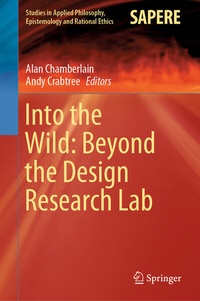
Into the Wild: Beyond the Design Research Lab
Description

This edited collection opens up new intellectual territories and articulates the ways in which academics are theorising and practicing new forms of research in 'wild' contexts. Many researchers are choosing to leave the familiarity of their laboratory-based settings in order to pursue in-situ studies 'in the wild' that can help them to better understand the implications of their work in real-world settings. This has naturally led to ethical, philosophical and practical reappraisals with regard to the taken for granted lab-based modus operandi of scientific, cultural and design-based ways of working. This evolving movement has led to a series of critical debates opening up around the nature of research in the wild, but up until now these debates have not been drawn together in a coherent way that could be useful in an academic context. The book brings together applied, methodological and theoretical perspectives relating to this subject area, and provides a platform and a source of reference material for researchers, students and academics to base their work on. Cutting across multiple disciplines relating to philosophy, sociology, ethnography, design, human-computer interaction, science, history and critical theory, this timely collection appeals to a broad range of academics in varying fields of research.
More details
Other editions
Additional editions
Persons
Alan Chamberlain is a Senior Research Fellow in the Mixed Reality Laboratory at the University of Nottingham. He has published numerous papers on varied aspects of human computer interaction. He has a longstanding interest in the development of computational systems in real world settings (research in the wild). His research interests relate to real-world problems as articulated by various communities of practice and relate to human computer interaction, ethnography, action research, participatory design, rural aspects of computing, and user engagement in order to develop networks of people that are able to involve themselves in the practices of innovation and design.
Andy Crabtree is Professor in the School of Computer Science at The University of Nottingham. His research focuses on the relationship between computing systems and social interaction. He has made substantive contributions to models of innovation and systems development, design and evaluation methodology, distributed systems, network infrastructure, and e-Science. His work has informed systems development across a range of application domains, including library services, customer services, interactive exhibitions, mixed reality games, home networks and applications, e-social science, tourism and leisure, culture and heritage.
