

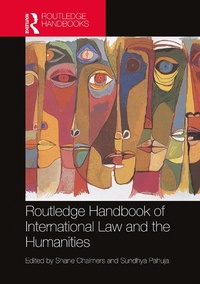
Routledge Handbook of International Law and the Humanities
1st Edition
Published on 19. May 2021
506 pages
978-1-000-38572-4 (ISBN)
Description

This Handbook brings together 40 of the world's leading scholars and rising stars who study international law from disciplines in the humanities - from history to literature, philosophy to the visual arts - to showcase the distinctive contributions that this field has made to the study of international law over the past two decades.
Including authors from Australia, Canada, Europe, India, South Africa, the UK and the USA, all the contributors engage the question of what is distinctive, and critical, about the work that has been done and that continues to be done in the field of 'international law and the humanities'. For many of these authors, answering this question involves reflecting on the work they themselves have been contributing to this path-breaking field since its inception at the end of the twentieth century. For others, it involves offering models of the new work they are carrying out, or else reflecting on the future directions of a field that has now taken its place as one of the most important sites for the study of international legal practice and theory. Each of the book's six parts foregrounds a different element, or cluster of elements, of international law and the humanities, from an attention to the office, conduct and training of the jurist and jurisprudent (Part 1); to scholarly craft and technique (Part 2); to questions of authority and responsibility (Part 3); history and historiography (Part 4); plurality and community (Part 5); as well as the challenge of thinking, and rethinking, international legal concepts for our times (Part 6).
Outlining new ways of imagining, and doing, international law at a moment in time when original, critical thought and practice is more necessary than ever, this Handbook will be essential for scholars, students and practitioners in international law, international relations, as well as in law and the humanities more generally.
Including authors from Australia, Canada, Europe, India, South Africa, the UK and the USA, all the contributors engage the question of what is distinctive, and critical, about the work that has been done and that continues to be done in the field of 'international law and the humanities'. For many of these authors, answering this question involves reflecting on the work they themselves have been contributing to this path-breaking field since its inception at the end of the twentieth century. For others, it involves offering models of the new work they are carrying out, or else reflecting on the future directions of a field that has now taken its place as one of the most important sites for the study of international legal practice and theory. Each of the book's six parts foregrounds a different element, or cluster of elements, of international law and the humanities, from an attention to the office, conduct and training of the jurist and jurisprudent (Part 1); to scholarly craft and technique (Part 2); to questions of authority and responsibility (Part 3); history and historiography (Part 4); plurality and community (Part 5); as well as the challenge of thinking, and rethinking, international legal concepts for our times (Part 6).
Outlining new ways of imagining, and doing, international law at a moment in time when original, critical thought and practice is more necessary than ever, this Handbook will be essential for scholars, students and practitioners in international law, international relations, as well as in law and the humanities more generally.
More details
Edition
1. Auflage
Language
English
Place of publication
London
United Kingdom
Publishing group
Taylor & Francis Ltd
Target group
College/higher education
Illustrations
3 Line drawings, black and white; 22 Halftones, black and white; 25 Illustrations, black and white
ISBN-13
978-1-000-38572-4 (9781000385724)
Copyright in bibliographic data and cover images is held by Nielsen Book Services Limited or by the publishers or by their respective licensors: all rights reserved.
Schweitzer Classification
Other editions
Additional editions
Shane Chalmers | Sundhya Pahuja
Routledge Handbook of International Law and the Humanities
Book
01/2023
1st Edition
Routledge
€70.20
Shipment within 15-20 days
Shane Chalmers | Sundhya Pahuja
Routledge Handbook of International Law and the Humanities
Book
05/2021
1st Edition
Routledge
€272.36
Shipment within 15-20 days
Persons
Shane Chalmers is a University of Melbourne McKenzie research fellow and Program Director in Law and Art at Institute for International Law and the Humanities (IILAH), Melbourne Law School. He is the author of Liberia and the Dialectic of Law: Critical Theory, Pluralism, and the Rule of Law (Routledge, 2018) and a forthcoming critical literary-legal history of the colonisation of Australia.
Sundhya Pahuja is a professor and the Director of Melbourne Law School's Institute for International Law and the Humanities (IILAH), The University of Melbourne. Sundhya has written widely on the history, theory and practice of international law in both its political and economic dimensions.
Sundhya Pahuja is a professor and the Director of Melbourne Law School's Institute for International Law and the Humanities (IILAH), The University of Melbourne. Sundhya has written widely on the history, theory and practice of international law in both its political and economic dimensions.
Content
Introduction Practice, Craft and Ethos: Inheriting a Tradition Part 1: Formation 1. Modus Vivendi: Office of Transnational Jurisprudent 2. Life in the Ruins: International Law as Doctrine and Discipline 3. Receiving Traditions of Civility, Remaking Conditions of Cohabitation: A Genealogy of Politics, Law and Piety in South Asia 4. The atomics 5. Tender Images: Characters of Private International Law in the Humanities 6. A Training in Conduct Part 2: Sense 7. Absent Images of International Law 8. Listening about Law in the Sonic Arts: John Cage's 4'33" and Lawrence Abu Hamdan's Saydnaya (the missing 19dB) 9. Criminal Procedure and the Humanities: Questions of Method and Orientation 10. Wayfaring Methods 11. Foot Notes. Reflections on Method and Form 12. Critical Humanities and the Human of International Human Rights Law Part 3: World-Making 13. Certain (mis)Conceptions: Westphalian Origins, Portraiture and Wampum 14. The Travels of Human Rights: The UNESCO Human Rights Exhibition 1950-53 15. International Law, Literature and Worldmaking 16. Sunil Gangopadhyay's Lord-Healer of Lost Cases, with a Translators Afterword: Cultivating a Postcolonial Literary Legal Imagination 17. We Are Making a New World Part 4: History-Telling 18. The Time of Revolution: Decolonisation, Heterodox International Legal Historiography and the Problem of the Contemporary 19. A Double Take on Debt: Reparations Claims and Shifting Regimes of Visibility 20. 'The Object is to Frighten Him with Hope': Questioning the Tragic Emplotments of International Law and Decolonisation in the Chagos Archipelago 21. Contested Histories: Revisiting the Relationship between International Law and Slavery 22. 'Space is the Only Way to Go': The Evolution of the Extractivist Imaginary of International Law 23. International Law and the Production of New Resources: Lessons from the Colonisation of Mars 24. Revisiting Local Hero Part 5: Community 25. The Politics of Legibility: 'The Family' in International Human Rights Law 26. International Law at the Border: Refugee Deaths, the Necropolitical State and Sovereign Accountability 27. Towards a Carceral Geography of International Law 28. Law and Sacrifice in Australian Extra-Territorial Nation Spaces: The Residue of Empire 29. Living Together after Violent Conflict: Museum-Making as Lawful Truth-Making 30. The Meeting of Laws in Australian Children's Literature Part 6: Concepts for Our Times 31. International Law and the Humanities in the 'Anthropocene' 32. Who, or What, is the Human of International Humanitarian Law? 33. Automating Authority: The Human and Automation in Legal Discourse on the Meaningful Human Control of Lethal Autonomous Weapons Systems 34. Rainbow Family: Machine Listening, Improvisation and Access to Justice in International Family Law 35. In the Name of the Victim: Representing Victims in International Criminal Justice 36. A Sovereignty that is 'Useless to Fascism'
