

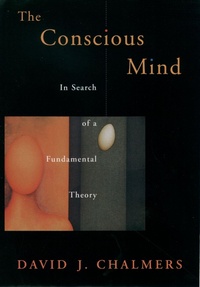
The Conscious Mind
In Search of a Fundamental Theory
1st Edition
Published on 9. May 1996
433 pages
978-0-19-802653-2 (ISBN)
Description

What is consciousness? How do physical processes in the brain give rise to the self-aware mind and to feelings as profoundly varied as love or hate, aesthetic pleasure or spiritual yearning? These questions today are among the most hotly debated issues among scientists and philosophers, and we have seen in recent years superb volumes by such eminent figures as Francis Crick, Daniel C. Dennett, Gerald Edelman, and Roger Penrose, all firing volleys in what has come to be called the consciousness wars. Now, in The Conscious Mind, philosopher David J. Chalmers offers a cogent analysis of this heated debate as he unveils a major new theory of consciousness, one that rejects the prevailing reductionist trend of science, while offering provocative insights into the relationship between mind and brain.
Writing in a rigorous, thought-provoking style, the author takes us on a far-reaching tour through the philosophical ramifications of consciousness. Chalmers convincingly reveals how contemporary cognitive science and neurobiology have failed to explain how and why mental events emerge from physiological occurrences in the brain. He proposes instead that conscious experience must be understood in an entirely new light--as an irreducible entity (similar to such physical properties as time, mass, and space) that exists at a fundamental level and cannot be understood as the sum of its parts. And after suggesting some intriguing possibilities about the structure and laws of conscious experience, he details how his unique reinterpretation of the mind could be the focus of a new science. Throughout the book, Chalmers provides fascinating thought experiments that trenchantly illustrate his ideas. For example, in exploring the notion that consciousness could be experienced by machines as well as humans, Chalmers asks us to imagine a thinking brain in which neurons are slowly replaced by silicon chips that precisely duplicate their functions--as the neurons are replaced, will consciousness gradually fade away? The book also features thoughtful discussions of how the author's theories might be practically applied to subjects as diverse as artificial intelligence and the interpretation of quantum mechanics.
All of us have pondered the nature and meaning of consciousness. Engaging and penetrating, The Conscious Mind adds a fresh new perspective to the subject that is sure to spark debate about our understanding of the mind for years to come.
More details
Other editions
Additional editions
Book
03/1998
Oxford University Press Inc
€28.50
Available immediately

Book
08/1996
Oxford University Press Inc
€86.61
Shipment within 15-20 days
Person
David J. Chalmers is a professor of philosophy at the University of California, Santa Cruz. His article "The Puzzle of Conscious Experience" appeared in the December 1995 issue of Scientific American.
Content
- Intro
- Contents
- Introduction: Taking Consciousness Seriously
- I: FOUNDATIONS
- 1 Two Concepts of Mind
- 1. What is consciousness?
- 2. The phenomenal and the psychological concepts of mind
- 3. The double life of mental terms
- 4. The two mind-body problems
- 5. Two concepts of consciousness
- 2 Supervenience and Explanation
- 1. Supervenience
- 2. Reductive explanation
- 3. Logical Supervenience and reductive explanation
- 4. Conceptual truth and necessary truth*
- 5. Almost everything is logically supervenient on the physical*
- II: THE IRREDUCIBILITY OF CONSCIOUSNESS
- 3 Can Consciousness Be Reductively Explained?
- 1. Is consciousness logically supervenient on the physical?
- 2. The failure of reductive explanation
- 3. Cognitive modeling
- 4. Neurobiological explanation
- 5. The appeal to new physics
- 6. Evolutionary explanation
- 7. Whither reductive explanation?
- 4 Naturalistic Dualism
- 1. An argument against materialism
- 2. Objections from a posteriori necessity*
- 3. Other arguments for dualism*
- 4. Is this epiphenomenalism?*
- 5. The logical geography of the issues
- 6. Reflections on naturalistic dualism
- 5 The Paradox of Phenomenal Judgment
- 1. Consciousness and cognition
- 2. The paradox of phenomenal judgment
- 3. On explaining phenomenal judgments
- 4. Arguments against explanatory irrelevance
- 5. The argument from self-knowledge*
- 6. The argument from memory*
- 7. The argument from reference*
- 8. The content of phenomenal beliefs*
- III: TOWARD A THEORY OF CONSCIOUSNESS
- 6 The Coherence Between Consciousness and Cognition
- 1. Toward a nonreductive theory
- 2. Principles of coherence
- 3. More on the notion of awareness
- 4. The explanatory role of coherence principles
- 5. Coherence as a psychophysical law
- 7 Absent Qualia, Fading Qualia, Dancing Qualia
- 1. The principle of organizational invariance
- 2. Absent qualia
- 3. Fading qualia
- 4. Inverted qualia
- 5. Dancing qualia
- 6. Nonreductive functionalism
- 8 Consciousness and Information: Some Speculation
- 1. Toward a fundamental theory
- 2. Aspects of information
- 3. Some supporting arguments
- 4. Is experience ubiquitous?
- 5. The metaphysics of information
- 6. Open questions
- IV: APPLICATIONS
- 9 Strong Artificial Intelligence
- 1. Machine consciousness
- 2. On implementing a computation
- 3. In defense of strong AI
- 4. The Chinese room and other objections
- 5. External objections
- 6. Conclusion
- 10 The Interpretation of Quantum Mechanics
- 1. Two mysteries
- 2. The framework of quantum mechanics
- 3. Interpreting quantum mechanics
- 4. The Everett interpretation
- 5. Objections to the Everett interpretation
- 6. Conclusion
- Notes
- Bibliography
- Index
- A
- B
- C
- D
- E
- F
- G
- H
- I
- J
- K
- L
- M
- N
- O
- P
- Q
- R
- S
- T
- U
- V
- W
- X
- Y
- Z
