

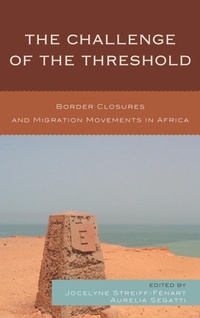
The Challenge of the Threshold
Border Closures and Migration Movements in Africa
Lexington Books (Publisher)
1st Edition
Published on 16. November 2011
290 pages
978-0-7391-6512-6 (ISBN)
Description

The recent containment policies aimed at regulating immigration flows towards Europe have profoundly altered the dynamics of migration in Africa. The impact of these policies is apparent in the redefinitions of the routes, itineraries and actors of migration. But their effect can also be felt in migrant categories and identities and in the perceptions of migrants in the societies through which they transit or the communities which they have left behind. By placing the problem of border control at the very heart of the migration issue, the policies aimed at the restriction of migration flows have changed the meaning and significance of migration. More than ever before, both migrants and institutions in charge of border control construe migration mostly around the challenge of border-crossing.
In the Global South, the transit situation in which would-be border jumpers are retained blurs the distinction between temporary migration and settlement. This contributes to change, in various ways, the relationship to strangers, from renewed forms of solidarities to the reactivation of latent xenophobic sentiment, whether around the Mediterranean or en route towards South Africa, the other migration hub on the continent.
The editors of this volume have decided to work on the notion of "threshold" as an operative concept for addressing the multiple dimensions of the issue: the discursive and conceptual frameworks that constitute the backbone of threshold policies aiming to keep undesirables beyond borders; the constitution of stopping places, intermediate areas and relay towns, which all represent threshold spaces that challenge local urban equilibria; and the experience of liminality, in which individuals caught for a time between two states (as migrant on the road and as immigrant, the state to which they aspire), experience the typically ambiguous situations characteristic of 'threshold people' (Turner). While ambitioning to innovate theoretically and methodologically, the volume is above all
In the Global South, the transit situation in which would-be border jumpers are retained blurs the distinction between temporary migration and settlement. This contributes to change, in various ways, the relationship to strangers, from renewed forms of solidarities to the reactivation of latent xenophobic sentiment, whether around the Mediterranean or en route towards South Africa, the other migration hub on the continent.
The editors of this volume have decided to work on the notion of "threshold" as an operative concept for addressing the multiple dimensions of the issue: the discursive and conceptual frameworks that constitute the backbone of threshold policies aiming to keep undesirables beyond borders; the constitution of stopping places, intermediate areas and relay towns, which all represent threshold spaces that challenge local urban equilibria; and the experience of liminality, in which individuals caught for a time between two states (as migrant on the road and as immigrant, the state to which they aspire), experience the typically ambiguous situations characteristic of 'threshold people' (Turner). While ambitioning to innovate theoretically and methodologically, the volume is above all
More details
Edition
1. Auflage
Language
English
Place of publication
New York
United States
Publishing group
Bloomsbury Publishing Plc
Target group
Professional and scholarly
ISBN-13
978-0-7391-6512-6 (9780739165126)
Copyright in bibliographic data and cover images is held by Nielsen Book Services Limited or by the publishers or by their respective licensors: all rights reserved.
Schweitzer Classification
Other editions
Additional editions
Jocelyne Streiff-Fenart | Aurelia Segatti
The Challenge of the Threshold
Border Closures and Migration Movements in Africa
Book
11/2011
Lexington Books
€143.50
Article exhausted; check different version
Persons
Jocelyne Streiff-Fénart Jocelyne Streiff-Fénart is director of the Research Unit on Migrations and Society at the University of Nice Sophia-Antipolis/University Paris Denis Diderot and IRD, France.
Aurelia Segatti is a senior researcher for the African Center for Migration and Society at the University of the Witwatersrand, South Africa.
Aurelia Segatti is a senior researcher for the African Center for Migration and Society at the University of the Witwatersrand, South Africa.
Content
Introduction
Part 1. Threshold Policies: Discourses and Practices of Control and Closure
Chapter 1. European Immigration Policies Outside the Union: An Impact Analysis on Migration Dynamics in North African Transit Areas
Chapter 2. Regional Integration Policy and Migration Reform in SADC Countries: Whether to Move beyond Bilateralism?
Chapter 3. The Manufacture of Transit Border Control, Urban Trends and Migrant Trajectories in Nouadhibou (Mauritania)
Chapter 4. The "Discursive Framework" of Development and the Repertoire of Actions of Senegalese Deportee Associations
Part 2. Threshold Spaces: Itineraries, Stages and Places of Transit
Chapter 5. Stuck in the Desert: Hampered Mobility among Transit Migrants in Northern Niger
Chapter 6. Time-Spaces of Transit Migration in West Africa: Life Transitions and Urban Transformations in Lomé (Togo) And Accra (Ghana)
Chapter 7. Beyond Departure and Arrival: Analyzing Migration Trajectories of Sub-Saharan African Migrants from a Mobilities Perspective
Chapter 8. Migration in South Africa: Tensions and Post-Apartheid Inter-Ethnic Compromises in a Central District of Johannesburg
Part 3. Threshold People: The Experience and Imaginary Dimension of Travel, Migrant Sociability and Routes to Individuation
Chapter 9. Ambiguous Europe: Repertoires of Subjectivation Among Prospective Migrants in Bamako, Mali
Chapter 10. Home as Transit: Would-Be Migrants and Immobility in Gambia
Chapter 11. Migration at the Level of Individuals. Life Trajectories in Mauritania and Spain
Chapter 12. Migrations between Transit, Settlement and Redefinitions of Identity: A Case Study of Senegalese Migrants in Morocco and Nigerian Migrants in Senegal
Chapter 13. The Mozambican Miner and the Aventureiro from Maputo: Figures of Individuation Between Southern Mozambique and theVicinity of Johannesburg
Part 1. Threshold Policies: Discourses and Practices of Control and Closure
Chapter 1. European Immigration Policies Outside the Union: An Impact Analysis on Migration Dynamics in North African Transit Areas
Chapter 2. Regional Integration Policy and Migration Reform in SADC Countries: Whether to Move beyond Bilateralism?
Chapter 3. The Manufacture of Transit Border Control, Urban Trends and Migrant Trajectories in Nouadhibou (Mauritania)
Chapter 4. The "Discursive Framework" of Development and the Repertoire of Actions of Senegalese Deportee Associations
Part 2. Threshold Spaces: Itineraries, Stages and Places of Transit
Chapter 5. Stuck in the Desert: Hampered Mobility among Transit Migrants in Northern Niger
Chapter 6. Time-Spaces of Transit Migration in West Africa: Life Transitions and Urban Transformations in Lomé (Togo) And Accra (Ghana)
Chapter 7. Beyond Departure and Arrival: Analyzing Migration Trajectories of Sub-Saharan African Migrants from a Mobilities Perspective
Chapter 8. Migration in South Africa: Tensions and Post-Apartheid Inter-Ethnic Compromises in a Central District of Johannesburg
Part 3. Threshold People: The Experience and Imaginary Dimension of Travel, Migrant Sociability and Routes to Individuation
Chapter 9. Ambiguous Europe: Repertoires of Subjectivation Among Prospective Migrants in Bamako, Mali
Chapter 10. Home as Transit: Would-Be Migrants and Immobility in Gambia
Chapter 11. Migration at the Level of Individuals. Life Trajectories in Mauritania and Spain
Chapter 12. Migrations between Transit, Settlement and Redefinitions of Identity: A Case Study of Senegalese Migrants in Morocco and Nigerian Migrants in Senegal
Chapter 13. The Mozambican Miner and the Aventureiro from Maputo: Figures of Individuation Between Southern Mozambique and theVicinity of Johannesburg
