

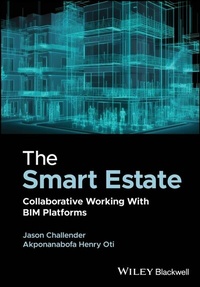
The Smart Estate
Description

Bring your estate management methods into the future with this accessible guide
Building information modeling, or BIM, is a catch-all term for a wide array of tools and processes for creating digital representations of buildings or building components. These tools have been widely embraced for use in the construction phase of projects, but their potential has only begun to be realized in facility management and maintenance, even though these account for 85% of costs in the life cycle of a building. Organizations controlling diverse estates with multiple buildings of varying ages stand to benefit enormously from a BIM-informed approach to estate management.
The Smart Estate outlines such an approach and its potential to improve facility and estate management. Emphasizing practical applications, it moves beyond the project delivery stage to focus on the much longer -- and costlier -- period of building operation and maintenance. The result is a thorough and accessible guide to generating collaborative, BIM-informed methods.
The Smart Estate readers will also find:
* Case studies and real-world scenarios illustrating best practices
* Detailed discussion particularly suited to the needs of large-scale or public-sector organizations
* Detailed step-by-step guide to developing a BIM-informed approach to a given asset portfolio
The Smart Estate is ideal for professionals in construction management and facilities management, as well as for advanced students and professionals in all construction related disciplines.
More details
Other editions
Additional editions
Persons
Jason Challender is Director of Estates and Facilities at the University of Salford, a member of its Senior Leadership Team and Visiting Professor at the University of Bolton. He has over 30 years' experience in procurement in a variety of major construction programmes and is a board member of the North West Construction Hub.
Akponanabofa Henry Oti is a lecturer in civil engineering at the University of Bolton, where he teaches a communications technology module, introducing students to information modelling using emerging BIM methodology, and BIM applications in construction project management and environmental management.
Content
About the Authors xi
Foreword xii
Acknowledgements xiii
1 The Smart Estate: Collaborative Working with Digital Information Management 1
2 Introduction and Background to Collaborative Working and Partnering 17
3 The Importance of Trust, Collaboration, and Partnering for the Built Environment 31
4 Analysis for the Lack of Collaborative Working and Partnering in the Built Environment 45
5 Potential Risks, Problems, and Barriers for Collaborative Working in Estates and the Built Environment 57
6 Collaborative Working with Digital Information Management in Estates and Construction 67
7 Technologies for Collaborative Digital Information Management in Estates and Construction 79
8 Infrastructures for Collaborative Digital Information Management for Estates 89
9 Actors in Digital Information Management for Estates 107
10 The Role of Digital Technology in Healthcare Facilities Management 121
11 An Introduction to Smart Estates and Digital Information Management for Collaboration in the Built Environment Using Case Studies 141
12 The Benefits and Value of Digital Twin Technologies for Collaborative Information Management 163
13 Digital Twin Enablers for Collaboration and the Risks and Barriers to Adoption of Digital Twins 175
14 Reflections, Overview, and Implications for Future Practice and Closing Remarks 193
Index 215
1
The Smart Estate: Collaborative Working with Digital Information Management
Digital transformation is a fundamental reality for businesses today.
Warren Buffett, Chairman and CEO of Berkshire Hathaway
1.1 Introduction to the Book
With regard to Warren Buffett's quotation, organisations should realise that to postpone their digital transformation places them at risk of obsolescence. This is especially true in times of disruption. For instance, it has been reported that 97% of companies have advised that COVID-19 has sped up their digital transformation and 68% say the pandemic sped up their digital transformation significantly. Accordingly, it is up to a company's leadership team to commandeer this revolution while ensuring business continuity. With this in mind, the aim of this book is to explore how collaborative working and digital information management, including building information modelling (BIM) and digital twin technologies, can be aligned and integrated into modern estates management working practices. It responds to the increasing demand for practical, and industry-aligned, practice in estates and construction management. More specifically, the book addresses how digital information management can be pragmatically applied to current practice to increase collaborative working. To assist readers in this pursuit, case studies and example scenarios aligned to best practice methodologies are included. Practical advice is also provided to apply the theoretical principles of collaborative working and BIM and to introduce them within future estates management practices and projects.
The book explores the extent to which collaborative working in digital information management and BIM represents a viable tool in delivering improved estates management and construction outcomes and provides an important insight into the influence on the success of estates projects and programmes. In this regard, the book seeks to address the ongoing dilemma of improving collaborative working and act as a catalyst for improvements to professional and industry practices. It also encourages more organisations and individuals to embrace and embed collaboration and partnering within BIM digital platforms. This is a deliberate attempt to improve estates and construction practices in the UK, which have arguably not been delivering the impact and benefits that were intended in terms of successful outcomes.
The book focuses on:
-
determining how collaborative working philosophies can be embedded and aligned in BIM technologies and practices to generate more successful project and estates management outcomes;
-
developing a toolkit as a practical guide to assist companies in applying collaborative BIM strategies;
-
identifying and detailing the steps required to enable digital information management, and specifically BIM, to benefit a building asset throughout its life cycle;
-
building collaboration into FM delivery incorporating extended soft landings;
-
case studies (featured in Chapters 8 and 9) detailing the successful and beneficial use of operational, maintenance, and facilities management software;
-
the use, benefits, and value of digital twin technologies for collaborative information management;
-
digital twin enablers for collaboration and the risks and barriers to adoption of digital twins; and
-
Golden Thread initiatives and concepts around BIM.
The book is designed to assist students, academics, and practitioners in their awareness, understanding, and breadth of knowledge of the issues around collaboration philosophies and BIM digital platforms. These attributes will help to build trust and improved long-standing relationships between contracting parties on projects, with the overarching aim of delivering projects that are more successful. The overarching aim of this book is to create a practical guide for clients that can develop into a common client framework on how to initiate, procure, and manage collaborative BIM strategies. In this way it can offer clients turnkey solutions for defining, curating, coordinating, and maintaining the entire life cycle of digital building information.
The 'value proposition' of this book is that it will be read, understood, and accepted by readers as their main guidance and reference tool for improving best practices around the use of BIM and other digital portals. This is a book written for businesspeople by businesspeople based on sound theory (how to do it) and sound practice (lessons derived from case studies).
The book's objectives are:
-
to be the standard reference for asset owners' understanding of the life cycle of their projects and therein reducing construction-based and operational-based risk;
-
to identify a set of clear guidelines, national or international, to support the role of collaborative working in digital platforms such as BIM;
-
to form the basis of a practical toolkit for guidance and teaching in the unique role that collaboration and BIM have for estates and project management practices;
-
to look to future developments and identify the key role clients take in BIM, new developments in the RIBA Outline Plan Stage of Work, and other areas such as continuing project integration and collaborative working;
-
to demonstrate the benefits of digital construction and information management in enabling a more efficient and effective estate; and
-
to explore the role of digital twin technologies for the global built environment.
In previous studies into collaborative working, very little attention has been focused on the use of BIM technologies and methodologies for promoting improved estates outcomes. This book seeks to infill the literature and knowledge gaps through examination of mechanisms via the toolkit to encourage collaborative working within BIM strategies. It is also designed to address academic calls for greater insight into how collaboration can be created, mobilised, and developed using BIM as the catalyst.
Collaborative working is emerging as a 'hot' topic, considering the many cases over recent years when adversarial practices have emerged. Attempts by professional institutions to 'turn the tide' on this growing trend through codes of conduct have not always proved effective. Using BIM as a platform is hoped to address this growing concern. To address the deficiency of adversarial practices, this book is a practical 'how to do it' guide based on analysis of case studies and powerful practice examples for clients and professional practitioners to use in managing their estates and projects. Furthermore, the book does not just look at collaboration for project delivery, but it considers ongoing collaboration during the much lengthier operation and maintenance phase of a building. The book is a reflection on 'before digital' and 'after digital' and illustrates the benefits of the 'art of the possible' on an existing, complex university estate. It draws on case studies from the authors' experiences and interviews, as well as other widely known recent publications. The book also incorporates a toolkit as a practical guide to introducing interventions to embed collaborative working into BIM strategies and therein improve practices and behaviours, which the research has found to be particularly beneficial for generating more successful project outcomes.
The book is mainly intended for construction management practitioners but could suit a wide target audience, including under- and postgraduate students and academics. The research findings are presented to prioritise use by professional practitioners and therein provide a practical guide for adherence to collaborative working philosophies and BIM technologies, and as a toolkit for improvements in estates and construction project management. The book is not designed as a holistic course textbook, albeit it could be a worthy inclusion in a recommended reading list for courses related to estates management and construction procurement. As such, it is not intended solely as a practitioner guide. Rather, the book aims to cross this divide and provide useful insight to both academics and practitioners in developing their understanding of the topic area.
Although the research was undertaken in the UK, and all findings are likely to therefore have best fit with the UK construction industry, the overall knowledge and understanding provided by this book will have international relevance. Other countries seeking to develop strategies for improved ethical practices using similar approaches to the UK will be able to utilise the book, with consideration of how the findings fit with their own understanding in practice.
1.2 Context and Background to Collaborative Working in Estates and Construction
Partnering and collaboration have long been championed and heralded as the future of the UK construction industry. Latham (1994) sought to 'construct the team.' He was heavily critical of traditional procurement and contractual routes, largely due to the lack of coordination between construction and design. He suggested a change in culture and a move to partnering to increase fairness, encourage teamwork, and enhance performance through collaborative engagement of clients and design teams with contractors. This view was reinforced by Egan (1998) who saw early establishment of construction teams as an essential aspect of cooperative construction,...
