

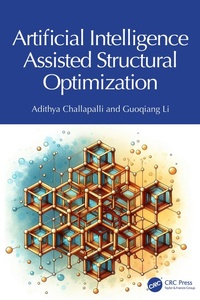
Artificial Intelligence Assisted Structural Optimization
1st Edition
Published on 27. February 2025
220 pages
978-1-040-30427-3 (ISBN)
Description

Artificial Intelligence Assisted Structural Optimization explores the use of machine learning and correlation analysis within the forward design and inverse design frameworks to design and optimize lightweight load-bearing structures as well as mechanical metamaterials.
Discussing both machine learning and design analysis in detail, this book enables readers to optimize their designs using a data-driven approach. This book discusses the basics of the materials utilized, for example, shape memory polymers, and the manufacturing approach employed, such as 3D or 4D printing. Additionally, the book discusses the use of forward design and inverse design frameworks to discover novel lattice unit cells and thin-walled cellular unit cells with enhanced mechanical and functional properties such as increased mechanical strength, heightened natural frequency, strengthened impact tolerance, and improved recovery stress. Inverse design methodologies using generative adversarial networks are proposed to further investigate and improve these structures. Detailed discussions on fingerprinting approaches, machine learning models, structure screening techniques, and typical Python codes are provided in the book.
The book provides detailed guidance for both students and industry engineers to optimize their structural designs using machine learning.
Discussing both machine learning and design analysis in detail, this book enables readers to optimize their designs using a data-driven approach. This book discusses the basics of the materials utilized, for example, shape memory polymers, and the manufacturing approach employed, such as 3D or 4D printing. Additionally, the book discusses the use of forward design and inverse design frameworks to discover novel lattice unit cells and thin-walled cellular unit cells with enhanced mechanical and functional properties such as increased mechanical strength, heightened natural frequency, strengthened impact tolerance, and improved recovery stress. Inverse design methodologies using generative adversarial networks are proposed to further investigate and improve these structures. Detailed discussions on fingerprinting approaches, machine learning models, structure screening techniques, and typical Python codes are provided in the book.
The book provides detailed guidance for both students and industry engineers to optimize their structural designs using machine learning.
More details
Edition
1. Auflage
Language
English
Place of publication
London
United Kingdom
Publishing group
Taylor & Francis Ltd
Target group
Professional and scholarly
Illustrations
15 Tables, black and white; 42 Line drawings, black and white; 44 Halftones, black and white; 86 Illustrations, black and white
File size
15,99 MB
ISBN-13
978-1-040-30427-3 (9781040304273)
Copyright in bibliographic data and cover images is held by Nielsen Book Services Limited or by the publishers or by their respective licensors: all rights reserved.
Schweitzer Classification
Other editions
Additional editions
Adithya Challapalli | Guoqiang Li
Artificial Intelligence Assisted Structural Optimization
Book
approx. 07/2026
1st Edition
CRC Press
€66.00
Not yet published

Adithya Challapalli | Guoqiang Li
Artificial Intelligence Assisted Structural Optimization
Book
03/2025
CRC Press
Unfortunately, price unknown
Available (delivery time upon request)
Adithya Challapalli | Guoqiang Li
Artificial Intelligence Assisted Structural Optimization
Book
02/2025
1st Edition
CRC Press
€175.90
Shipment within 10-20 days
Persons
Adithya Challapalli earned an MS at the University of North Texas (UNT) in mechanical and energy engineering and a PhD at Louisiana State University (LSU) in materials engineering, engineering science. Concurrently, he is a project engineer at Graphic Packaging International focusing on optimizing sustainable and renewable products.
Guoqiang Li earned a BS, an MS, and a PhD at Hebei University of Technology, Beijing University of Technology, and Southeast University, respectively, all in civil engineering. He received his postdoc training in mechanical engineering at Louisiana State University (LSU). He is the Major Morris S. and DeEtte A. Anderson Memorial alumni professor and holder of the John W. Rhea Jr. Professorship in Engineering in the Department of Mechanical and Industrial Engineering at LSU. He is also the associate vice provost of the Graduate School at LSU. Concurrently, he is a distinguished research professor in the Department of Mechanical Engineering at Southern University, Baton Rouge, Louisiana. His research interests include engineering materials, engineering structures, manufacturing, and engineering mechanics. He currently serves as an associate editor for the ASCE Journal of Materials in Civil Engineering, an editorial board member for the journal Scientific Reports, an Associate Editor for the journal Cleaner Materials, and the specialty editor of Frontiers in Mechanical Engineering: Solid and Structural Mechanics. He has received over 40 awards and recognitions for his research, mentoring, and services.
Guoqiang Li earned a BS, an MS, and a PhD at Hebei University of Technology, Beijing University of Technology, and Southeast University, respectively, all in civil engineering. He received his postdoc training in mechanical engineering at Louisiana State University (LSU). He is the Major Morris S. and DeEtte A. Anderson Memorial alumni professor and holder of the John W. Rhea Jr. Professorship in Engineering in the Department of Mechanical and Industrial Engineering at LSU. He is also the associate vice provost of the Graduate School at LSU. Concurrently, he is a distinguished research professor in the Department of Mechanical Engineering at Southern University, Baton Rouge, Louisiana. His research interests include engineering materials, engineering structures, manufacturing, and engineering mechanics. He currently serves as an associate editor for the ASCE Journal of Materials in Civil Engineering, an editorial board member for the journal Scientific Reports, an Associate Editor for the journal Cleaner Materials, and the specialty editor of Frontiers in Mechanical Engineering: Solid and Structural Mechanics. He has received over 40 awards and recognitions for his research, mentoring, and services.
Content
1. Introduction to Structures with Complex Geometrical Configurations. 2. Structural Optimization. 3. Introduction to Machine Learning-Assisted Structural Optimization. 4. Structural Optimization of Biomimetic Rods Using Machine Learning Regression. 5. Structural Optimization of Lattice Structures. 6. Inverse Machine Learning Using Generative Adversarial Networks. 7. Design and Optimization of Mechanical Metamaterials Using Correlation Analysis. 8. Summary and Future Perspectives.
