

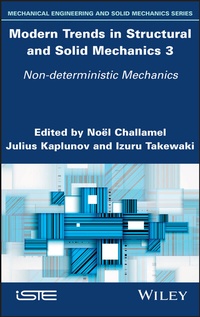
Modern Trends in Structural and Solid Mechanics 3
Non-deterministic Mechanics
1st Edition
Published on 2. June 2021
304 pages
978-1-119-83182-2 (ISBN)
Description

This book comprised of three separate volumes presents the recent
developments and research discoveries in structural and solid
mechanics; it is dedicated to Professor Isaac Elishakoff. This third
volume is devoted to non-deterministic mechanics.
Modern Trends in Structural and Solid Mechanics 3 has broad scope,
covering topics such: design optimization under uncertainty, interval
field approaches, convex analysis, quantum inspired topology
optimization and stochastic dynamics. The book is illustrated by many
applications in the field of aerospace engineering, mechanical
engineering, civil engineering, biomedical engineering and automotive
engineering.
This book is intended for graduate students and researchers in the field
of theoretical and applied mechanics.
developments and research discoveries in structural and solid
mechanics; it is dedicated to Professor Isaac Elishakoff. This third
volume is devoted to non-deterministic mechanics.
Modern Trends in Structural and Solid Mechanics 3 has broad scope,
covering topics such: design optimization under uncertainty, interval
field approaches, convex analysis, quantum inspired topology
optimization and stochastic dynamics. The book is illustrated by many
applications in the field of aerospace engineering, mechanical
engineering, civil engineering, biomedical engineering and automotive
engineering.
This book is intended for graduate students and researchers in the field
of theoretical and applied mechanics.
More details
Other editions
Additional editions
Noel Challamel | Julius Kaplunov | Izuru Takewaki
Modern Trends in Structural and Solid Mechanics 3
Non-deterministic Mechanics
Book
07/2021
1st Edition
Wiley-ISTE
€164.50
Shipment within 3-4 weeks
Persons
Noel Challamel is Professor at the University of Southern Brittany,
France. He is the co-author of several books and over a hundred journal
papers in the field of mechanics and civil engineering and is on the
editorial board of numerous international journals. He is also Editor and
Head of the ?Solid Mechanics and Mechanical Engineering? series
published by ISTE-Wiley.
Julius Kaplunov is Professor at Keele University, UK. He is the co-author
of over a hundred publications in mechanics, including three books. He
is a member of the European Academy of Sciences and sits on the
editorial boards of more than ten journals.
Izuru Takewaki is Professor of building structures at Kyoto University,
Japan, and is the 56th President of the Architectural Institute of Japan.
He is the Field Chief Editor of Frontiers in Built Environment and has
published over 200 international journal papers.
France. He is the co-author of several books and over a hundred journal
papers in the field of mechanics and civil engineering and is on the
editorial board of numerous international journals. He is also Editor and
Head of the ?Solid Mechanics and Mechanical Engineering? series
published by ISTE-Wiley.
Julius Kaplunov is Professor at Keele University, UK. He is the co-author
of over a hundred publications in mechanics, including three books. He
is a member of the European Academy of Sciences and sits on the
editorial boards of more than ten journals.
Izuru Takewaki is Professor of building structures at Kyoto University,
Japan, and is the 56th President of the Architectural Institute of Japan.
He is the Field Chief Editor of Frontiers in Built Environment and has
published over 200 international journal papers.
Content
- Cover
- Half-Title Page
- Title Page
- Copyright Page
- Contents
- Preface: Short Bibliographical Presentation of Prof. Isaac Elishakoff
- Books by Elishakoff
- Books edited or co-edited by Elishakoff
- 1 Optimization in Mitochondrial Energetic Pathways
- 1.1. Optimization in neural and cell biology
- 1.2. Mitochondria
- 1.3. General morphology
- fission and fusion
- 1.4. Mechanical aspects
- 1.5. Mitochondrial motility
- 1.6. Cristae, ultrastructure and supercomplexes
- 1.7. Mitochondrial diseases and neurodegenerative disorders
- 1.8. Modeling
- 1.9. Concluding summary
- 1.10. Acknowledgments
- 1.11. Appendix
- 1.12. References
- 2 The Concept of Local and Non-Local Randomness for Some Mechanical Problems
- 2.1. Introduction
- 2.2. Preliminary concepts
- 2.2.1. Statically determinate stochastic beams
- 2.2.2. Statically indeterminate stochastic beams
- 2.3. Local and non-local randomness
- 2.3.1. Statically determinate stochastic beams
- 2.3.2. Statically indeterminate stochastic beams
- 2.3.3. Comments on the results
- 2.4. Conclusion
- 2.5. References
- 3 On the Applicability of First-Order Approximations for Design Optimization under Uncertainty
- 3.1. Introduction
- 3.2. Summary of first- and second-order Taylor series approximations for uncertainty quantification
- 3.2.1. Approximations of stochastic moments
- 3.2.2. Probabilistic lower bound approximation
- 3.2.3. Convex anti-optimization
- 3.2.4. Correlation of probabilistic approaches and convex anti-optimization
- 3.3. Design optimization under uncertainty
- 3.3.1. Robust design optimization
- 3.3.2. Reliability-based design optimization
- 3.3.3. Optimization with convex anti-optimization
- 3.4. Numerical examples
- 3.4.1. Imperfect von Mises truss analysis
- 3.4.2. Three-bar truss optimization
- 3.4.3. Topology optimization
- 3.5. Conclusion and outlook
- 3.6. References
- 4 Understanding Uncertainty
- 4.1. Introduction
- 4.2. Uncertainty and uncertainties
- 4.3. Design and uncertainty
- 4.3.1. Decision modules
- 4.3.2. Designing in uncertain
- 4.4. Knowledge entity
- 4.4.1. Structure of a knowledge entity
- 4.5. Robust and reliable engineering
- 4.5.1. Definitions
- 4.5.2. Robustness
- 4.5.3. Reliability
- 4.5.4. Optimization
- 4.5.5. Reliable and robust optimization
- 4.6. Conclusion
- 4.7. References
- 5 New Approach to the Reliability Verification of Aerospace Structures
- 5.1. Introduction
- 5.2. Factor of safety and probability of failure
- 5.3. Reliability verification of aerospace structural systems
- 5.3.1. Reliability demonstration is integrated into the design process
- 5.3.2. Analysis of failure mechanism and failure modes
- 5.3.3. Modeling the structural behavior, verifying the model by tests
- 5.3.4. Design of structural development tests to surface failure modes
- 5.3.5. Design of development tests to find unpredicted failure modes
- 5.3.6. "Cleaning" failure mechanism and failure modes
- 5.3.7. Determination of required safety and confidence in models
- 5.3.8. Determination of the reliability by "orders of magnitude"
- 5.4. Summary
- 5.5. References
- 6 A Review of Interval Field Approaches for Uncertainty Quantification in Numerical Models
- 6.1. Introduction
- 6.2. Interval finite element analysis
- 6.3. Convex-set analysis
- 6.4. Interval field analysis
- 6.4.1. Explicit interval field formulation
- 6.4.2. Interval fields based on KL expansion
- 6.4.3. Interval fields based on convex descriptors
- 6.5. Conclusion
- 6.6. Acknowledgments
- 6.7. References
- 7 Convex Polytopic Models for the Static Response of Structures with Uncertain-but-bounded Parameters
- 7.1. Introduction
- 7.2. Problem statements
- 7.3. Analysis and solution of the convex polytopic model for the static response of structures
- 7.4. Vertex solution theorem of the convex polytopic model for the static response of structures
- 7.5. Review of the vertex solution theorem of the interval model for the static response of structures
- 7.6. Numerical examples
- 7.6.1. Two-step bar
- 7.6.2. Ten-bar truss
- 7.6.3. Plane frame
- 7.7. Conclusion
- 7.8. Acknowledgments
- 7.9. References
- 8 On the Interval Frequency Response of Cracked Beams with Uncertain Damage
- 8.1. Introduction
- 8.2. Crack modeling for damaged beams
- 8.2.1. Finite element crack model
- 8.2.2. Continuous crack model
- 8.3. Statement of the problem
- 8.3.1. Interval model for the uncertain crack depth
- 8.3.2. Governing equations of damaged beams
- 8.3.3. Finite element model versus continuous model
- 8.4. Interval frequency response of multi-cracked beams
- 8.4.1. Interval deflection function in the FE model
- 8.4.2. Interval deflection function in the continuous model
- 8.5. Numerical applications
- 8.6. Concluding remarks
- 8.7. Acknowledgments
- 8.8. References
- 9 Quantum-Inspired Topology Optimization
- 9.1. Introduction
- 9.2. General statements
- 9.2.1. Density-based continuum structural topology optimization formulation
- 9.2.2. Characteristics of quantum computing
- 9.3. Topology optimization design model based on quantum-inspired evolutionary algorithms
- 9.3.1. Classic procedure of topology optimization based on the SIMP method and optimality criteria
- 9.3.2. The fundamental theory of a quantum-inspired evolutionary algorithm - DCQGA
- 9.3.3. Implementation of the integral topology optimization framework
- 9.4. A quantum annealing operator to accelerate the calculation and jump out of local extremum
- 9.5. Numerical examples
- 9.5.1. Example of a short cantilever
- 9.5.2. Example of a wing rib
- 9.6. Conclusion
- 9.7. Acknowledgments
- 9.8. References
- 10 Time Delay Vibrations and Almost Sure Stability in Vehicle Dynamics
- 10.1. Introduction to road vehicle dynamics
- 10.2. Delay resonances of half-car models on road
- 10.3. Extensions to multi-body vehicles on a random road
- 10.4. Non-stationary road excitations applying sinusoidal models
- 10.5. Resonance reduction or induction by means of colored noise
- 10.6. Lyapunov exponents and rotation numbers in vehicle dynamics
- 10.7. Concluding remarks and main new results
- 10.8. References
- 11 Order Statistics Approach to Structural Optimization Considering Robustness and Confidence of Responses
- 11.1. Introduction
- 11.2. Overview of order statistics
- 11.2.1. Definition of order statistics
- 11.2.2. Tolerance intervals and confidence intervals of quantiles
- 11.3. Robust design
- 11.3.1. Overview of the robust design problem
- 11.3.2. Worst-case-based method
- 11.3.3. Order statistics-based method
- 11.4. Numerical examples
- 11.4.1. Design response spectrum
- 11.4.2. Optimization of the building frame considering seismic responses
- 11.4.3. Multi-objective optimization considering robustness
- 11.5. Conclusion
- 11.6. References
- List of Authors
- Index
- Summary of Volume 1
- Summary of Volume 2
- Other titles from iSTE in Mechanical Engineering and Solid Mechanics
- EULA
