

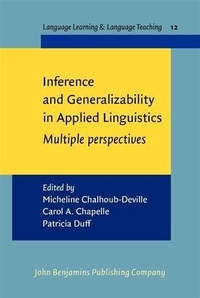
Inference and Generalizability in Applied Linguistics
Multiple perspectives
1st Edition
Published on 24. March 2006
VI, 248 pages
978-90-272-9368-8 (ISBN)
Description

Concepts such as dependability/generalization and inferences are dealt with implicitly or explicitly in any research undertaken in applied linguistics. This volume provides a well-balanced and cross-disciplinary perspective on how researchers conceptualize inferences about learner acquisition and performances as well as dependability and generalizability of findings. The book is a collection of chapters by prominent researchers in applied linguistics, working in diverse domains such as vocabulary, syntax, discourse analysis, SLA, and language testing. The goal of the book is to bring attention to these issues, which underpin much of applied linguistics research and to highlight what is considered good practice so as to buttress confidence in the research claims made. The book represents current thinking on fundamental research concepts in applied linguistics and can be used as a textbook in courses on research methodology in applied linguistics. The book is also an excellent source of in-depth analysis of research conceptualization for applied linguistics researchers and graduate students.
More details
Other editions
Additional editions
Micheline Chalhoub-Deville | Carol A. Chapelle | Patricia A. Duff
Inference and Generalizability in Applied Linguistics
Multiple perspectives
Book
03/2006
John Benjamins Publishing Co
€111.30
Shipment within 10-15 days
Persons
Content
- Inference and Generalizability in Applied Linguistics
- Editorial page
- Title page
- LCC data
- Table of contents
- Drawing the line
- Dependability
- Generalizability
- Inferences
- Chapters in this volume
- Perspectives on inference and generalizability in applied linguistics
- Old and new thoughts on test score variability
- Introduction
- The roles of language testers
- Language testers as testers
- Language testers as researchers
- Summary and conclusion
- Acknowledgements
- References
- Validity and values
- Introduction
- Drawing generalizable inferences in language assessment
- Validating test score inferences
- Constructs and evidence as the basis for test score inferences
- Generalization as reliability
- Epistemology and research methodology in investigating the validity of test score inferences
- Values and consequences in language tests
- Notes
- References
- L2 vocabulary acquisition theory
- 1. The assessment basis for vocabulary theory
- 2. Inference in assessment
- Construct inference
- Theory inference
- Inference, dependability, and generalizability
- Construct definition as central
- 3. Progress for vocabulary acquisition research
- Probing construct definition
- Validation studies
- Salience of L2 vocabulary assessment
- 4. Conclusion
- Notes
- References
- Beyond generalizability
- Introduction
- Inference
- Generalizability in quantitative vs. qualitative research: Problematics and possibilities
- Inference and generalizability in qualitative research: Case study and ethnography
- Contextualization, complexity, and credibility
- Capturing participants' (or emic) perspectives to bolster credibility
- Enhancing generalizability: Representativeness or typicality of cases selected
- Analytic generalization
- Conclusion
- Notes
- References
- Verbal protocols
- What do verbal protocols represent?
- Some relevant research
- Implications
- Notes
- References
- Functional grammar
- Introduction
- The object and purpose of the research
- A research methodology for functional grammar
- Intuitional data
- Observational data
- Elicited data
- On the provisionality and partiality of linguistic inferences
- Optimal level of generalizability
- Conclusion
- References
- A conversation analytic perspective on the role of quantification and generalizability in second language acquisition
- Introduction
- The interactionist hypothesis: An overview
- A critique of mainstream work on SLA
- The domain problem
- The significance problem
- The denominator problem
- The numerator problem
- Conversation analysis: An emprical example
- Conclusion
- Notes
- Appendix 1: Transcription conventions
- References
- Discussion
- Generalizability
- Introduction
- What is the nature of ``generalizability''?
- Consistency of observations and reports
- Meaningfulness of interpretations
- Meaningfulness in quantitative research
- Meaningfulness in qualitative research
- Consequences of decisions or actions for stakeholders
- The researcher's responsibility for consequences
- Dimensions of applied linguistics research
- The observer/researcher
- The entity of interest: The ``construct''
- The nature and role of context
- The observation and report
- The observer's interpretation of the observation
- Combining different perspectives and approaches in research
- Conclusion
- Notes
- References
- Generalizability
- Note
- References
- Negotiating methodological rich points in applied linguistics research
- Introduction
- Who researches whom in applied linguistics?
- What do we research?
- Where do we research?
- How do we collect, analyze, and interpret data?
- Why do we research?
- Final reflections
- Notes
- References
- Author index
- Subject index
- The series Language Learning & Language Teaching
