

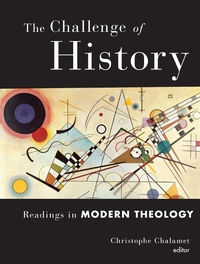
Challenge of History
Readings in Modern Theology
Published on 7. April 2020
416 pages
978-1-5064-5892-2 (ISBN)
Description

The advent of the modern, historical, and critical methods of reading Scripture is one of the most significant events in the last five hundred years of Christian history and theology. New questions arose in the course of that history that led to new, sometimes troubling answers. New ways of considering Scripture were articulated. The crisis in which academic Christian theology has found itself for approximately two hundred years is directly related to the emergence of new ways of studying--and criticizing--the Bible.
The Challenge of History traces the trajectory of these developments, presenting key readings from over thirty-five theologians--from Erasmus to Pannenberg--whose writings relate to the birth of modern historical and critical exegesis and, more broadly, to the emergence, among theologians and biblical scholars, of a certain historical consciousness that characterizes vast segments of modernity. How did the historical and critical methods arise? How did they impact the study of Scripture? What are their implications for Christian theology? Scripture is read--and needs to be read--differently in a parish, in a monastery, and in an academic setting. But the various ways of approaching Scripture should not be cordoned off from one another.
This volume is an ideal textbook for in-depth study of one of the most important topics in modern theology.
The Challenge of History traces the trajectory of these developments, presenting key readings from over thirty-five theologians--from Erasmus to Pannenberg--whose writings relate to the birth of modern historical and critical exegesis and, more broadly, to the emergence, among theologians and biblical scholars, of a certain historical consciousness that characterizes vast segments of modernity. How did the historical and critical methods arise? How did they impact the study of Scripture? What are their implications for Christian theology? Scripture is read--and needs to be read--differently in a parish, in a monastery, and in an academic setting. But the various ways of approaching Scripture should not be cordoned off from one another.
This volume is an ideal textbook for in-depth study of one of the most important topics in modern theology.
More details
Other editions
Additional editions
Book
04/2020
Fortress Press,U.S.
€39.00
Shipment within 10-20 days
Person
Edited by Christophe Chalamet
Content
- Front Cover
- Praise for The Challenge of History
- The Challenge of History
- Title Page
- Contents
- Acknowledgments
- Introduction
- Notes on the Edition and the Translation of Texts
- Erasmus of Rotterdam (1466-1536)
- Sebastian Castellio (1515-63)
- Louis Cappel (1585-1658)
- Thomas Hobbes (1588-1679)
- Baruch Spinoza (1632-77)
- Richard Simon (1638-1712)
- Jean Le Clerc (1657-1736)
- John Locke (1632-1704)
- Johann Salomo Semler (1725-91)
- Gotthold Ephraim Lessing (1729-81)
- Hermann Samuel Reimarus (1694-1768)
- Johann Philipp Gabler (1753-1826)
- Friedrich D. E. Schleiermacher (1768-1834)
- Johann Sebastian Drey (1777-1853)
- Georg Wilhelm Friedrich Hegel (1770-1831)
- David Friedrich Strauss (1808-74)
- Ferdinand Christian Baur (1792-1860)
- Søren Kierkegaard (1813-55)
- Albrecht Ritschl (1822-89)
- Walter Rauschenbusch (1861-1918)
- Martin Kähler (1835-1912)
- Alfred Loisy (1857-1940)
- Adolf von Harnack (1851-1930)
- William Wrede (1859-1906)
- Ernst Troeltsch (1865-1923)
- Wilhelm Herrmann (1846-1922)
- Hermann Gunkel (1862-1932)
- Albert Schweitzer (1875-1965)
- Karl Barth (1886-1968)
- Rudolf Bultmann (1884-1976)
- Marie-Dominique Chenu (1895-1990)
- Prefatory Note to Sources chrétiennes, vol. 1 (1942)
- Gerhard Ebeling (1912-2001)
- Georges Florovsky (1893-1979)
- Wolfhart Pannenberg (1928-2014)
- Elisabeth Schüssler Fiorenza (b. 1938)
- Ignacio Ellacuría (1930-89)
- Concluding Interpretive Postscript
- Abbreviations
- Works Cited
- List of Original Sources
- Index of Names
- Index of Subjects
- Permissions
- Back Cover
