

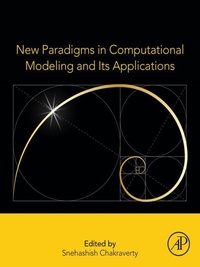
New Paradigms in Computational Modeling and Its Applications
Published on 9. January 2021
278 pages
978-0-12-822168-6 (ISBN)
Description

In general, every problem of science and engineering is governed by mathematical models. There is often a need to model, solve and interpret the problems one encounters in the world of practical problems. Models of practical application problems usually need to be handled by efficient computational models.
New Paradigms in Computational Modeling and Its Applications deals with recent developments in mathematical methods, including theoretical models as well as applied science and engineering. The book focuses on subjects that can benefit from mathematical methods with concepts of simulation, waves, dynamics, uncertainty, machine intelligence, and applied mathematics. The authors bring together leading-edge research on mathematics combining various fields of science and engineering. This perspective acknowledges the inherent characteristic of current research on mathematics operating in parallel over different subject fields.
New Paradigms in Computational Modeling and Its Applications meets the present and future needs for the interaction between various science and technology/engineering areas on the one hand and different branches of mathematics on the other. As such, the book contains 13 chapters covering various aspects of computational modeling from theoretical to application problems. The first six chapters address various problems of structural and fluid dynamics.
The next four chapters include solving problems where the governing parameters are uncertain regarding fuzzy, interval, and affine. The final three chapters will be devoted to the use of machine intelligence in artificial neural networks.
- Presents a self-contained and up to date review of modelling real life scientific and engineering application problems
- Introduces new concepts of various computing techniques to handle different engineering and science problems
- Demonstrates the efficiency and power of the various algorithms and models in a simple and easy to follow style, including numerous examples to illustrate concepts and algorithms
More details
Other editions
Additional editions
Snehashish Chakraverty
New Paradigms in Computational Modeling and Its Applications
Book
01/2021
Academic Press
€158.50
Shipment within 15-20 days
Content
1. Nanostructural dynamics problems with complicating effects2. Vibration of functionally graded piezoelectric material beams3. Vibration of microstructural elements4. Coupled shallow water wave equations5. Natural convection in a nanofluid flow6. Fractional fluid mechanics systems7. Inverse problems in diffusion processes with uncertain parameters8. Affine approach in solving linear structural dynamic problems with uncertain parameters9. Numerical solution of Langevin stochastic differential equation with uncertain parameters10. Fuzzy eigenvalue problems of structural dynamics using ANN11. Artificial neural network approach for solving fractional order applied problems12. Speech emotion recognition using deep learning13. A user independent hand gesture recognition system using deep CNN feature fusion and machine learning technique14. A survey on group modeling strategies for recommender systems15. Extraction of glacial lakes in the Himalayan region using landsat imagery
