

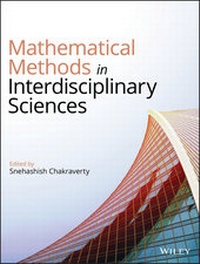
Mathematical Methods in Interdisciplinary Sciences
Description

Mathematical Methods in Interdisciplinary Sciences provides a practical and usable framework for bringing a mathematical approach to modelling real-life scientific and technological problems. The collection of chapters Dr. Snehashish Chakraverty has provided describe in detail how to bring mathematics, statistics, and computational methods to the fore to solve even the most stubborn problems involving the intersection of multiple fields of study. Graduate students, postgraduate students, researchers, and professors will all benefit significantly from the author's clear approach to applied mathematics.
The book covers a wide range of interdisciplinary topics in which mathematics can be brought to bear on challenging problems requiring creative solutions. Subjects include:
* Structural static and vibration problems
* Heat conduction and diffusion problems
* Fluid dynamics problems
The book also covers topics as diverse as soft computing and machine intelligence. It concludes with examinations of various fields of application, like infectious diseases, autonomous car and monotone inclusion problems.
More details
Other editions
Additional editions

Person
PROFESSOR SNEHASHISH CHAKRAVERTY, is working in the Department of Mathematics (Applied Mathematics Group), National Institute of Technology Rourkela, Odisha, India as a Senior (Higher Administrative Grade) Professor. Prior to this he was with CSIR-Central Building Research Institute, Roorkee, India. Prof. Chakraverty received his Ph. D. from University of Roorkee (now IIT Roorkee). There after he did his post-doctoral research at Institute of Sound and Vibration Research (ISVR), University of Southampton, U.K. and at the Faculty of Engineering and Computer Science, Concordia University, Canada. He has authored/co-authored 20 books, published 356 research papers in journals and conferences. Prof. Chakraverty is the Chief Editor of "International Journal of Fuzzy Computation and Modelling" (IJFCM), Inderscience Publisher, Switzerland (http://www.inderscience.com/ijfcm) and Associate Editor of "Computational Methods in Structural Engineering, Frontiers in Built Environment". He has been the President of the Section of Mathematical sciences (including Statistics) of "Indian Science Congress" (2015-2016) and was the Vice President "Orissa Mathematical Society" (2011-2013). Prof. Chakraverty is recipient of prestigious awards viz. Indian National Science Academy (INSA) nomination under International Collaboration/Bilateral Exchange Program, Platinum Jubilee ISCA Lecture Award (2014), CSIR Young Scientist (1997), BOYSCAST (DST), UCOST Young Scientist (2007, 2008), Golden Jubilee Director's (CBRI) Award (2001), Roorkee University Gold Medals (1987, 1988) etc. His present research area includes Differential Equations (Ordinary, Partial and Fractional), Numerical Analysis and Computational Methods, Structural Dynamics (FGM, Nano) and Fluid Dynamics, Mathematical Modeling and Uncertainty Modeling, Soft Computing and Machine Intelligence (Artificial Neural Network, Fuzzy, Interval and Affine Computations).
Content
Notes on Contributors xv
Preface xxv
Acknowledgments xxvii
1 Connectionist Learning Models for Application Problems Involving Differential and Integral Equations 1
Susmita Mall, Sumit Kumar Jeswal, and Snehashish Chakraverty
1.1 Introduction 1
1.1.1 Artificial Neural Network 1
1.1.2 Types of Neural Networks 1
1.1.3 Learning in Neural Network 2
1.1.4 Activation Function 2
1.1.4.1 Sigmoidal Function 3
1.1.5 Advantages of Neural Network 3
1.1.6 Functional Link Artificial Neural Network (FLANN) 3
1.1.7 Differential Equations (DEs) 4
1.1.8 Integral Equation 5
1.1.8.1 Fredholm Integral Equation of First Kind 5
1.1.8.2 Fredholm Integral Equation of Second Kind 5
1.1.8.3 Volterra Integral Equation of First Kind 5
1.1.8.4 Volterra Integral Equation of Second Kind 5
1.1.8.5 Linear Fredholm Integral Equation System of Second Kind 6
1.2 Methodology for Differential Equations 6
1.2.1 FLANN-Based General Formulation of Differential Equations 6
1.2.1.1 Second-Order Initial Value Problem 6
1.2.1.2 Second-Order Boundary Value Problem 7
1.2.2 Proposed Laguerre Neural Network (LgNN) for Differential Equations 7
1.2.2.1 Architecture of Single-Layer LgNN Model 7
1.2.2.2 Training Algorithm of Laguerre Neural Network (LgNN) 8
1.2.2.3 Gradient Computation of LgNN 9
1.3 Methodology for Solving a System of Fredholm Integral Equations of Second Kind 9
1.3.1 Algorithm 10
1.4 Numerical Examples and Discussion 11
1.4.1 Differential Equations and Applications 11
1.4.2 Integral Equations 16
1.5 Conclusion 20
References 20
2 Deep Learning in Population Genetics: Prediction and Explanation of Selection of a Population 23
Romila Ghosh and Satyakama Paul
2.1 Introduction 23
2.2 Literature Review 23
2.3 Dataset Description 25
2.3.1 Selection and Its Importance 25
2.4 Objective 26
2.5 Relevant Theory, Results, and Discussions 27
2.5.1 automl 27
2.5.2 Hypertuning the Best Model 28
2.6 Conclusion 30
References 30
3 A Survey of Classification Techniques in Speech Emotion Recognition 33
Tanmoy Roy, Tshilidzi Marwala, and Snehashish Chakraverty
3.1 Introduction 33
3.2 Emotional Speech Databases 33
3.3 SER Features 34
3.4 Classification Techniques 35
3.4.1 Hidden Markov Model 36
3.4.1.1 Difficulties in Using HMM for SER 37
3.4.2 Gaussian Mixture Model 37
3.4.2.1 Difficulties in Using GMM for SER 38
3.4.3 Support Vector Machine 38
3.4.3.1 Difficulties with SVM 39
3.4.4 Deep Learning 39
3.4.4.1 Drawbacks of Using Deep Learning for SER 41
3.5 Difficulties in SER Studies 41
3.6 Conclusion 41
References 42
4 Mathematical Methods in Deep Learning 49
Srinivasa Manikant Upadhyayula and Kannan Venkataramanan
4.1 Deep Learning Using Neural Networks 49
4.2 Introduction to Neural Networks 49
4.2.1 Artificial Neural Network (ANN) 50
4.2.1.1 Activation Function 52
4.2.1.2 Logistic Sigmoid Activation Function 52
4.2.1.3 tanh or Hyperbolic Tangent Activation Function 53
4.2.1.4 ReLU (Rectified Linear Unit) Activation Function 54
4.3 Other Activation Functions (Variant Forms of ReLU) 55
4.3.1 Smooth ReLU 55
4.3.2 Noisy ReLU 55
4.3.3 Leaky ReLU 55
4.3.4 Parametric ReLU 56
4.3.5 Training and Optimizing a Neural Network Model 56
4.4 Backpropagation Algorithm 56
4.5 Performance and Accuracy 59
4.6 Results and Observation 59
References 61
5 Multimodal Data Representation and Processing Based on Algebraic System of Aggregates 63
Yevgeniya Sulema and Etienne Kerre
5.1 Introduction 63
5.2 Basic Statements of ASA 64
5.3 Operations on Aggregates and Multi-images 65
5.4 Relations and Digital Intervals 72
5.5 Data Synchronization 75
5.6 Fuzzy Synchronization 92
5.7 Conclusion 96
References 96
6 Nonprobabilistic Analysis of Thermal and Chemical Diffusion Problems with Uncertain Bounded Parameters 99
Sukanta Nayak, Tharasi Dilleswar Rao, and Snehashish Chakraverty
6.1 Introduction 99
6.2 Preliminaries 99
6.2.1 Interval Arithmetic 99
6.2.2 Fuzzy Number and Fuzzy Arithmetic 100
6.2.3 Parametric Representation of Fuzzy Number 101
6.2.4 Finite Difference Schemes for PDEs 102
6.3 Finite Element Formulation for Tapered Fin 102
6.4 Radon Diffusion and Its Mechanism 105
6.5 Radon Diffusion Mechanism with TFN Parameters 107
6.5.1 EFDM to Radon Diffusion Mechanism with TFN Parameters 108
6.6 Conclusion 112
References 112
7 Arbitrary Order Differential Equations with Fuzzy Parameters 115
Tofigh Allahviranloo and Soheil Salahshour
7.1 Introduction 115
7.2 Preliminaries 115
7.3 Arbitrary Order Integral and Derivative for Fuzzy-Valued Functions 116
7.4 Generalized Fuzzy Laplace Transform with Respect to Another Function 118
References 122
8 Fluid Dynamics Problems in Uncertain Environment 125
Perumandla Karunakar, Uddhaba Biswal, and Snehashish Chakraverty
8.1 Introduction 125
8.2 Preliminaries 126
8.2.1 Fuzzy Set 126
8.2.2 Fuzzy Number 126
8.2.3 ¿¿¿¿-Cut 127
8.2.4 Parametric Approach 127
8.3 Problem Formulation 127
8.4 Methodology 129
8.4.1 Homotopy Perturbation Method 129
8.4.2 Homotopy Perturbation Transform Method 130
8.5 Application of HPM and HPTM 131
8.5.1 Application of HPM to Jeffery-Hamel Problem 131
8.5.2 Application of HPTM to Coupled Whitham-Broer-Kaup Equations 134
8.6 Results and Discussion 136
8.7 Conclusion 142
References 142
9 Fuzzy Rough Set Theory-Based Feature Selection: A Review 145
Tanmoy Som, Shivam Shreevastava, Anoop Kumar Tiwari, and Shivani Singh
9.1 Introduction 145
9.2 Preliminaries 146
9.2.1 Rough Set Theory 146
9.2.1.1 Rough Set 146
9.2.1.2 Rough Set-Based Feature Selection 147
9.2.2 Fuzzy Set Theory 147
9.2.2.1 Fuzzy Tolerance Relation 148
9.2.2.2 Fuzzy Rough Set Theory 149
9.2.2.3 Degree of Dependency-Based Fuzzy Rough Attribute Reduction 149
9.2.2.4 Discernibility Matrix-Based Fuzzy Rough Attribute Reduction 149
9.3 Fuzzy Rough Set-Based Attribute Reduction 149
9.3.1 Degree of Dependency-Based Approaches 150
9.3.2 Discernibility Matrix-Based Approaches 154
9.4 Approaches for Semisupervised and Unsupervised Decision Systems 154
9.5 Decision Systems with Missing Values 158
9.6 Applications in Classification, Rule Extraction, and Other Application Areas 158
9.7 Limitations of Fuzzy Rough Set Theory 159
9.8 Conclusion 160
References 160
10 Universal Intervals: Towards a Dependency-Aware Interval Algebra 167
Hend Dawood and Yasser Dawood
10.1 Introduction 167
10.2 The Need for Interval Computations 169
10.3 On Some Algebraic and Logical Fundamentals 170
10.4 Classical Intervals and the Dependency Problem 174
10.5 Interval Dependency: A Logical Treatment 176
10.5.1 Quantification Dependence and Skolemization 177
10.5.2 A Formalization of the Notion of Interval Dependency 179
10.6 Interval Enclosures Under Functional Dependence 184
10.7 Parametric Intervals: How Far They Can Go 186
10.7.1 Parametric Interval Operations: From Endpoints to Convex Subsets 186
10.7.2 On the Structure of Parametric Intervals: Are They Properly Founded? 188
10.8 Universal Intervals: An Interval Algebra with a Dependency Predicate 192
10.8.1 Universal Intervals, Rational Functions, and Predicates 193
10.8.2 The Arithmetic of Universal Intervals 196
10.9 The S-Field Algebra of Universal Intervals 201
10.10 Guaranteed Bounds or Best Approximation or Both? 209
Supplementary Materials 210
Acknowledgments 211
References 211
11 Affine-Contractor Approach to Handle Nonlinear Dynamical Problems in Uncertain Environment 215
Nisha Rani Mahato, Saudamini Rout, and Snehashish Chakraverty
11.1 Introduction 215
11.2 Classical Interval Arithmetic 217
11.2.1 Intervals 217
11.2.2 Set Operations of Interval System 217
11.2.3 Standard Interval Computations 218
11.2.4 Algebraic Properties of Interval 219
11.3 Interval Dependency Problem 219
11.4 Affine Arithmetic 220
11.4.1 Conversion Between Interval and Affine Arithmetic 220
11.4.2 Affine Operations 221
11.5 Contractor 223
11.5.1 SIVIA 223
11.6 Proposed Methodology 225
11.7 Numerical Examples 230
11.7.1 Nonlinear Oscillators 230
11.7.1.1 Unforced Nonlinear Differential Equation 230
11.7.1.2 Forced Nonlinear Differential Equation 232
11.7.2 Other Dynamic Problem 233
11.7.2.1 Nonhomogeneous Lane-Emden Equation 233
11.8 Conclusion 236
References 236
12 Dynamic Behavior of Nanobeam Using Strain Gradient Model 239
Subrat Kumar Jena, Rajarama Mohan Jena, and Snehashish Chakraverty
12.1 Introduction 239
12.2 Mathematical Formulation of the Proposed Model 240
12.3 Review of the Differential Transform Method (DTM) 241
12.4 Application of DTM on Dynamic Behavior Analysis 242
12.5 Numerical Results and Discussion 244
12.5.1 Validation and Convergence 244
12.5.2 Effect of the Small-Scale Parameter 245
12.5.3 Effect of Length-Scale Parameter 247
12.6 Conclusion 248
Acknowledgment 249
References 250
13 Structural Static and Vibration Problems 253
M. Amin Changizi and Ion Stiharu
13.1 Introduction 253
13.2 One-parameter Groups 254
13.3 Infinitesimal Transformation 254
13.4 Canonical Coordinates 254
13.5 Algorithm for Lie Symmetry Point 255
13.6 Reduction of the Order of the ODE 255
13.7 Solution of First-Order ODE with Lie Symmetry 255
13.8 Identification 256
13.9 Vibration of a Microcantilever Beam Subjected to Uniform Electrostatic Field 258
13.10 Contact Form for the Equation 259
13.11 Reducing in the Order of the Nonlinear ODE Representing the Vibration of a Microcantilever Beam Under Electrostatic Field 260
13.12 Nonlinear Pull-in Voltage 261
13.13 Nonlinear Analysis of Pull-in Voltage of Twin Microcantilever Beams 266
13.14 Nonlinear Analysis of Pull-in Voltage of Twin Microcantilever Beams of Different Thicknesses 268
References 272
14 Generalized Differential and Integral Quadrature: Theory and Applications 273
Francesco Tornabene and Rossana Dimitri
14.1 Introduction 273
14.2 Differential Quadrature 274
14.2.1 Genesis of the Differential Quadrature Method 274
14.2.2 Differential Quadrature Law 275
14.3 General View on Differential Quadrature 277
14.3.1 Basis Functions 278
14.3.1.1 Lagrange Polynomials 281
14.3.1.2 Trigonometric Lagrange Polynomials 282
14.3.1.3 Classic Orthogonal Polynomials 282
14.3.1.4 Monomial Functions 291
14.3.1.5 Exponential Functions 291
14.3.1.6 Bernstein Polynomials 291
14.3.1.7 Fourier Functions 292
14.3.1.8 Bessel Polynomials 292
14.3.1.9 Boubaker Polynomials 292
14.3.2 Grid Distributions 293
14.3.2.1 Coordinate Transformation 293
14.3.2.2 ¿¿¿¿-Point Distribution 293
14.3.2.3 Stretching Formulation 293
14.3.2.4 Several Types of Discretization 293
14.3.3 Numerical Applications: Differential Quadrature 297
14.4 Generalized Integral Quadrature 310
14.4.1 Generalized Taylor-Based Integral Quadrature 312
14.4.2 Classic Integral Quadrature Methods 314
14.4.2.1 Trapezoidal Rule with Uniform Discretization 314
14.4.2.2 Simpson's Method (One-third Rule) with Uniform Discretization 314
14.4.2.3 Chebyshev-Gauss Method (Chebyshev of the First Kind) 314
14.4.2.4 Chebyshev-Gauss Method (Chebyshev of the Second Kind) 314
14.4.2.5 Chebyshev-Gauss Method (Chebyshev of the Third Kind) 315
14.4.2.6 Chebyshev-Gauss Method (Chebyshev of the Fourth Kind) 315
14.4.2.7 Chebyshev-Gauss-Radau Method (Chebyshev of the First Kind) 315
14.4.2.8 Chebyshev-Gauss-Lobatto Method (Chebyshev of the First Kind) 315
14.4.2.9 Gauss-Legendre or Legendre-Gauss Method 315
14.4.2.10 Gauss-Legendre-Radau or Legendre-Gauss-Radau Method 315
14.4.2.11 Gauss-Legendre-Lobatto or Legendre-Gauss-Lobatto Method 316
14.4.3 Numerical Applications: Integral Quadrature 316
14.4.4 Numerical Applications: Taylor-Based Integral Quadrature 320
14.5 General View: The Two-Dimensional Case 324
References 340
15 Brain Activity Reconstruction by Finding a Source Parameter in an Inverse Problem 343
Amir H. Hadian-Rasanan and Jamal Amani Rad
15.1 Introduction 343
15.1.1 Statement of the Problem 344
15.1.2 Brief Review of Other Methods Existing in the Literature 345
15.2 Methodology 346
15.2.1 Weighted Residual Methods and Collocation Algorithm 346
15.2.2 Function Approximation Using Chebyshev Polynomials 349
15.3 Implementation 353
15.4 Numerical Results and Discussion 354
15.4.1 Test Problem 1 355
15.4.2 Test Problem 2 357
15.4.3 Test Problem 3 358
15.4.4 Test Problem 4 359
15.4.5 Test Problem 5 362
15.5 Conclusion 365
References 365
16 Optimal Resource Allocation in Controlling Infectious Diseases 369
A.C. Mahasinghe, S.S.N. Perera, and K.K.W.H. Erandi
16.1 Introduction 369
16.2 Mobility-Based Resource Distribution 370
16.2.1 Distribution of National Resources 370
16.2.2 Transmission Dynamics 371
16.2.2.1 Compartment Models 371
16.2.2.2 SI Model 371
16.2.2.3 Exact Solution 371
16.2.2.4 Transmission Rate and Potential 372
16.2.3 Nonlinear Problem Formulation 373
16.2.3.1 Piecewise Linear Reformulation 374
16.2.3.2 Computational Experience 374
16.3 Connection-Strength Minimization 376
16.3.1 Network Model 376
16.3.1.1 Disease Transmission Potential 376
16.3.1.2 An Example 376
16.3.2 Nonlinear Problem Formulation 377
16.3.2.1 Connection Strength Measure 377
16.3.2.2 Piecewise Linear Approximation 378
16.3.2.3 Computational Experience 379
16.4 Risk Minimization 379
16.4.1 Novel Strategies for Individuals 379
16.4.1.1 Epidemiological Isolation 380
16.4.1.2 Identifying Objectives 380
16.4.2 Minimizing the High-Risk Population 381
16.4.2.1 An Example 381
16.4.2.2 Model Formulation 382
16.4.2.3 Linear Integer Program 383
16.4.2.4 Computational Experience 383
16.4.3 Minimizing the Total Risk 384
16.4.4 Goal Programming Approach 384
16.5 Conclusion 386
References 387
17 Artificial Intelligence and Autonomous Car 391
Merve Aritürk, Sirma Yavuz, and Tofigh Allahviranloo
17.1 Introduction 391
17.2 What is Artificial Intelligence? 391
17.3 Natural Language Processing 391
17.4 Robotics 393
17.4.1 Classification by Axes 393
17.4.1.1 Axis Concept in Robot Manipulators 393
17.4.2 Classification of Robots by Coordinate Systems 394
17.4.3 Other Robotic Classifications 394
17.5 Image Processing 395
17.5.1 Artificial Intelligence in Image Processing 395
17.5.2 Image Processing Techniques 395
17.5.2.1 Image Preprocessing and Enhancement 396
17.5.2.2 Image Segmentation 396
17.5.2.3 Feature Extraction 396
17.5.2.4 Image Classification 396
17.5.3 Artificial Intelligence Support in Digital Image Processing 397
17.5.3.1 Creating a Cancer Treatment Plan 397
17.5.3.2 Skin Cancer Diagnosis 397
17.6 Problem Solving 397
17.6.1 Problem-solving Process 397
17.7 Optimization 399
17.7.1 Optimization Techniques in Artificial Intelligence 399
17.8 Autonomous Systems 400
17.8.1 History of Autonomous System 400
17.8.2 What is an Autonomous Car? 401
17.8.3 Literature of Autonomous Car 402
17.8.4 How Does an Autonomous Car Work? 405
17.8.5 Concept of Self-driving Car 406
17.8.5.1 Image Classification 407
17.8.5.2 Object Tracking 407
17.8.5.3 Lane Detection 408
17.8.5.4 Introduction to Deep Learning 408
17.8.6 Evaluation 409
17.9 Conclusion 410
References 410
18 Different Techniques to Solve Monotone Inclusion Problems 413
Tanmoy Som, Pankaj Gautam, Avinash Dixit, and D. R. Sahu
18.1 Introduction 413
18.2 Preliminaries 414
18.3 Proximal Point Algorithm 415
18.4 Splitting Algorithms 415
18.4.1 Douglas-Rachford Splitting Algorithm 416
18.4.2 Forward-Backward Algorithm 416
18.5 Inertial Methods 418
18.5.1 Inertial Proximal Point Algorithm 419
18.5.2 Splitting Inertial Proximal Point Algorithm 421
18.5.3 Inertial Douglas-Rachford Splitting Algorithm 421
18.5.4 Pock and Lorenz's Variable Metric Forward-Backward Algorithm 422
18.5.5 Numerical Example 428
18.6 Numerical Experiments 429
References 430
Index 433
Notes on Contributors
Snehashish Chakraverty has an experience of 29 years as a researcher and teacher. Presently, he is working in the Department of Mathematics (Applied Mathematics Group), National Institute of Technology Rourkela, Odisha, as a senior (HAG) professor. Before this, he was with CSIR-Central Building Research Institute, Roorkee, India. After completing graduation from St. Columba's College (Ranchi University), his career started from the University of Roorkee (Now, Indian Institute of Technology Roorkee) and did MSc (Mathematics) and MPhil (Computer Applications) from there securing the first position in the university. Dr. Chakraverty received his PhD from IIT Roorkee in 1992. Thereafter, he did his postdoctoral research at the Institute of Sound and Vibration Research (ISVR), University of Southampton, UK, and at the Faculty of Engineering and Computer Science, Concordia University, Canada. He was also a visiting professor at Concordia and McGill Universities, Canada, during 1997-1999 and a visiting professor of University of Johannesburg, South Africa, during 2011-2014. He has authored/coauthored 16 books, published 333 research papers (till date) in journals and conferences, 2 more books are in press, and 2 books are ongoing. He is in the editorial boards of various International Journals, Book Series, and Conferences. Prof. Chakraverty is the chief editor of the "International Journal of Fuzzy Computation and Modelling" (IJFCM), Inderscience Publisher, Switzerland (http://www.inderscience.com/ijfcm), associate editor of "Computational Methods in Structural Engineering, Frontiers in Built Environment," and happens to be the editorial board member of "Springer Nature Applied Sciences," "IGI Research Insights Books," "Springer Book Series of Modeling and Optimization in Science and Technologies," "Coupled Systems Mechanics (Techno Press)," "Curved and Layered Structures (De Gruyter)," "Journal of Composites Science (MDPI)," "Engineering Research Express (IOP)," and "Applications and Applied Mathematics: An International Journal." He is also the reviewer of around 50 national and international journals of repute, and he was the President of the Section of Mathematical Sciences (including Statistics) of "Indian Science Congress" (2015-2016) and was the Vice President - "Orissa Mathematical Society" (2011-2013). Prof. Chakraverty is a recipient of prestigious awards, viz. Indian National Science Academy (INSA) nomination under International Collaboration/Bilateral Exchange Program (with Czech Republic), Platinum Jubilee ISCA Lecture Award (2014), CSIR Young Scientist (1997), BOYSCAST (DST), UCOST Young Scientist (2007, 2008), Golden Jubilee Director's (CBRI) Award (2001), INSA International Bilateral Exchange Award (2010-2011 [selected but could not undertake], 2015 [selected]), Roorkee University Gold Medals (1987, 1988) for first positions in MSc and MPhil (Computer Applications), etc. He has already guided 15 PhD students and 9 are ongoing. Prof. Chakraverty has undertaken around 16 research projects as the principle investigator funded by international and national agencies totaling about ?1.5 crores. A good number of international and national conferences, workshops, and training programs have also been organized by him. His present research area includes differential equations (ordinary, partial, and fractional), Numerical Analysis and Computational Methods, Structural Dynamics (FGM, Nano) and Fluid Dynamics, Mathematical Modeling and Uncertainty Modeling, Soft Computing and Machine Intelligence (Artificial Neural Network, Fuzzy, Interval, and Affine Computations).
Susmita Mall received her PhD degree in Mathematics from the National Institute of Technology Rourkela, Rourkela, Odisha, India, in 2016. Currently, she is a postdoctoral fellow in National Institute of Technology, Rourkela - 769 008, Odisha, India. She has been awarded Women Scientist Scheme-A (WOS-A) fellowship, under Department of Science and Technology (DST), Government of India, to undertake her PhD studies and Post Doc. Her current research interest includes mathematical modeling, artificial neural network, differential equations, and numerical analysis.
Sumit Kumar Jeswal received the undergraduation degree from G.M. College, Sambalpur, India, the MSc degree in mathematics from Utkal University, Bhubaneswar, India, and the MTech degree in computer science and data processing from Indian Institute of Technology Kharagpur, Kharagpur, India. He is currently pursuing the PhD degree with the Department of Mathematics, National Institute of Technology Rourkela, Rourkela, India. His current research interests include artificial neural network, fuzzy and interval analysis, and numerical analysis.
Romila Ghosh did her master's graduate in statistics from Amity University, India. At present, she is working with the Data Sciences team in one of the reputed Big 4 consulting MNCs. Her areas of interest include biostatistics, population genetics, and data science.
Satyakama Paul is a PhD and postdoctorate in computational intelligence from the University of Johannesburg, South Africa. At present, he is a senior data scientist of a consulting firm in Kolkata, India. His research interests lie in deep learning and its application in various domains such as finance, medical image processing, etc.
Tanmoy Roy is doing his doctoral studies from the University of Johannesburg. His primary research interest is speech emotion recognition (SER), where he is applying the latest machine learning and deep learning techniques to solve the SER problem. His publications include one journal paper in an Elsevier journal named "Communications in Nonlinear Science and Numerical Simulations" and two conference papers, one IEEE and another Elsevier. Apart from that, he has also submitted one book chapter with Springer. Before his doctoral studies, he was an experienced software programmer and worked as an associate consultant at SIEMENS.
Tshilidzi Marwala received his PhD from the University of Cambridge in Artificial Intelligence. He is presently the Vice Chancellor and Principal of the University of Johannesburg. University of Johannesburg is making remarkable progress under his energetic and dynamic leadership. After his PhD, he became a postdoctoral research associate at the University of London's Imperial College of Science, Technology, and Medicine, where he worked on intelligence software. He was a visiting fellow at Harvard University and Wolfson College, Cambridge. His research interests include the theory and application of artificial intelligence to engineering, computer science, finance, economics, social science, and medicine. He has made fundamental contributions to engineering science including the development of the concept of pseudo-modal energies, proposing the theory of rational counterfactual thinking, rational opportunity cost, and the theory of flexibly bounded rationality. He was a coinventor of the innovative methods of radiation imaging with Megan Jill Russell and invented the artificial larynx with David Rubin. His publication list is long, which includes important patents, books, and articles. He has published his work in reputed journals and conferences. His work has been cited by many organizations, including the International Standards Organizations (ISO) and NASA. He collaborates with researchers in South Africa, the United States of America, England, France, Sweden, and India. He regularly acts as a reviewer for international journals. He has received numerous awards and honors including winning the National Youth Science Olympiad, and because of this, he attended the 1989 London International Youth Science Forum, the Order of Mapungubwe, Case Western Reserve University Professional Achievement Award, The Champion of Research Capacity Development and Transformation at SA Higher Education Institutions, NSTF Award, Harvard-South Africa Fellowship, TWAS-AAS-Microsoft Award, and ACM Distinguished Member Award.
Srinivasa Manikant Upadhyayula is the lead analyst for machine learning and automation team at CRISIL Global Research & Analytics with an extensive experience of over a decade in financial services and technology across investment banking, private banking, risk, and finance. He is passionately pursuing an active innovation roadmap to enable artificial intelligence (AI)-based products in financial risk and analytics. He is pioneering initiatives that apply AI, ML, NLP, and big data platforms to automate business processes and control functions, validate model risk scenarios, and proactively manage operational and reputational risk for various large banks.
He holds an MBA in finance with honors from Great Lakes Institute of Management and Bachelor's in electronics and communication engineering from Sri Chandrasekharendra Saraswathi Viswa Mahavidyalaya (SCSVMV) University.
Kannan Venkataramanan is a senior quantitative analyst for risk and analytics at CRISIL Global Research & Analytics, which has a broad mandate to build and implement ML- and AI-based automation solutions across clients. He is involved in driving efforts to apply word embedding techniques and NLP algorithms to...
