

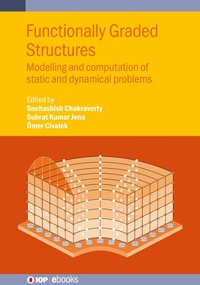
Functionally Graded Structures
Description

Functionally graded structures play a vital role in diverse engineering applications and industrial sectors, such as aerospace, nuclear power, automobiles, aviation, space vehicles, and biomedical fields. These structures exhibit inhomogeneous material properties that gradually vary along interfaces in a predetermined mathematical pattern. Their unique characteristics of low thermal conductivity and high mechanical strength make them ideal for high-temperature environments like nuclear reactors, chemical plants, etc.
This book serves as a comprehensive exploration of the static and dynamical behaviours of functionally graded structures, covering bending, buckling, and vibration analyses. Utilizing both existing and novel theories, the book delves into state-of-the-art modelling techniques, incorporating analytical, semi-analytical, and numerical approaches. Additionally, several complexities of functionally graded structures are considered, making this book a timely and valuable addition to the challenging field. The target audience for this book includes researchers, undergraduate and graduate students, as well as industry professionals engaged in structural, mechanical, civil, and aerospace engineering, applied mathematics and mathematical physics. Overall, this book provides a comprehensive and multidisciplinary perspective on functionally graded structures, making it an essential resource for academia, industry, and research communities alike.
More details
Other editions
Additional editions

Persons
Prof. S. Chakraverty has 30 years of experience as a researcher and teacher. Presently, he is a Senior Professor at the Department of Mathematics (Applied Mathematics Group), National Institute of Technology Rourkela, Odisha. He has authored/co-authored 32 books and published 437 research papers in journals and conferences. He is on the editorial boards of various international journals, including the IOP journal Engineering Research Express. He received the IOPP Top Cited Paper Awards 2021 and 2022 for most cited articles from India, published across the IOP materials journal portfolio in the past three years respectively (2018 to 2020 and 2019 to 2021). He has already guided 22 Ph. D. students and undertaken 16 research projects as PI.
Dr Subrat Kumar Jena currently holds the position of postdoctoral fellow at the Department of Applied Mechanics in the Indian Institute of Technology Delhi, New Delhi, India. He has recently concluded an honorary postdoctoral fellowship at the Nonlinear Multifunctional Composites-Analysis and Design (NMCAD) Laboratory, Department of Aerospace Engineering, Indian Institute of Science (IISc), Bengaluru, India. Dr Jena completed his PhD at the Department of Mathematics, National Institute of Technology Rourkela, Odisha, India. His research expertise encompasses computational solid mechanics, multifunctional materials, applied mathematics, mathematical modelling, and uncertainty modelling. His research contributions are widely recognized; he has 32 research papers in peer-reviewed international journals, 2 international conference papers, 9 book chapters, and 3 books (one book is in press, two other books are ongoing) to his credit.
Prof. Ömer Civalek has been serving as a professor at the Faculty of Engineering in the University of Akdeniz since 2004. He has received two PhD degrees in Structural Engineering and Applied Mechanics from Dokuz Eylül University and the University of Firat, respectively. He has made substantial contributions to the field of engineering in the form of over 350 refereed journal papers, more than 50 conference papers, a few book chapters, and 70 papers published in various national journals. His research interests are primarily focused on continuum mechanics, solid mechanics, nanoscale mechanics, the vibration and buckling of plates and shells, computational mechanics, laminated structures, structural dynamics, the modeling of nanostructures, and biomechanics. Professor Civalek has been appointed as a visiting professor for a term of three years (2020-3) at the China Medical University in Taichung, Taiwan.
Content
Preface
Acknowledgements
Editors' biographies
List of contributors
1 The static behavior of functionally graded beams
2 The static behavior of functionally graded sandwich beams
3 The static behavior of functionally graded plates
4 A static bending analysis of porous functionally graded sandwich beams
5 Dynamic analysis of porous functionally graded shell structures using the generalized differential quadrature method
6 Assessing the effects of porosity on the buckling of functionally graded beams
7 Vibration and buckling problems of functionally graded structures
8 Free vibration analysis of porous functionally graded sandwich beams
9 The torsional vibration of functionally graded nanobeams
10 Determining the accurate free vibration response of thin functionally graded plates using the dynamic stiffness method
11 Effect of functionally graded magneto-electro-elastic facings on the damped nonlinear transient response of a sandwich plate with agglomerated CNT core
12 Lamb-type waves in functionally graded orthotropic piezoelectric plates
13 Analysis of Lamb wave propagation in a generalized thermoelastic functionally graded plate
Appendix
References
