

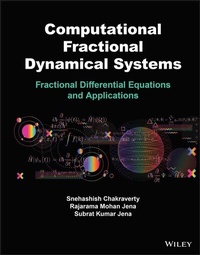
Computational Fractional Dynamical Systems
Description

A rigorous presentation of different expansion and semi-analytical methods for fractional differential equations
Fractional differential equations, differential and integral operators with non-integral powers, are used in various science and engineering applications. Over the past several decades, the popularity of the fractional derivative has increased significantly in diverse areas such as electromagnetics, financial mathematics, image processing, and materials science. Obtaining analytical and numerical solutions of nonlinear partial differential equations of fractional order can be challenging and involve the development and use of different methods of solution.
Computational Fractional Dynamical Systems: Fractional Differential Equations and Applications presents a variety of computationally efficient semi-analytical and expansion methods to solve different types of fractional models. Rather than focusing on a single computational method, this comprehensive volume brings together more than 25 methods for solving an array of fractional-order models. The authors employ a rigorous and systematic approach for addressing various physical problems in science and engineering.
- Covers various aspects of efficient methods regarding fractional-order systems
- Presents different numerical methods with detailed steps to handle basic and advanced equations in science and engineering
- Provides a systematic approach for handling fractional-order models arising in science and engineering
- Incorporates a wide range of methods with corresponding results and validation
Computational Fractional Dynamical Systems: Fractional Differential Equations and Applications is an invaluable resource for advanced undergraduate students, graduate students, postdoctoral researchers, university faculty, and other researchers and practitioners working with fractional and integer order differential equations.
More details
Other editions
Additional editions
Persons
Snehashish Chakraverty, Senior Professor, Department of Mathematics (Applied Mathematics Group), National Institute of Technology Rourkela, Odisha, India.
Rajarama Mohan Jena, Senior Research Fellow, Department of Mathematics, National Institute of Technology Rourkela, Odisha, India.
Subrat Kumar Jena, Senior Research Fellow, Department of Mathematics, National Institute of Technology Rourkela, Odisha, India.
Content
Preface
Acknowledgments
About the Authors
Introduction to Fractional Calculus
1.1. Introduction
1.2. Birth of fractional calculus
1.3. Useful mathematical functions
1.3.1. The gamma function
1.3.2. The beta function
1.3.3. The Mittag-Leffler function
1.3.4. The Mellin-Ross function
1.3.5. The Wright function
1.3.6. The error function
1.3.7. The hypergeometric function
1.3.8. The H-function
1.4. Riemann-Liouville fractional integral and derivative
1.5. Caputo fractional derivative
1.6. Grünwald-Letnikov fractional derivative and integral
1.7. Riesz fractional derivative and integral
1.8. Modified Riemann-Liouville derivative
1.9. Local fractional derivative
1.9.1. Local fractional continuity of a function
1.9.2. Local fractional derivative
References
Recent Trends in Fractional Dynamical Models and Mathematical Methods
2.1. Introduction
2.2. Fractional calculus: A generalization of integer-order calculus
2.3. Fractional derivatives of some functions and their graphical illustrations
2.4. Applications of fractional calculus
2.4.1. N.H. Abel and Tautochronous problem
2.4.2. Ultrasonic wave propagation in human cancellous bone
2.4.3. Modeling of speech signals using fractional calculus
2.4.4. Modeling the cardiac tissue electrode interface using fractional calculus
2.4.5. Application of fractional calculus to the sound waves propagation in rigid porous Materials
2.4.6. Fractional calculus for lateral and longitudinal control of autonomous vehicles
2.4.7. Application of fractional calculus in the theory of viscoelasticity
2.4.8. Fractional differentiation for edge detection
2.4.9. Wave propagation in viscoelastic horns using a fractional calculus rheology model
2.4.10. Application of fractional calculus to fluid mechanics
2.4.11. Radioactivity, exponential decay and population growth
2.4.12. The Harmonic oscillator
2.5. Overview of some analytical/numerical methods
2.5.1. Fractional Adams-Bashforth/Moulton methods
2.5.2. Fractional Euler method
2.5.3. Finite difference method
2.5.4. Finite element method
2.5.5. Finite volume method
2.5.6. Meshless method
2.5.7. Reproducing kernel Hilbert space method
2.5.8. Wavelet method
2.5.9. The Sine-Gordon expansion method
2.5.10. The Jacobi elliptic equation method
2.5.11. The generalized Kudryashov method
References
Adomian Decomposition Method (ADM)
3.1. Introduction
3.2. Basic Idea of ADM
3.3. Numerical Examples
References
Adomian Decomposition Transform Method
4.1. Introduction
4.2. Transform methods for the Caputo sense derivatives
4.3. Adomian decomposition Laplace transform method (ADLTM)
4.4. Adomian decomposition Sumudu transform method (ADSTM)
4.5. Adomian decomposition Elzaki transform method (ADETM)
4.6. Adomian decomposition Aboodh transform method (ADATM)
4.7. Numerical Examples
4.7.1. Implementation of ADLTM
4.7.2. Implementation of ADSTM
4.7.3. Implementation of ADETM
4.7.4. Implementation of ADATM
References
Homotopy Perturbation Method (HPM)
5.1. Introduction
5.2. Procedure of HPM
5.3. Numerical examples
References
Homotopy Perturbation Transform Method
6.1. Introduction
6.2. Transform methods for the Caputo sense derivatives
6.3. Homotopy perturbation Laplace transform method (HPLTM)
6.4. Homotopy perturbation Sumudu transform method (HPSTM)
6.5. Homotopy perturbation Elzaki transform method (HPETM)
6.6. Homotopy perturbation Aboodh transform method (HPATM)
6.7. Numerical Examples
6.7.1. Implementation of HPLTM
6.7.2. Implementation of HPSTM
6.7.3. Implementation of HPETM
6.7.4. Implementation of HPATM
References
Fractional Differential Transform Method
7.1. Introduction
7.2. Fractional differential transform method
7.3. Illustrative Examples
References
Fractional Reduced Differential Transform Method
8.1. Introduction
8.2. Description of FRDTM
8.3. Numerical Examples
References
Variational Iterative Method
9.1. Introduction
9.2. Procedure for VIM
9.3. Examples
References
Method of Weighted Residuals
10.1. Introduction
10.2. Collocation method
10.3. Least-square method
10.4. Galerkin method
10.5. Numerical Examples
References
Boundary Characteristics Orthogonal Polynomials
11.1. Introduction
11.2. Gram-Schmidt orthogonalization procedure
11.3. Generation of BCOPs
11.4. Galerkin method with BCOPs
11.5. Least-Square method with BCOPs
11.6. Application Problems
References
Residual Power Series Method
12.1. Introduction
12.2. Theorems and lemma related to RPSM
12.3. Basic idea of RPSM
12.4. Convergence Analysis
12.5. Examples
References
Homotopy Analysis Method
13.1. Introduction
13.2. Theory of homotopy analysis method
13.3. Convergence theorem of HAM
13.4. Test Examples
References
Homotopy Analysis Transform Method
14.1. Introduction
14.2. Transform methods for the Caputo sense derivative
14.3. Homotopy analysis Laplace transform method (HALTM)
14.4. Homotopy analysis Sumudu transform method (HASTM)
14.5. Homotopy analysis Elzaki transform method (HAETM)
14.6. Homotopy analysis Aboodh transform method (HAATM)
14.7. Numerical Examples
14.7.1. Implementation of HALTM
14.7.2. Implementation of HASTM
14.7.3. Implementation of HAETM
14.7.4. Implementation of HAATM
References
q-Homotopy Analysis Method
15.1. Introduction
15.2. Theory of q-HAM
15.3. Illustrative Examples
References
q-Homotopy Analysis transform Method
16.1. Introduction
16.2. Transform methods for the Caputo sense derivative
16.3. q-homotopy analysis Laplace transform method (q-HALTM)
16.4. q-homotopy analysis Sumudu transform method (q-HASTM)
16.5. q-homotopy analysis Elzaki transform method (q-HAETM)
16.6. q-homotopy analysis Aboodh transform method (q-HAATM)
16.7. Test Problems
16.7.1. Implementation of q-HALTM
16.7.2. Implementation of q-HASTM
16.7.3. Implementation of q-HAETM
16.7.4. Implementation of q-HAATM
References
(G'/G)-Expansion Method
17.1. Introduction
17.2. Description of the (G'/G)-expansion method
17.3. Application Problems
References
(G'/G^2)-Expansion Method
18.1. Introduction
18.2. Description of the (G'/G^2)-expansion method
18.3. Numerical Examples
References
(G'/G,1/G)-Expansion Method
19.1. Introduction
19.2. Algorithm of the (G'/G,1/G)-expansion method
19.3. Illustrative Examples
References
The modified simple equation method
20.1. Introduction
20.2. Procedure of the modified simple equation method
20.3. Application Problems
References
Sine-Cosine Method
21.1. Introduction
21.2. Details of Sine-Cosine method
21.3. Numerical Examples
References
Tanh Method
22.1. Introduction
22.2. Description of the Tanh method
22.3. Numerical Examples
References
Fractional sub-equation method
23.1. Introduction
23.2. Implementation of the fractional sub-equation method
23.3. Numerical Examples
References
Exp-function Method
24.1. Introduction
24.2. Procedure of the Exp-function method
24.3. Numerical Examples
References
Exp(-f(¿))-expansion method
25.1. Introduction
25.2. Methodology of the exp(-f(¿))-expansion method
25.3. Numerical Examples
References
Index
1
Introduction to Fractional Calculus
1.1 Introduction
Fractional calculus is a generalization of ordinary differentiation and integration to arbitrary (non-integer) order. It is also an area of mathematics that investigates the possibilities of using real or even complex numbers as powers of the differential operator. This area is three centuries old compared to conventional calculus, but initially, it was not very popular. Fractional derivatives and integrals are not local in nature, so the nonlocal distributed effects are considered. The subject of fractional calculus has gained considerable popularity and importance during the past three decades, mainly due to its validated applications, dynamic nature, and comprehensive representation of complex nonlinear phenomena in various fields of science and engineering. The mathematical models in electromagnetics, rheology, viscoelasticity, electrochemistry, control theory, fluid dynamics, financial mathematics, and material science are well defined by fractional-order differential equations.
1.2 Birth of Fractional Calculus
In a letter to L'Hospital in 1695, Leibniz asked the following question: "Can the meaning of integer-order derivatives be generalized to non-integer-order derivatives?" L'Hospital was very curious about that question and replied to Leibniz by asking what would happen to the term if . In order to explain the answer to the query raised by L'Hospital, Leibniz wrote a letter dated 30 September 1695, known as the birthday of fractional calculus, which mentioned that "It will lead to a paradox, from which one-day useful consequences will be drawn." This was the beginning of fractional calculus. Many famous mathematicians, namely Liouville, Riemann, Weyl, Fourier, Abel, Lacroix, Leibniz, Grünwald, and Letnikov, contributed to fractional calculus over the years. Recently, various types of fractional differential and integral operators have been developed, namely the Riemann-Liouville fractional integral and derivative, Caputo fractional derivative, Grünwald-Letnikov fractional derivative, Riesz fractional derivative, modified Riemann-Liouville derivative, and local fractional derivative, which are all discussed in this chapter.
1.3 Useful Mathematical Functions
In order to understand various types of fractional derivatives and integrals arising in fractional calculus, we need first to understand some necessary preliminaries and related functions used in fractional calculus. These functions include the gamma function, the Euler psi function, incomplete gamma function, beta function, incomplete beta function, Mittag-Leffler functions (MLFs), Mellin-Ross function, the Wright function, the error function, the hypergeometric functions (Gauss, Kummer, and generalized hypergeometric functions), and the H-function.
1.3.1 The Gamma Function
In this section, the definitions and some properties of the gamma function have been covered. The fundamental characteristic of the gamma function is just an extension of the factorial for all real numbers. It can also be defined in terms of a complex number.
Figure 1.1 The graph of gamma function in the real axis.
Definition 1.1
The gamma function is most important in the fractional-order calculus, and it is written as (Baleanu et al. 2012; Chakraverty et al. 2020; Das 2011; Kilbas et al. 2006; Kiryakova 1993; Miller and Ross 1993; Oldham and Spanier 1974; Podlubny 1999; Samko et al. 2002):
(1.1)where R(z) is the real part of the complex number z ? C. Equation (1.1) is convergent for all complex numbers z ? C (R(z) > 0). The gamma function is defined everywhere on the real axis except its singular points, viz. 0, -1, -2, .. As a result, the domain of the gamma function is . ? (-2, - 1) ? (-1, 0) ? (0, + 8). The graph of the gamma function is depicted in the Figure 1.1.
Some properties of the gamma function are as follows (Chakraverty et al. 2020; Miller and Ross 1993; Podlubny 1999; Samko et al. 2002):
- G(z + 1) = zG(z), for z ? R+.
Definition 1.2 (Euler psi Function)
The Euler psi function is the logarithmic derivative of the gamma function, which is defined as (Kilbas et al. 2006):
(1.2)with the following property:
(1.3)Definition 1.3 (Incomplete Gamma Function)
The incomplete gamma function (Herrmann 2011; Kilbas et al. 2006) is derived from Eq. (1.1) by decomposing into an integral from 0 to ? and another from ? to 8 as:
(1.4) (1.5)The incomplete gamma functions have the following properties (Herrmann2011; Kilbas et al. 2006):
- ?(z, 8) = G(z, 0) = G(z),
- ?(z, ?) + G(z, ?) = G(z), R(z) > 0.
Figure 1.2 The graph of beta function.
1.3.2 The Beta Function
Definition 1.4
The beta function is defined as (Kilbas et al. 2006; Miller and Ross 1993; Podlubny 1999; Samko et al. 2002):
(1.6)3D plot of the beta function Eq. (1.6) has been illustrated in Figure 1.2.
Some properties of the beta function are given as follows (Kilbas et al. 2006; Miller and Ross 1993; Podlubny 1999; Samko et al. 2002):
- B(z, ?) = B(?, z),
- B(z, ?) = B(z, ? + 1) + B(z + 1, ?),
Note 1.1
The relationship between gamma and beta functions is written as:
Definition 1.5 (Incomplete Beta Function)
The generalized form beta function is known as incomplete beta function, which is given as:
(1.7)It is worth mentioning that when z = 1, the incomplete beta function transforms into the beta function, which has several applications in physics, functional analysis, and integral calculus.
1.3.3 The Mittag-Leffler Function
The MLF comes from the solution of fractional-order differential equations or fractional-order integral equations. It is an extension of exponential functions that may be expressed as a power series.
Definition 1.6 (One-Parametric Mittag-Leffler Function)
One-parameter MLF is defined as (Baleanu et al. 2012; Chakraverty et al. 2020; Das 2011; Kilbas et al. 2006; Kiryakova 1993; Miller and Ross 1993; Oldham and Spanier 1974; Podlubny 1999; Samko et al. 2002):
(1.8)If we put a = 1 in Eq. (1.8), we obtain
(1.9)which is the summation form of the exponential function ez. So, MLF is an extension of the exponential function in one parameter.
Definition 1.7 (Two-Parametric Mittag-Leffler Function)
Two-parameter representation of the MLF may be written as (Miller and Ross 1993; Podlubny 1999; Samko et al. 2002):
(1.10)Definition 1.8 (Generalized Mittag-Leffler Function)
The generalized MLF can be defined as (Haubold et al. 2011; Kilbas et al. 2006; Kurulay and Bayram 2012):
(1.11)where (?)n is the Pochhammer symbol and is defined as
(1.12)Note 1.2
The derivative of the two-parametric MLF can be expressed in the form of generalized MLF as (Kilbas et al. 2006):
(1.13)Some properties of the MLF are given as follows (Mathai and Haubold 2008):
1.3.4 The Mellin-Ross Function
The Mellin-Ross function Et(?, a) is obtained while evaluating the fractional derivative of an exponential function eat. Both the incomplete gamma and MLFs are closely related to this function.
Definition 1.9
The Mellin-Ross function is defined as (Mathai and Haubold 2008):
(1.14)1.3.5 The Wright Function
Definition 1.10
The Wright function was proposed by Wright (1993) in 1933, which is denoted by...
