

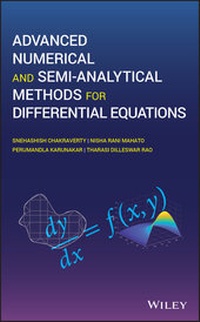
Advanced Numerical and Semi-Analytical Methods for Differential Equations
Description

This student-friendly book deals with various approaches for solving differential equations numerically or semi-analytically depending on the type of equations and offers simple example problems to help readers along.
Featuring both traditional and recent methods, Advanced Numerical and Semi Analytical Methods for Differential Equations begins with a review of basic numerical methods. It then looks at Laplace, Fourier, and weighted residual methods for solving differential equations. A new challenging method of Boundary Characteristics Orthogonal Polynomials (BCOPs) is introduced next. The book then discusses Finite Difference Method (FDM), Finite Element Method (FEM), Finite Volume Method (FVM), and Boundary Element Method (BEM). Following that, analytical/semi analytic methods like Akbari Ganji's Method (AGM) and Exp-function are used to solve nonlinear differential equations. Nonlinear differential equations using semi-analytical methods are also addressed, namely Adomian Decomposition Method (ADM), Homotopy Perturbation Method (HPM), Variational Iteration Method (VIM), and Homotopy Analysis Method (HAM). Other topics covered include: emerging areas of research related to the solution of differential equations based on differential quadrature and wavelet approach; combined and hybrid methods for solving differential equations; as well as an overview of fractal differential equations. Further, uncertainty in term of intervals and fuzzy numbers have also been included, along with the interval finite element method. This book:
* Discusses various methods for solving linear and nonlinear ODEs and PDEs
* Covers basic numerical techniques for solving differential equations along with various discretization methods
* Investigates nonlinear differential equations using semi-analytical methods
* Examines differential equations in an uncertain environment
* Includes a new scenario in which uncertainty (in term of intervals and fuzzy numbers) has been included in differential equations
* Contains solved example problems, as well as some unsolved problems for self-validation of the topics covered
Advanced Numerical and Semi Analytical Methods for Differential Equations is an excellent text for graduate as well as post graduate students and researchers studying various methods for solving differential equations, numerically and semi-analytically.
More details
Other editions
Additional editions
Persons
SNEHASHISH CHAKRAVERTY, PHD, is Professor in the Department of Mathematics at National Institute of Technology, Rourkela, Odisha, India. He is also the author of Fuzzy Arbitrary Order System: Fuzzy Fractional Differential Equations and Applications and 12 other books.
NISHA RANI MAHATO is a Senior Research Fellow in the Department of Mathematics at the National Institute of Technology, Rourkela, Odisha, India where she is pursuing her PhD.
PERUMANDLA KARUNAKAR is a Senior Research Fellow in the Department of Mathematics at the National Institute of Technology, Rourkela, Odisha, India where he is pursuing his PhD.
THARASI DILLESWAR RAO, is a Senior Research Fellow in the Department of Mathematics at the National Institute of Technology, Rourkela, Odisha, India where he is pursuing his PhD.
Content
Acknowledgments xi
Preface xiii
1 Basic Numerical Methods 1
1.1 Introduction 1
1.2 Ordinary Differential Equation 2
1.3 Euler Method 2
1.4 Improved Euler Method 5
1.5 Runge-Kutta Methods 7
1.5.1 Midpoint Method 7
1.5.2 Runge-Kutta Fourth Order 8
1.6 Multistep Methods 10
1.6.1 Adams-Bashforth Method 10
1.6.2 Adams-Moulton Method 10
1.7 Higher-Order ODE 13
References 16
2 Integral Transforms 19
2.1 Introduction 19
2.2 Laplace Transform 19
2.2.1 Solution of Differential Equations Using Laplace Transforms 20
2.3 Fourier Transform 25
2.3.1 Solution of Partial Differential Equations Using Fourier Transforms 26
References 28
3 Weighted Residual Methods 31
3.1 Introduction 31
3.2 Collocation Method 33
3.3 Subdomain Method 35
3.4 Least-square Method 37
3.5 Galerkin Method 39
3.6 Comparison of WRMs 40
References 42
4 Boundary Characteristics Orthogonal Polynomials 45
4.1 Introduction 45
4.2 Gram-Schmidt Orthogonalization Process 45
4.3 Generation of BCOPs 46
4.4 Galerkin's Method with BCOPs 46
4.5 Rayleigh-Ritz Method with BCOPs 48
References 51
5 Finite Difference Method 53
5.1 Introduction 53
5.2 Finite Difference Schemes 53
5.2.1 Finite Difference Schemes for Ordinary Differential Equations 54
5.2.1.1 Forward Difference Scheme 54
5.2.1.2 Backward Difference Scheme 55
5.2.1.3 Central Difference Scheme 55
5.2.2 Finite Difference Schemes for Partial Differential Equations 55
5.3 Explicit and Implicit Finite Difference Schemes 55
5.3.1 Explicit Finite Difference Method 56
5.3.2 Implicit Finite Difference Method 57
References 61
6 Finite Element Method 63
6.1 Introduction 63
6.2 Finite Element Procedure 63
6.3 Galerkin Finite Element Method 65
6.3.1 Ordinary Differential Equation 65
6.3.2 Partial Differential Equation 71
6.4 Structural Analysis Using FEM 76
6.4.1 Static Analysis 76
6.4.2 Dynamic Analysis 78
References 79
7 Finite Volume Method 81
7.1 Introduction 81
7.2 Discretization Techniques of FVM 82
7.3 General Form of Finite Volume Method 82
7.3.1 Solution Process Algorithm 83
7.4 One-Dimensional Convection-Diffusion Problem 84
7.4.1 Grid Generation 84
7.4.2 Solution Procedure of Convection-Diffusion Problem 84
References 89
8 Boundary Element Method 91
8.1 Introduction 91
8.2 Boundary Representation and Background Theory of BEM 91
8.2.1 Linear Differential Operator 92
8.2.2 The Fundamental Solution 93
8.2.2.1 Heaviside Function 93
8.2.2.2 Dirac Delta Function 93
8.2.2.3 Finding the Fundamental Solution 94
8.2.3 Green's Function 95
8.2.3.1 Green's Integral Formula 95
8.3 Derivation of the Boundary Element Method 96
8.3.1 BEM Algorithm 96
References 100
9 Akbari-Ganji's Method 103
9.1 Introduction 103
9.2 Nonlinear Ordinary Differential Equations 104
9.2.1 Preliminaries 104
9.2.2 AGM Approach 104
9.3 Numerical Examples 105
9.3.1 Unforced Nonlinear Differential Equations 105
9.3.2 Forced Nonlinear Differential Equation 107
References 109
10 Exp-Function Method 111
10.1 Introduction 111
10.2 Basics of Exp-Function Method 111
10.3 Numerical Examples 112
References 117
11 Adomian Decomposition Method 119
11.1 Introduction 119
11.2 ADM for ODEs 119
11.3 Solving System of ODEs by ADM 123
11.4 ADM for Solving Partial Differential Equations 125
11.5 ADM for System of PDEs 127
References 130
12 Homotopy Perturbation Method 131
12.1 Introduction 131
12.2 Basic Idea of HPM 131
12.3 Numerical Examples 133
References 138
13 Variational Iteration Method 141
13.1 Introduction 141
13.2 VIM Procedure 141
13.3 Numerical Examples 142
References 146
14 Homotopy Analysis Method 149
14.1 Introduction 149
14.2 HAM Procedure 149
14.3 Numerical Examples 151
References 156
15 Differential Quadrature Method 157
15.1 Introduction 157
15.2 DQM Procedure 157
15.3 Numerical Examples 159
References 165
16 Wavelet Method 167
16.1 Introduction 167
16.2 HaarWavelet 168
16.3 Wavelet-Collocation Method 170
References 175
17 Hybrid Methods 177
17.1 Introduction 177
17.2 Homotopy Perturbation Transform Method 177
17.3 Laplace Adomian Decomposition Method 182
References 186
18 Preliminaries of Fractal Differential Equations 189
18.1 Introduction to Fractal 189
18.1.1 Triadic Koch Curve 190
18.1.2 Sierpinski Gasket 190
18.2 Fractal Differential Equations 191
18.2.1 Heat Equation 192
18.2.2 Wave Equation 194
References 194
19 Differential Equations with Interval Uncertainty 197
19.1 Introduction 197
19.2 Interval Differential Equations 197
19.2.1 Interval Arithmetic 198
19.3 Generalized Hukuhara Differentiability of IDEs 198
19.3.1 Modeling IDEs by Hukuhara Differentiability 199
19.3.1.1 Solving by Integral Form 199
19.3.1.2 Solving by Differential Form 199
19.4 Analytical Methods for IDEs 201
19.4.1 General form of nth-order IDEs 202
19.4.2 Method Based on Addition and Subtraction of Intervals 202
References 206
20 Differential Equations with Fuzzy Uncertainty 209
20.1 Introduction 209
20.2 Solving Fuzzy Linear System of Differential Equations 209
20.2.1 ¿¿¿¿-Cut of TFN 209
20.2.2 Fuzzy Linear System of Differential Equations (FLSDEs) 210
20.2.3 Solution Procedure for FLSDE 211
References 215
21 Interval Finite Element Method 217
21.1 Introduction 217
21.1.1 Preliminaries 218
21.1.1.1 Proper and Improper Interval 218
21.1.1.2 Interval System of Linear Equations 218
21.1.1.3 Generalized Interval Eigenvalue Problem 219
21.2 Interval Galerkin FEM 219
21.3 Structural Analysis Using IFEM 223
21.3.1 Static Analysis 223
21.3.2 Dynamic Analysis 225
References 227
Index 231
Preface
Differential equations form the backbone of various physical systems occurring in a wide range of science and engineering disciplines viz. physics, chemistry, biology, economics, structural mechanics, control theory, circuit analysis, biomechanics, etc. Generally, these physical systems are modeled either using ordinary or partial differential equations (ODEs or PDEs). In order to know the behavior of the system, we need to investigate the solutions of the governing differential equations. The exact solution of differential equations may be obtained using well-known classical methods. Generally, the physical systems occurring in nature comprise of complex phenomena for which computation of exact results may be quite challenging. In such cases, numerical or semi-analytical methods may be preferred. In this regard, there exist a variety of standard books related to solution of ODEs and PDEs. But, the existing books are sometimes either method or subject specific. Few existing books deal with basic numerical methods for solving the ODEs and/or PDEs whereas some other books may be found related with semi-analytical methods only. But, as per the authors' knowledge, books covering the basic concepts of the numerical as well as semi-analytical methods to solve various types of ODEs and PDEs in a systematic manner are scarce. Another challenge is that of handling uncertainty when introduced in the model. Moreover, some books include complex example problems which may not be convincing to the readers for ease of understanding. As such, the authors came to the realization of need for a book that contains traditional as well as recent numerical and semi-analytic methods with simple example problems along with idea of uncertainty handling in models with uncertain parameters. With respect to student-friendly, straightforward, and easy understanding of the methods, this book may definitely be a benchmark for the teaching/research courses for students, teachers, and industry. The present book consists of 21 chapters giving basic knowledge of various recent and challenging methods. The best part of the book is that it discusses various methods for solving linear as well as nonlinear ODEs, PDEs, and sometimes system of ODEs/PDEs along with solved example problems for better understanding. Before we address some details of the book, the authors assume that the readers have prerequisite knowledge of calculus, basic differential equations, and linear algebra.
As such, the book starts with Chapter 1 containing preliminaries of differential equations and recapitulation of basic numerical techniques viz. Euler, improved Euler, Runge-Kutta, and multistep methods for solving ODEs subject to initial conditions. Chapter 2 deals with the exact solution approach for ODEs and PDEs. In this chapter, we address two widely used integral transform methods viz. Laplace and Fourier transform methods for solving ODEs and PDEs. Another powerful approximation technique, weighted residual method (WRM), is addressed in Chapter 3 for finding solution of differential equations subject to boundary conditions referred to as boundary value problems (BVPs). In this regard, this chapter is organized such that various WRMs viz. collocation, subdomain, least-square, and Galerkin methods are applied for solving BVPs. A new challenging technique viz. using boundary characteristic orthogonal polynomials (BCOPs) in well-known methods like Rayleigh-Ritz, Galerkin, collocation, etc. has also been introduced in Chapter 4.
Due to complexity in various engineering fields viz. structural mechanics, biomechanics, and electromagnetic field problems, the WRMs over the entire domain discussed in Chapter 3 may yield better results when considered over discretized domain. In this regard, various types of finite difference schemes for ODEs and PDEs, and application of the finite difference method (FDM) to practical problems by using schemes like explicit and implicit have been presented in Chapter 5. Finite element method (FEM) serves as another powerful numerical discretization approach that converts differential equations into algebraic equations. The FDM discussed in Chapter 5 generally considers the node spacing such that the entire domain is partitioned in terms of squares or rectangles, but the FEM overcomes this drawback by spacing the nodes such that the entire domain is partitioned using any shape in general. As such, Chapter 6 is mainly devoted to the FEM and especially Galerkin FEM. Effectiveness of the FEM is further studied for static and dynamic analysis of one-dimensional structural systems. Chapter 7 gives an idea of widely used numerical technique named finite volume method (FVM). Accordingly, brief background, physical theory, and algorithm for solving particular practical problem are addressed in this chapter. A brief introduction to another numerical discretization method known as boundary element method (BEM) is addressed in Chapter 8 along with BEM algorithm and procedure to find fundamental solution.
Some problems are nonlinear in nature resulting in governing nonlinear differential equations. Recently, research studies have been done for solving nonlinear differential equations efficiently and modeling of such differential equations analytically is rather more difficult compared to solving linear differential equations discussed in Chapters 1-8. So, this book may also be considered as a platform consisting of various methods that may be used for solving different linear as well as nonlinear ODEs and PDEs. Though the computation of exact solutions for nonlinear differential equations may be cumbersome, a new class of obtaining analytical solutions, that is semi-analytic approach, has emerged. Generally, semi-analytic techniques comprise of power series or closed-form solutions which have been discussed in subsequent chapters. In this regard, Akbari-Ganji's method (AGM) has been considered as a powerful algebraic (semi-analytic) approach in Chapter 9 for solving ODEs. In the AGM, initially a solution function consisting of unknown constant coefficients is assumed satisfying the differential equation subject to initial conditions. Then, the unknown coefficients are computed using algebraic equations obtained with respect to function derivatives and initial conditions. Further, the procedure of exp-function method and its application to nonlinear PDEs have been illustrated in Chapter 10. Semi-analytical techniques based on perturbation parameters also exist and have wide applicability. As such, Chapter 11 addresses Adomian decomposition method (ADM) for solving linear as well as nonlinear ODEs, PDEs, and system of ODEs, PDEs. In this regard, another well-known semi-analytical technique that does not require a small parameter assumption (for solving linear as well as nonlinear ODEs/PDEs) is Homotopy Perturbation Method (HPM). The HPM is easy to use for handling various types of differential equations in general. As such, a detailed procedure of the HPM is explained and applied to linear and nonlinear problems in Chapter 12. Further, Chapter 13 deals with a semi-analytical method viz. variational iteration method (VIM) for finding the approximate series solution of linear and nonlinear ODEs/PDEs. Then, Chapter 14 confers homotopy analysis method (HAM), which is based on coupling of the traditional perturbation method and homotopy in topology. Generally, the HAM involves a control parameter that controls the convergent region and rate of convergence of solution. It may be worth mentioning that the methods viz. ADM, HPM, VIM, and HAM discussed in Chapters 11, 12, 13, and 14, respectively, not only yield approximate series solution (which converges to exact solution) but they may produce exact solution also depending upon the considered problem.
Emerging areas of research related to solution of differential equations based on differential quadrature and wavelet approach have been considered in Chapters 15 and 16, respectively. Chapter 15 contributes an effective numerical method called differential quadrature method (DQM) that approximates the solution of the PDEs by functional values at certain discretized points. In this analysis, shifted Legendre polynomials have been used for computation of weighted coefficients. Further, in order to have an overview of handling ODEs using Haar wavelets, a preliminary procedure based on Haar wavelet-collocation method has been discussed in Chapter 16. Other advanced methods viz. hybrid methods that combine more than one method are discussed in Chapter 17. Two such methods viz. homotopy perturbation transform method (HPTM) and Laplace Adomian decomposition method (LADM) which are getting more attention of researchers are demonstrated to make the readers familiar with these methods. Differential equations over fractal domain are often referred to as fractal differential equations. Recently, fractal analysis has become a subject of great interest in various science and engineering applications. Often, the differential equations over fractal domains are referred to as fractal differential equations. Accordingly, in Chapter 18, only a basic idea of fractals and notion of fractal differential have been incorporated.
Another challenging concept of this book is also to introduce a new scenario in which uncertainty has been included to handle uncertain environment. In actual practice, the variables or coefficients in differential equations exhibit uncertainty due...
