

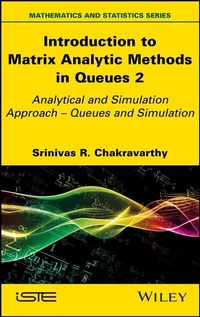
Introduction to Matrix-Analytic Methods in Queues 2
Description

Matrix-analytic methods (MAM) were introduced by Professor Marcel Neuts and have been applied to a variety of stochastic models since.
In order to provide a clear and deep understanding of MAM while showing their power, this book presents MAM concepts and explains the results using a number of worked-out examples. This book's approach will inform and kindle the interest of researchers attracted to this fertile field.
To allow readers to practice and gain experience in the algorithmic and computational procedures of MAM, Introduction to Matrix-Analytic Methods in Queues 2 provides a number of computational exercises. It also incorporates simulation as another tool for studying complex stochastic models, especially when the state space of the underlying stochastic models under analytic study grows exponentially.
This book's detailed approach will make it more accessible for readers interested in learning about MAM in stochastic models.
Srinivas R. Chakravarthy retired from Kettering University in Michigan, USA after serving as Professor of Mathematics, and as Professor and Head of Industrial and Manufacturing Engineering. He was bestowed the Distinguished Faculty (Kettering's Faculty and Alumni Honor Wall) award in 2015. He obtained his PhD under the supervision of Professor Marcel Neuts and is the co-founder of the International Conference Series on MAM in Stochastic Models. His research interests are in queues, inventory and reliability.
More details
Other editions
Additional editions
Person
Srinivas R. Chakravarthy retired from Kettering University in Michigan, USA after serving as Professor of Mathematics, and as Professor and Head of Industrial and Manufacturing Engineering. He was bestowed the Distinguished Faculty (Kettering's Faculty and Alumni Honor Wall) award in 2015. He obtained his PhD under the supervision of Professor Marcel Neuts and is the co-founder of the International Conference Series on MAM in Stochastic Models. His research interests are in queues, inventory and reliability.
Content
1. Single-Server Queues Embedded at Departure Epochs
2. Single-Server Queues Embedded at Arrival Epochs
3. Single-Server Queues Based on Arbitrary Epochs
4. Busy Period in Queues
5. Multi-Server Queues
6. Finite-Capacity Queues
7. Simulation
Preface
The introduction of the phase type (PH) distributions in the early 1970s by Marcel Neuts opened up a wide range of possibilities in Applied Probability modeling and ushered in the idea that finding computable, numerical solutions was an acceptable and desirable goal in analyzing stochastic models. Furthermore, he popularized incorporating the computational aspects in the study of stochastic models. It gave researchers a powerful new tool that enabled them to move beyond the traditional models limited to exponential processes for analytical convenience to studying more realistic stochastic models with algorithmic solutions and simple, elegant probabilistic interpretations. The goal of building models with computationally tractable solutions rather than the abstract transform-based solutions took root. This rapidly led to an entirely new area of research on the study of stochastic models in queues, inventory, reliability, and communication networks using matrix-analytic methods (MAM). The versatile Markovian point process (VMPP) was introduced by Neuts in the late 1970s. This process was used in the study of a single-server queueing system with general services by one of Neuts's students, V. Ramaswami, for his PhD dissertation. In 1990, this VMPP was studied differently as a batch Markovian arrival process (BMAP) by Neuts and his students David Lucantoni and Kathy Meier-Hellstern. At that time it was thought that VMPP was a special case of BMAP, but it was proved that BMAP and VMPP are the same. However, the compact and transparent notations with which BMAP is described allowed the readers to understand this versatile point process with relative ease, and since then VMPP is referred to as BMAP in the literature. In the case of single arrivals, the process is referred to as a Markovian arrival process (MAP).
The study of stochastic models possessing matrix-geometric solutions (thus extending the geometric solution result for the scalar case for Poisson arrivals and exponential services in a single server queue) by Neuts in the late 1970s and the introduction of PH distributions, BMAP, and an emphasis on the algorithmic approach, paved the way for Neuts to the introduction of MAM. Ever since, these methods have been extensively studied both theoretically and computationally in the context of a variety of stochastic models useful in many applied areas. A handful of books starting with Neuts's two classical books, Matrix-Geometric Solutions in Stochastic Models: An Algorithmic Approach, originally published in 1981, and Structured Stochastic Matrices of M/G/1 Type and Their Applications in 1989, to the latest one, The Theory of Queuing Systems with Correlated Flows by Dudin, Klimenok and Vishnevsky in 2020, have appeared in the literature that deal with MAM. The other books published from 1989 to 2020 include Introduction to Matrix Analytic Methods in Stochastic Modeling by Latouche and Ramaswami (1999); Numerical Methods for Structured Markov Chains by Bini et al. (2005); Queueing Theory for Telecommunications by Alfa (2010); Fundamentals of Matrix-Analytic Methods by He (2014); and Matrix-Exponential Distributions in Applied Probability by Bladt and Nielsen (2017).
All the texts mentioned above provide an excellent foundation of a variety of stochastic models in general and of theoretical properties and applications of MAM to those models. The present work takes a different approach by covering the basics of MAM but focusing on clearly illustrating its use in analyzing many stochastic models. It is also my strong belief that the art of model building and analysis is better learned by studying carefully constructed examples and by practicing those skills on other models. A text that incorporates the mathematical ideas of MAM along with clearly illustrated examples on the use of these methods in analyzing interesting stochastic models makes MAM more accessible to current researchers. I believe this juxtaposition reinforces the power of MAM, enables one to appreciate and get better in the art of model building, and helps in improving "probabilistic thinking" of models and solutions. It is also for these reasons that I have included a large collection of exercises, most of which are computational in nature, for the reader to practice, experiment and get the experience in the algorithmic and computational procedures. It should be pointed out that the illustrative examples and the exercises are deliberately made more generic so as to let the readers modify them for their areas of applications. This approach was motivated by the feedback that I have had from numerous graduate students and fellow researchers in the past.
Furthermore, the text also contains exploration of simulation as an integral tool in studying stochastic models, which don't admit analytical or numerical solutions. Finally, the text provides detailed explanations on the mathematics and the applications of MAM to enable graduate students with a strong background in probability and mathematics.
Thus, the text is a useful source of reference for researchers established in this field and, more importantly, a valuable, inviting guide for those venturing into this rich research area.
This two-volume book is organized as follows: Volume 1 has nine chapters. Chapter 1 reviews basic concepts in probability and matrix theory. Chapter 2 has a brief review of discrete-state-discrete-time and discrete-state-continuous-time Markov chains. These two chapters are not meant to be an exhaustive and thorough review of those topics but hopefully sufficient enough to understand the rest of the materials in the two-volume book. In Chapter 3, discrete-time phase type distribution is presented. Chapter 4 focuses on the continuous-time phase type distributions. Chapters 5 and 6, respectively, cover discrete and continuous time BMAP. The basics of MAM from both discrete time (through embedded epochs) and continuous time points of view along with many examples and exercises are, respectively, presented in Chapters 7 and 8. A brief summary of the applications of queueing (and in turn MAM) is given in Chapter 9. The presence of numerous detailed solutions and exercises benefit students by piquing their interest in MAM, helping them learn and understand basic concepts, and succeed in constructing and solving models of their own in their research. The solutions to these exercises can be found at the following link: www.iste.co.uk/chakravarthy/queues2.zip.
Volume 2 contains seven chapters. In Chapters 1, 2, and 3, respectively, single-server queues are studied by looking at departure, arrivals, and at arbitrary epochs. Chapter 4 focuses on the busy periods in queues. Selected multi-server queues are studied in Chapter 5, and finite capacity queues are the focus in Chapter 6. Finally in Chapter 7, we present analysis of queues via simulation using ARENA, a powerful simulation software. In this chapter we also provide a very brief introduction to ARENA. All these chapters have exercises.
This two-volume book can be used in a number of settings. Senior undergraduate students (with sufficient background in probability) and Master's level graduate students could use Volume 1 to get an understanding of the fundamentals of MAM. Research scholars pursuing MPhil and PhD degrees can start with Volume 1 and, after going through the basics covered there, move on to finishing Volume 2. For research scholars pursuing MPhil and PhD degrees, the two volumes would constitute a two- to three-semester course.
Writing this book has been lot of fun but also a challenge. However, my family, friends, and mentors helped me to meet that challenge. I take a great pleasure in acknowledging them. This book project would not have been possible without the educational foundation, moral support, encouragement, and critical analysis of teachers, friends, and families.
Specifically, I want to acknowledge the following people who made a positive difference.
- - My (late) father, P.S.S. Raghavan, for being a role model. My mother, P.S.S. Rajalakshmi, for her encouragement. Both my parents made many sacrifices that enabled me to first go to college and, later on, to leave for the United States to pursue higher studies.
- - My sister, Vasumathi Parthasarathy, for exposing me to mathematics at a very young age.
- - My (late) Professors Marcel F. Neuts and K.N. Venkataraman. While K.N.V. gave me an opportunity to learn probability theory under him while in India, M.F.N. showed me the path to MAM. I owe a debt of gratitude to him for what I am now and for his important role in shaping my career as a teacher and a researcher.
- - My college teachers, Prof. D. Ratnasabapathi (Presidency College in Madras) and Prof. K. Suresh Chandra (University of Madras), who not only taught me statistics but also were a source of encouragement to pursue higher studies.
- - I benefited a lot through interacting with my friends and colleagues V. Ramaswami, D.M. Lucantoni, Kathy Meier-Hellstern and S. Kumar, during my days at Delaware.
- - R. Parthasarathy (Kent State University), whom I knew from my college days in India and who has always been there to give moral support since those days.
- - My research colleagues who played key roles in my career, notably A.S. Alfa, A.N. Dudin, A. Krishnamoorthy, and A. Rumyantsev.
- - My students: Serife Ozkar, who visited from Turkey to finish up her doctoral thesis with me at Kettering, and Shruti Goel, who attended the workshops I conducted in...
