

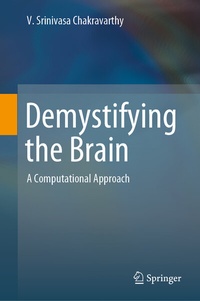
Demystifying the Brain
Description

This book presents an emerging new vision of the brain, which is essentially expressed in computational terms, for non-experts. As such, it presents the fundamental concepts of neuroscience in simple language, without overwhelming non-biologists with excessive biological jargon. In addition, the book presents a novel computational perspective on the brain for biologists, without resorting to complex mathematical equations.
It addresses a comprehensive range of topics, starting with the history of neuroscience, the function of the individual neuron, the various kinds of neural network models that can explain diverse neural phenomena, sensory-motor function, language, emotions, and concluding with the latest theories on consciousness. The book offers readers a panoramic introduction to the "new brain" and a valuable resource for interdisciplinary researchers looking to gatecrash the world of neuroscience.
Reviews / Votes
"This very good book on basic neuroscience presents interesting concepts. It is a complete analysis in every way. . the book will help readers better understand neuroscience-related concepts by broadly presenting and discussing some very interesting questions. It is certainly worth reading." (João Luís G. Rosa, Computing Reviews, October 28, 2019)More details
Other editions
Additional editions
Person
V. Srinivasa Chakravarthy obtained his PhD degree from the University of Texas at Austin and completed his postdoctoral training at Baylor College of Medicine, Houston. He is currently a Professor of Biology at the Indian Institute of Technology Madras, India. His research interests are in the areas of computational neuroscience and machine learning. In computational neuroscience, his research focuses on the modeling of basal ganglia to understand Parkinson's Disease, modeling neuron-astrocyte-vascular networks, and modeling spatial cells of the hippocampus. Further, his work on character recognition in Indic scripts led him to develop the Bharati Script-a simple and unified script that can be used to express all major Indian languages.
Content
Chapter 1. Brain Ideas Through the Centuries.- Chapter 2. Brain - Through the Aeons.- Chapter 3. The World at the Level of a Neuron.- Chapter 4. Networks that Learn.- Chapter 5. Memories and Holograms.- Chapter 6. Maps, Maps Everywhere.- Chapter 7. Pathways of Light.- Chapter 8. This Palpable World.- Chapter 9. On Sound and Music.- Chapter 10. Sniffing at the World.- Chapter 11. Get, Set, Action.- Chapter 12. Circuits of Emotion.- Chapter 13. A Gossamer of Words.- Chapter 14. The Stuff that Minds are Made of.- Chapter 15. Mindware.
