

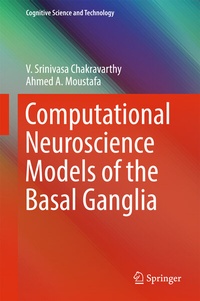
Computational Neuroscience Models of the Basal Ganglia
Published on 21. March 2018
XIV, 296 pages
978-981-10-8494-2 (ISBN)
Description

The book is a compendium of the aforementioned subclass of models of Basal Ganglia, which presents some the key existent theories of Basal Ganglia function. The book presents computational models of basal ganglia-related disorders, including Parkinson's disease, schizophrenia, and addiction. Importantly, it highlights the applications of understanding the role of the basal ganglia to treat neurological and psychiatric disorders. The purpose of the present book is to amend and expand on James Houk's book (MIT press; ASIN: B010BF4U9K) by providing a comprehensive overview on computational models of the basal ganglia. This book caters to researchers and academics from the area of computational cognitive neuroscience.
More details
Other editions
Additional editions
V. Srinivasa Chakravarthy | Ahmed A. Moustafa
Computational Neuroscience Models of the Basal Ganglia
Book
04/2018
Springer
€160.49
Shipment within 15-20 days
Persons
V Srinivasa Chakravarthy obtained his PhD degree from the University of Texas at Austin and received postdoctoral training from Baylor College of Medicine, Houston. He is currently a professor in the Department of Biotechnology, at Indian Institute of Technology Madras, India. His research interests are in the areas of computational neuroscience, computational cardiology and machine learning. In computational neuroscience, his interests in modeling of basal ganglia to understand Parkinson's Disease, modeling neuron-astrocyte-vascular networks and modeling spatial cells of hippocampus. He has written an e-book titled "Demystifying the Brain" which presents the contemporary computational perspective of the brain to the lay reader using a minimum of equations.
Dr. Ahmed Moustafa is a Senior Lecturer in Cognitive and Behavioural Neuroscience at Marcs Institute for Brain, Behaviour, and Development & School of Social Sciences and Psychology, Western Sydney University. Ahmed Moustafa is trained in computer science, psychology, neuroscience, and cognitive science. His early training took place at Cairo University in mathematics and computer science. Before joining Western Sydney University as a lab director, Ahmed spent 11 years in America studying psychology and neuroscience. Ahmed conducts research on computational and neuropsychological studies of addiction, schizophrenia, Parkinson's disease, PTSD, and depression. He has published over 130 papers in high-ranking journals including Science, PNAS, Journal of Neuroscience, Brain, Neuroscience and Biobehavioral Reviews, Nature (Parkinson's disease), Neuron, among others. His recent book, Computational models of brain and behavior, provides a comprehensive overview of recent advances in the field of computational neuroscience.
Content
Part 1: Modeling Basal Ganglia.- Introduction.- Basal Ganglia neurobiology.- Functions of Basal Ganglia.- Computational approaches to Basal Ganglia.- Principles of Reinforcement Learning.- The Basal ganglia as an Exploration Engine.- Spiking neuron and biophysical network models of BG with GEN dynamics.- Part 2: Modeling the Functions of Basal Ganglia.- A model of the role of basal ganglia in reaching movements.- A model of the role of basal ganglia in precision grip performance.- A model of the role of basal ganglia in spatial navigation.- A model of the role of basal ganglia in saccade generation.- A model of the role of basal ganglia in gait control.- A model of the role of basal ganglia in working memory.- A model of the role of basal ganglia in action selection.- Part 3: Modeling the action of Neuromodulators in Basal Ganglia.- A model of interaction between dopamine and serotonin in risk-based decision making.- Modeling the joint roles of dopamine andacetylcholine in the striatum.- Modeling the role of norepinephrine in exploratory behaviour.- Part 4: Applications.- Modeling the effects of Deep Brain Stimulation Parkinsonian motor and cognitive symptoms.- Modeling the effects of L-Dopa and dopamine agonists on Parkinsonian motor symptoms.- Modeling the role of the basal ganglia in schizophrenia.- Modeling the role of the basal ganglia in addiction.
