

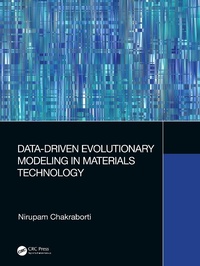
Data-Driven Evolutionary Modeling in Materials Technology
1st Edition
Published on 15. September 2022
318 pages
978-1-000-63582-9 (ISBN)
Description

Due to efficacy and optimization potential of genetic and evolutionary algorithms, they are used in learning and modeling especially with the advent of big data related problems. This book presents the algorithms and strategies specifically associated with pertinent issues in materials science domain. It discusses the procedures for evolutionary multi-objective optimization of objective functions created through these procedures and introduces available codes. Recent applications ranging from primary metal production to materials design are covered. It also describes hybrid modeling strategy, and other common modeling and simulation strategies like molecular dynamics, cellular automata etc.
Features:
Focuses on data-driven evolutionary modeling and optimization, including evolutionary deep learning.
Include details on both algorithms and their applications in materials science and technology.
Discusses hybrid data-driven modeling that couples evolutionary algorithms with generic computing strategies.
Thoroughly discusses applications of pertinent strategies in metallurgy and materials.
Provides overview of the major single and multi-objective evolutionary algorithms.
This book aims at Researchers, Professionals, and Graduate students in Materials Science, Data-Driven Engineering, Metallurgical Engineering, Computational Materials Science, Structural Materials, and Functional Materials.
Features:
Focuses on data-driven evolutionary modeling and optimization, including evolutionary deep learning.
Include details on both algorithms and their applications in materials science and technology.
Discusses hybrid data-driven modeling that couples evolutionary algorithms with generic computing strategies.
Thoroughly discusses applications of pertinent strategies in metallurgy and materials.
Provides overview of the major single and multi-objective evolutionary algorithms.
This book aims at Researchers, Professionals, and Graduate students in Materials Science, Data-Driven Engineering, Metallurgical Engineering, Computational Materials Science, Structural Materials, and Functional Materials.
More details
Edition
1. Auflage
Language
English
Place of publication
London
United Kingdom
Publishing group
Taylor & Francis Ltd
Target group
Professional and scholarly
Illustrations
58 Tables, black and white; 162 Line drawings, black and white; 1 Halftones, black and white; 163 Illustrations, black and white
ISBN-13
978-1-000-63582-9 (9781000635829)
Copyright in bibliographic data and cover images is held by Nielsen Book Services Limited or by the publishers or by their respective licensors: all rights reserved.
Schweitzer Classification
Other editions
Additional editions
Nirupam Chakraborti
Data-Driven Evolutionary Modeling in Materials Technology
Book
10/2024
1st Edition
CRC Press
€81.80
Shipment within 10-20 days
Nirupam Chakraborti
Data-Driven Evolutionary Modeling in Materials Technology
Book
09/2022
1st Edition
CRC Press
€240.50
Shipment within 10-20 days
Person
Professor Nirupam Chakraborti was educated in India and USA, receiving his B.Met.E from Jadavpur University, India, followed by an MS from New Mexico Tech, USA and PhD, PhD degrees from University of Washington, Seattle, USA. He joined Indian Institute of Technology, Kanpur as a member of the faculty in 1984 and switched to Indian Institute of Technology, Kharagpur in 2000.
Internationally known for his pioneering work on evolutionary computation in the area of Metallurgy and Materials, globally, Professor Chakraborti was rated among the top 2% highly cited researchers in the Materials area in 2000, as per Scopus records. A former Docent of Abo Akademi, Finland, former Visiting Professors of Florida International University and POSTECH, Korea, he also taught and conducted research at several other academic institutions in Austria, Brazil, Finland, Germany, Italy and the US. An international symposium, under the KomPlasTech 2019, which is world's longest running conference series in the area of computational materials technology, was organized in Poland in 2019 to honor him. In 2020, an issue of a prominent Taylor of Francis journal, Materials and Manufacturing Processes was dedicated to him as well. In 2021 Indian Institute of Technology, Kharagpur and Indian Institute of Metals, a professional body, also organized another international seminar in his honor.
This book is a culmination of Professor Chakarborti's decades of research and teaching efforts in this area.
Internationally known for his pioneering work on evolutionary computation in the area of Metallurgy and Materials, globally, Professor Chakraborti was rated among the top 2% highly cited researchers in the Materials area in 2000, as per Scopus records. A former Docent of Abo Akademi, Finland, former Visiting Professors of Florida International University and POSTECH, Korea, he also taught and conducted research at several other academic institutions in Austria, Brazil, Finland, Germany, Italy and the US. An international symposium, under the KomPlasTech 2019, which is world's longest running conference series in the area of computational materials technology, was organized in Poland in 2019 to honor him. In 2020, an issue of a prominent Taylor of Francis journal, Materials and Manufacturing Processes was dedicated to him as well. In 2021 Indian Institute of Technology, Kharagpur and Indian Institute of Metals, a professional body, also organized another international seminar in his honor.
This book is a culmination of Professor Chakarborti's decades of research and teaching efforts in this area.
Content
1. Introduction
2. Data with random noise and its modeling
3. Nature inspired non-calculus optimization
4. Single-objective evolutionary algorithms
5. Multi-objective evolutionary optimization
6. Evolutionary learning and optimization using Neural Net paradigm
7. Evolutionary learning and optimization using Genetic Programming paradigm
8. The challenge of big data and Evolutionary Deep Learning
9. Software available in public domain and the commercial software
10. Applications in Iron and Steel making
11. Applications in chemical and metallurgical unit processing
12. Applications in Materials Design
13. Applications in Atomistic Materials Design
14. Applications in Manufacturing
15. Miscellaneous Applications
2. Data with random noise and its modeling
3. Nature inspired non-calculus optimization
4. Single-objective evolutionary algorithms
5. Multi-objective evolutionary optimization
6. Evolutionary learning and optimization using Neural Net paradigm
7. Evolutionary learning and optimization using Genetic Programming paradigm
8. The challenge of big data and Evolutionary Deep Learning
9. Software available in public domain and the commercial software
10. Applications in Iron and Steel making
11. Applications in chemical and metallurgical unit processing
12. Applications in Materials Design
13. Applications in Atomistic Materials Design
14. Applications in Manufacturing
15. Miscellaneous Applications
