

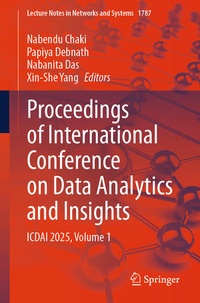
Proceedings of International Conference on Data Analytics and Insights
Description

This book is a collection of peer-reviewed best selected research papers presented at the International Conference on Data Analytics and Insights (ICDAI 2025), organized by Techno International, Kolkata, India, during August 28-30, 2025. The two volumes of the book cover important topics like sensor and network data analytics and insights; big data analytics and insights; biological and biomedical data analysis and insights; optimization techniques, time series analysis and forecasting; power and energy systems data analytics and insights; civil and environmental data analytics and insights; and industry and applications.
More details
Other editions
Additional editions
Persons
Nabendu Chaki is a senior member of IEEE and an associate professor in the Department of Computer Science & Engineering, University of Calcutta, India. Besides editing several volumes in LNCS, Springer, and other series, Nabendu has authored three textbooks with reputed publishers like Taylor and Francis (CRC Press), Pearson Education, etc. Dr. Chaki has published more than 100 refereed research papers in journals and international conferences. His areas of research interest include image processing, distributed systems, and network security. Dr. Chaki has also served as a research assistant professor in the Ph.D. program (Software Engineering) at US Naval Postgraduate School, Monterey, CA. He is a visiting faculty member for many universities including the University of Ca'Foscari, Venice, Italy. Dr. Chaki has contributed to SWEBOK v3 of the IEEE Computer Society as a knowledge area editor for Mathematical Foundations.
Papiya Debnath is a professor in the Department of Basic Science and Humanities (Mathematics), at Techno International New Town, Kolkata, India. She received her Master of Science in Applied Mathematics from the Indian Institute of Engineering Science and Technology, Shibpur, in 2006. She received M.Phil. degree in Applied Mathematics from the University of Calcutta, India, in 2009 and Ph.D. in Applied Mathematics from the University of Calcutta in 2019. She has 18 years of experience in teaching, research, and administration. She has published 49 papers in national, international journals, and conference proceedings, 7 book chapters, and served as the editor of 3 book, and 5 patents. She is guiding 2 Ph.D. students. She is a member of the IEEE EDS and IEEE Geoscience and Remote Sensing Society.
Nabanita Das is an associate professor in the Department of Computer Science & Engineering, Techno International New Town, Kolkata, with over 19 years of experience in the academic field. She received her Ph.D. from the University of Engineering and Management, Kolkata, India. Dr. Das has mentored numerous undergraduate students, helping them publish research papers in recognized international platforms. Her current research focuses on areas such as stock market prediction, sentiment analysis, and the application of machine learning and deep learning in practical scenarios. Dr. Das has published 28 research papers in various journals and conferences. She has published 5 patents.
Xin-She Yang obtained his DPhil in Applied Mathematics from the University of Oxford. He then worked at Cambridge University and then later at National Physical Laboratory (UK) as a Senior Research Scientist. Now he is Reader in Modelling and Optimization at Middlesex University London, and a co-Editor of the Springer Tracts in Nature-Inspired Computing. He is also an elected Fellow of the Institute of Mathematics and its Applications (FIMA, UK), Fellow of Asian Computational Intelligence Society and Fellow of Soft Computing Research Society. He was the IEEE Computational Intelligence Society (CIS) chair for the Task Force on Business Intelligence and Knowledge Management (2015 to 2020). He has edited more than 50 books and published more than 400 peer-reviewed research papers with more than 100400 citations, and he has been on the prestigious list of most influential researchers or highly-cited researchers (Web of Sciences) for ten consecutive years since 2016.
Content
A Comprehensive Review of Image Enhancement Techniques for Brain Tumor Detection in MRI Scans.- A Bibliometric Analysis of Supply Chain Optimization Research: Trends, Themes, and Future Directions.- Improving Public Transport Timeliness With Machine Learning And Smartphone Sensor Data.- A Review Of The Application And Challenges Of IoT In Zero Energy Building's Energy Management Systems.- Assessment of dyslexia in primary school children using technological tools: A focus on phonological awareness and the use of digital PECFO.- Design of a Knock Out Drum for the Stabilization of Condensate at Low Pressure in an Associated Gas Treatment Plant.- Psychomotor testing through technological tools.- Towards a Hybridized Business Intelligence Framework: A Sentiment Analysis and Topic Modeling Approach.- Improving Future Safety with Robotics in Disaster Management (DM) in Bangladesh.- Analyzing Climate Change and GHG Emissions in Bangladesh: A Statistical Approach to Environmental Sustainability.
