

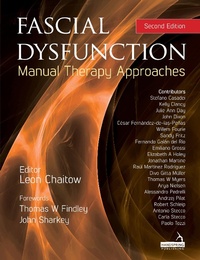
Fascial Dysfunction
Manual Therapy Approaches
2nd Edition
Published on 1. November 2018
416 pages
978-1-909141-95-7 (ISBN)
Description

Fascial dysfunction is now recognised as one of the main underlying causes of musculoskeletal pain leading to impaired and reduced mobility. These are the symptoms which confront all practitioners of manual therapy in their everyday practice. In this second edition of his very successful book, Leon Chaitow brings together contributions from 20 leading practitioners and researchers from many different fields of manual therapy. Fascial Dysfunction - Manual Therapy Approaches, Second Edition aims to help those practitioners to assess more precisely the dysfunction of their clients and its cause and to increase practitioner awareness of the various techniques which may help them in their attempts to alleviate their clients' problems.
New features of the Second edition include:
Descriptions of new research evidence and its implications for practice:
The dependence of collagen health on a mixture of balanced internal and external tension
The importance of adequate hydration
The possible role of the telocyte
The importance of 'dosage' of therapies in management of fascial dysfunction
New chapters on:
Gua Sha and cupping
Global postural re-education
Scar remodelling
The book is in two sections. Section I, written by Chaitow with a contribution by Tom Myers, presents a review of the current understanding of the function of fascia in the human body and describes what can go wrong - the causes and effects of fascial dysfunction and disease, and how to assess the problem and remove obstacles to the success of treatment.
Section II contains chapters by experts in different types of manual therapy including three by Chaitow. Each practitioner describes their own approach to the problem of assessing and treating fascial dysfunction and explains their specialist therapeutic approach. These approaches include: * Bowen Therapy * Connective Tissue Manipulation and Skin Rolling * Fascia oriented training applications in sports and movement therapy * The Fascial Manipulation (R) method applied to low back pain * Fascial Unwinding * Balanced Ligamentous Tension Technique * Gua sha (press-stroking) and Ba guan (cupping): traditional East Asian instrument- assisted manual therapies * Muscle Energy Techniques (MET) * Myofascial Induction Therapy (MIT (R)) * Neuromuscular Technique and associated Soft Tissue Manipulation Modalities * Positional Release Techniques - (including counterstrain) * Global Postural Re-education: Souchard Method * Rolfing (R) Structural Integration * Management of Scars and Adhesions * Manual Matrix Remodeling in myofascial injuries: scar modeling technique * Massage Therapy and Fascia * Trigger Point release methods including dry needling
New features of the Second edition include:
Descriptions of new research evidence and its implications for practice:
The dependence of collagen health on a mixture of balanced internal and external tension
The importance of adequate hydration
The possible role of the telocyte
The importance of 'dosage' of therapies in management of fascial dysfunction
New chapters on:
Gua Sha and cupping
Global postural re-education
Scar remodelling
The book is in two sections. Section I, written by Chaitow with a contribution by Tom Myers, presents a review of the current understanding of the function of fascia in the human body and describes what can go wrong - the causes and effects of fascial dysfunction and disease, and how to assess the problem and remove obstacles to the success of treatment.
Section II contains chapters by experts in different types of manual therapy including three by Chaitow. Each practitioner describes their own approach to the problem of assessing and treating fascial dysfunction and explains their specialist therapeutic approach. These approaches include: * Bowen Therapy * Connective Tissue Manipulation and Skin Rolling * Fascia oriented training applications in sports and movement therapy * The Fascial Manipulation (R) method applied to low back pain * Fascial Unwinding * Balanced Ligamentous Tension Technique * Gua sha (press-stroking) and Ba guan (cupping): traditional East Asian instrument- assisted manual therapies * Muscle Energy Techniques (MET) * Myofascial Induction Therapy (MIT (R)) * Neuromuscular Technique and associated Soft Tissue Manipulation Modalities * Positional Release Techniques - (including counterstrain) * Global Postural Re-education: Souchard Method * Rolfing (R) Structural Integration * Management of Scars and Adhesions * Manual Matrix Remodeling in myofascial injuries: scar modeling technique * Massage Therapy and Fascia * Trigger Point release methods including dry needling
More details
Edition
2nd edition
Language
English
Place of publication
London
United Kingdom
Publishing group
Jessica Kingsley Publishers
Target group
Professional and scholarly
File size
18,00 MB
ISBN-13
978-1-909141-95-7 (9781909141957)
Copyright in bibliographic data and cover images is held by Nielsen Book Services Limited or by the publishers or by their respective licensors: all rights reserved.
Schweitzer Classification
Other editions
Additional editions
Book
11/2018
Handspring Publishing Limited
€68.50
Shipment within 3-4 weeks
Person
Leon Chaitow is well-known internationally as the author of over 60 books on natural heath and complementary medicine. He has written authoritatively at many levels, from easy to understand guides for the general public on health issues and treatment approaches to detailed, well-referenced texts for health care students and practitioners and their clients. He studied osteopathy and naturopathy at the British College of Osteopathic Medicine. He subsequently studied acupuncture, cranial osteopathy and orthomolecular nutrition. Leon Chaitow was the first naturopath/osteopath to be appointed to a UK medical practice (Marylebone Health Centre, London).
Content
The functions of fascia: translating research into clinical relevance Leon Chaitow
Fascial dysfunction: adaptation as a major feature Leon Chaitow
Global postural assessment Thomas W. Myers
Additional global and local assessment approaches Leon Chaitow
Removing obstacles to recovery: therapeutic methods, mechanisms and fascia Leon Chaitow
Bowen therapy Kelly Clancy
Connective tissue manipulation and skin rolling Elizabeth A. Holey, John Dixon
Use it or lose it: recommendations for fascia-oriented training applications in sports and movement therapy Robert Schleip, Divo Gitta Mueller
The Fascial Manipulation (R) method applied to low back pain Antonio Stecco, Stefano Casadei, Alessandro Pedrelli, Julie Ann Day, Carla Stecco
Functional fascial treatment: fascial unwinding and balanced ligamentous tension technique Paolo Tozzi
Gua sha (press-stroking) and Ba guan (cupping): traditional East Asian instrument-assisted manual therapies Arya Nielsen
Muscle energy techniques Leon Chaitow
Myofascial induction therapy (MIT (R)) Andrzej Pilat
Neuromuscular technique (NMT) and associated soft tissue manipulation (neuromuscular) modalities Leon Chaitow
Positional release techniques (including counterstrain) Leon Chaitow
Rolfing (R) structural integration Jonathan Martine
Global postural re-education: Souchard method Emiliano Grossi
Management of scars and adhesions Willem Fourie
Manual matrix remodeling in myofascial injuries: scar modeling technique Raul Martinez Rodriguez, Fernando Galan del Rio
Massage therapy and fascia Sandy Fritz
Trigger point release methods including dry needling Cesar Fernandez-de-las-Penas
Fascial dysfunction: adaptation as a major feature Leon Chaitow
Global postural assessment Thomas W. Myers
Additional global and local assessment approaches Leon Chaitow
Removing obstacles to recovery: therapeutic methods, mechanisms and fascia Leon Chaitow
Bowen therapy Kelly Clancy
Connective tissue manipulation and skin rolling Elizabeth A. Holey, John Dixon
Use it or lose it: recommendations for fascia-oriented training applications in sports and movement therapy Robert Schleip, Divo Gitta Mueller
The Fascial Manipulation (R) method applied to low back pain Antonio Stecco, Stefano Casadei, Alessandro Pedrelli, Julie Ann Day, Carla Stecco
Functional fascial treatment: fascial unwinding and balanced ligamentous tension technique Paolo Tozzi
Gua sha (press-stroking) and Ba guan (cupping): traditional East Asian instrument-assisted manual therapies Arya Nielsen
Muscle energy techniques Leon Chaitow
Myofascial induction therapy (MIT (R)) Andrzej Pilat
Neuromuscular technique (NMT) and associated soft tissue manipulation (neuromuscular) modalities Leon Chaitow
Positional release techniques (including counterstrain) Leon Chaitow
Rolfing (R) structural integration Jonathan Martine
Global postural re-education: Souchard method Emiliano Grossi
Management of scars and adhesions Willem Fourie
Manual matrix remodeling in myofascial injuries: scar modeling technique Raul Martinez Rodriguez, Fernando Galan del Rio
Massage therapy and fascia Sandy Fritz
Trigger point release methods including dry needling Cesar Fernandez-de-las-Penas
