


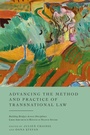
Advancing the Method and Practice of Transnational Law
Building Bridges Across Disciplines
1st Edition
Published on 21. September 2023
464 pages
978-1-5099-6451-2 (ISBN)
Description

This book adopts a transnational methodology to reflect on the legalisation of international economic relations. A Liber Amicorum for Professor Francis Snyder, it outlines the ways in which legal scholarship has taken his legacy further in relation to the concept of transnational law, the 'law in context' method, and the evolution of sustainability law. The lens is both theoretical and practical, delving into international investment law, financial/monetary law, free trade agreements, indigenous rights, and food law, and covering case studies from EU law, WTO law, American law, Chinese law, and Indonesian law.
The chapters explore how Snyder's ideas have advanced legal research and determined change in regulation, impacting trade relationships worldwide. Part I of the book gives an overview of the actors, the norms, and the processes of transnational economic law, discussing sites of governance, legal pluralism, and soft law. Part II takes stock of the 'law in context' research method, looking not only at the way in which it can be refined and used by academics, but also at the practical implications of such a method to improve regulatory settings and promote social and policy goals (including the emerging generation of FTAs, such as TPP, TTIP, and RCEP). Part III focuses on sustainability law, assessing Francis Snyder's contribution to systemic changes and reforms in China and the Asia Pacific region.
The book is a must have for any academic or practitioner interested in an up-to-date account of the recent developments in transnational trade law research.
The chapters explore how Snyder's ideas have advanced legal research and determined change in regulation, impacting trade relationships worldwide. Part I of the book gives an overview of the actors, the norms, and the processes of transnational economic law, discussing sites of governance, legal pluralism, and soft law. Part II takes stock of the 'law in context' research method, looking not only at the way in which it can be refined and used by academics, but also at the practical implications of such a method to improve regulatory settings and promote social and policy goals (including the emerging generation of FTAs, such as TPP, TTIP, and RCEP). Part III focuses on sustainability law, assessing Francis Snyder's contribution to systemic changes and reforms in China and the Asia Pacific region.
The book is a must have for any academic or practitioner interested in an up-to-date account of the recent developments in transnational trade law research.
More details
Edition
1. Auflage
Language
English
Place of publication
London
United Kingdom
Publishing group
Bloomsbury Publishing PLC
Target group
Professional and scholarly
College/higher education
ISBN-13
978-1-5099-6451-2 (9781509964512)
Copyright in bibliographic data and cover images is held by Nielsen Book Services Limited or by the publishers or by their respective licensors: all rights reserved.
Schweitzer Classification
Other editions
Additional editions
Julien Chaisse | Oana Stefan
Advancing the Method and Practice of Transnational Law
Building Bridges Across Disciplines
Book
03/2025
Hart Publishing
€65.80
Shipment within 15-20 days

Julien Chaisse | Oana Stefan
Advancing the Method and Practice of Transnational Law
Building Bridges Across Disciplines
Book
09/2023
Hart Publishing
€133.70
Shipment within 15-20 days
Persons
Julien Chaisse is Professor at the School of Law, City University of Hong Kong, Hong Kong.
Oana Stefan is Reader at the Dickson Poon School of Law, King's College London, UK.
Oana Stefan is Reader at the Dickson Poon School of Law, King's College London, UK.
Content
Foreword
Rostane MEHDI, Director of Sciences Po Aix
Introduction
Julien Chaisse (City University of Hong Kong, Hong Kong) and Oana Stefan (The Dickson Poon School of Law, UK)
Part 1 - Governance and The Law
1. The Dramatis Personae of International Law: Rethinking International Legal Personality
Paulo Canelas De Castro (University of Macau, China)
2. Sustainable Governance and Soft Law: The Bamboo and the Oak
Imelda Maher (University College Dublin, Ireland)
3. The Asian Infrastructure Investment Bank as a Site of Governance
Mark Feldman (Peking University, China)
4. Towards an Ethics Body for the European Union
Alberto Alemmano (HEC Paris, France)
5. The Transnationalisation of the Foreign Investment Contract: An Unrealised Myth
Muthucumaraswamy Sornarajah (National University of Singapore, Singapore)
Part 2 - Law In Context
6. The EU and Law in Context: The Context
Carol Harlow (London School of Economics, UK)
7. Still Out on the Weekend: Renewing EU Law in Context
Agustín José Menéndez (Universidad Complutense de Madrid, Spain)
8. A Genealogy of Constitutional Europe
Leone Niglia (Sapienza University of Rome, Italy)
9. The EU - China Comprehensive Agreement on Investment: A New Beginning?
Henry GAO (Singapore Management University, Singapore)
Part 3 - Sustainability Law
10. Land and the Legal Language of Decolonization
Keebet Von Benda-Beckmann (Max Planck Institute for Social Anthropology, Germany)
11. The Incorporation of the Principle of Sustainable Development in Chinese (Environmental) Law
Ying Song (Peking University Law School, China)
12. Trade and Labour Linkages in Free Trade Agreements: A Critical Assessment and Future Impact of the US-Guatemala Panel Report
Federico Ortino (King's College London, UK)
13. The Precautionary Principle and China's Regulation of GMOs: Retrospect and Prospect
Jin Zining (Peking University Law School, China)
14. China as the Next Global Data Regulator? Assessing China's Global Data Security Initiative as a Site of Governance
Qianlan Wu (University of Nottingham, UK)
Rostane MEHDI, Director of Sciences Po Aix
Introduction
Julien Chaisse (City University of Hong Kong, Hong Kong) and Oana Stefan (The Dickson Poon School of Law, UK)
Part 1 - Governance and The Law
1. The Dramatis Personae of International Law: Rethinking International Legal Personality
Paulo Canelas De Castro (University of Macau, China)
2. Sustainable Governance and Soft Law: The Bamboo and the Oak
Imelda Maher (University College Dublin, Ireland)
3. The Asian Infrastructure Investment Bank as a Site of Governance
Mark Feldman (Peking University, China)
4. Towards an Ethics Body for the European Union
Alberto Alemmano (HEC Paris, France)
5. The Transnationalisation of the Foreign Investment Contract: An Unrealised Myth
Muthucumaraswamy Sornarajah (National University of Singapore, Singapore)
Part 2 - Law In Context
6. The EU and Law in Context: The Context
Carol Harlow (London School of Economics, UK)
7. Still Out on the Weekend: Renewing EU Law in Context
Agustín José Menéndez (Universidad Complutense de Madrid, Spain)
8. A Genealogy of Constitutional Europe
Leone Niglia (Sapienza University of Rome, Italy)
9. The EU - China Comprehensive Agreement on Investment: A New Beginning?
Henry GAO (Singapore Management University, Singapore)
Part 3 - Sustainability Law
10. Land and the Legal Language of Decolonization
Keebet Von Benda-Beckmann (Max Planck Institute for Social Anthropology, Germany)
11. The Incorporation of the Principle of Sustainable Development in Chinese (Environmental) Law
Ying Song (Peking University Law School, China)
12. Trade and Labour Linkages in Free Trade Agreements: A Critical Assessment and Future Impact of the US-Guatemala Panel Report
Federico Ortino (King's College London, UK)
13. The Precautionary Principle and China's Regulation of GMOs: Retrospect and Prospect
Jin Zining (Peking University Law School, China)
14. China as the Next Global Data Regulator? Assessing China's Global Data Security Initiative as a Site of Governance
Qianlan Wu (University of Nottingham, UK)
