

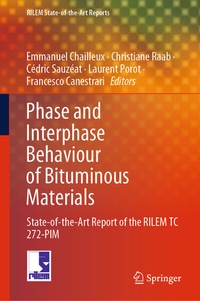
Phase and Interphase Behaviour of Bituminous Materials
Description

This book presents the work of the RILEM Technical Committee 272-PIM on Phase and Interphase behaviour of Bituminous Materials and showcases advances and innovations in the field of bituminous materials for flexible pavements.
The first section delves into complex and combined binders, unravelling intricate phenomena and shedding light on the unique challenges posed by these materials. Through meticulous cross-testing, the fundamental physical processes are better understood. The second section addresses the low-temperature performance of bituminous mixtures, exploring important behaviour regarding the longevity and resilience of bituminous pavements. The use of innovative methodologies, particularly the restrained shrinkage test exploited using a three-dimensional perspective, enriches the understanding regarding the mechanical behaviour at cold temperatures. The third section delves into dynamic interlayer shear testing, providing a comprehensive guide to evaluate the bonding behaviour of bituminous interlayers under cyclic loadings.
By considering the multiphase nature of road materials and structures, the book not only fills gaps in existing knowledge but also lays the foundation for the development of more durable materials. Its emphasis on a performance-driven and internationally validated approach makes it a reference tool for those contributing to the advancement of sustainable materials in the field of bituminous material engineering.
More details
Other editions
Additional editions
Persons
Emmanuel Chailleux has been at Gustave Eiffel University in the pavement department since 2004. His current instigations deal with bituminous binder performances, including rheological properties, viscoelastic modelling, ageing and cracking phenomena. He also conducts researches to develop and characterize alternative binder from biomass.
Christiane Raab is Senior Scientist at the EMPA Laboratory for Concrete and Asphalt in Duebendorf, Switzerland. Her research interests focus on interlayer bonding, accelerated pavement testing, asphalt reinforcement and low energy pavements. She serves as Associate Editor of the International Journal of Pavement Research and Technology.
Cédric Sauzéat is Professor at University of Lyon/ENTPE, affiliated with the Laboratory of Tribology and Dynamics Systems. His research primarily focuses on the behaviour of bituminous materials encompassing binders, mastics and mixtures, as well as the structural behaviour of pavements.
Francesco Canestrari is Professor of Roads, Railways and Airports at Marche Polytechnic University, Italy, where he holds Chairs of "Management and Maintenance of Road Pavements" and "Road Pavements and Materials". He is Expert of international standing in the field of road materials and pavements. He serves as Associate Editor of the Journal of Traffic and Transportation Engineering.
Content
Introduction and Summary.- Bituminous Binder.- Low temperature behaviour of bituminous mixtures: Thermal Stress Restrained Specimen Test.- Cyclic characterization of bituminous interlayers.
