

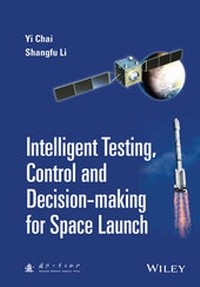
Intelligent Testing, Control and Decision-making for Space Launch
Description

Reviews / Votes
"A comprehensive exposition of the theory and techniques of fault identification and decision theory when applied to complex systems." (Zentralblatt MATH 2016)More details
Other editions
Additional editions
Persons
Yi Chai graduated from the Department of Electronic Technology, University of National Defense Science and Technology in 1982, and received his Ph.D. from Chongqing University, China in 2001, where he now lectures on Linear System Theory, Computer Communication Networks, Digital Signal Processing, Smart Computing and Intelligent Control, and Advanced Artificial Intelligence. Professor Chai has undertaken more than 40 research projects, including the National Natural Science Foundation of China, the "863" High-tech Research Projects of China, and technological projects for the Natural Science Foundation. He has published more than 80 academic papers and co-edited a published conference proceedings in 2011 on swarm intelligence.
Shangfu Li, Director, Xichang Satellite Launch Center, Sichuan, China.
Content
1
Overview of Testing and Control for Space Launch
Astronautical engineering is recognized as a scientific domain that exerted great impact on human society in the twentieth century. Human space activities have stimulated human imagination and innovation. Space launch is, without any doubt, a systematic engineering because of its difficulty, complexity, high reliability, and high risk. With further human exploration of space resource in the twenty-first century, space entry and research are supposed to be more economic, safe, and fast, which requires space launch to be featured by high reliability and accuracy.
This chapter is an overview of testing and control for space launch. The author intends to make a brief introduction of research subject, basic content, and related concepts. By introducing different development stages of spacecrafts and space launch vehicles, the author elaborates the features of testing and control system in different space development stages; focusing on intelligent data collection, processing, analysis, control and decision-making, the author discusses online detection, distributed processing, diagnosis, and decision-making control in the process of space launch. Readers are expected to have a general picture of technology and theories on testing and control for space launch.
1.1 Survey of Space Launch Engineering
Astronautical engineering refers to a comprehensive system involving exploration and exploitation of outer space and celestial bodies, centering on spacecraft and space launch vehicle design, manufacture, experiment, launch, operation, return, control, management, and utility. Sometimes astronautical engineering also means certain large-scale space activities, research tasks, or construction projects. Usually, theories and methods of systems engineering are adopted to guarantee the implementation and progress of astronautical engineering. One of the most fundamental and essential factors in astronautical engineering is testing, launching, and control for spacecrafts and space launch vehicles.
Also called space vehicle or aircraft, spacecraft can be generalized as all kinds of flying machines that orbit in the space according to celestial mechanics under the particular tasks of space exploration, exploitation, and celestial body research. The first spacecraft in the world is Sputnik 1 launched on October 4, 1957, in the Soviet Union.
Space launch vehicle, also known as space carrier rocket, is a general term for carriers that carry payloads from the ground to a specific location in the outer space or the other way around and from one spot to another in space. Space launch vehicles include disposable carrier rockets and partly-recycled and fully-recycled launch vehicles.
1.1.1 Overview of International Carrier Rockets and Spacecrafts
No power could enable objects to realize cosmic velocity until modern rocket technology emerged. Human beings were being fascinated by space travel in the early ancient time. Thanks to celestial mechanics, scientists were able to study the movement of celestial bodies in the perspective of dynamics and help space pioneers to overcome the gravity so as to lay a theoretical foundation to space travel. In the late nineteenth century and the early twentieth century, Konstantin Eduardovich Tsiolkovsky, a Russian and Soviet rocket scientist and pioneer of the astronautics, theoretically proved it possible to overcome gravity to go into space by using multistage rockets. He put forward three important concepts-the first cosmic velocity that is needed to orbit around the earth; the second cosmic velocity that is needed to break free from the gravitational attraction of the earth; and the third cosmic velocity that is needed to break free from the gravitational attraction of the solar system. He gave the main equations for the kinematic and kinetic equations of rocket. All of his efforts and contributions laid a solid foundation to astronautics and helped space travel come into reality.
After World War II, the United States and the former Soviet Union succeeded to develop medium-range and long-range surface-to-surface ballistic missiles. In August and December 1957, the two countries respectively achieved to launch an intercontinental missile. On October 4th of the same year, the former Soviet Union transformed such missile into a carrier rocket for Satellite 1, the first artificial Earth satellite in the world with which human beings opened a brand new chapter for space research. One month later, using this kind of carrier rocket again, the former Soviet Union launched Satellite 2 into space carrying a little dog named Laika. On January 3, 1958, the United States launched Explorer 1, the first artificial satellite carried by the carrier rocket Jupiter-C which had been designed and upgraded by Wernher Von Braun. In April 1961, the Soviet Union successfully launched Vostok 1, the world's first manned spacecraft using the Vostok carrier rocket. Yuri Gagarin, a Soviet pilot and cosmonaut, became the first human to journey into outer space. In July 1969, the United States launched Apollo 11 by the carrier rocket Saturn V. Neil Armstrong, one of the most famous American astronauts, became the first person to walk on the moon. After the former Soviet Union and the United states were France, Japan, China, the United Kingdom, Europe Space Agency, and India that achieved to launch their own first artificial satellite one after another using carrier rockets they developed by themselves.
With the development of space missions and the invention of new spacecrafts, carrier rocket technology has made a rapid progress. These carriers are called "high ladder" for human beings to get to outer space.
Through the developmental history, it was ballistic missiles that pushed carrier rockets to improvement because the removed missile warhead and some adaptive modification brought carrier rockets into reality.
1.1.2 Overview of Chinese Carrier Rockets and Spacecrafts
On October 8, 1956, China founded the first missile research institute whose president was Hsue-Shen Tsien, the renowned Chinese missile scientist who was assigned to be responsible for missile and space programs of China. From then on, China's missile and space technology started to boom in a rapid way.
1.1.2.1 Development of Missile
China's research and manufacture of missile started in the late 1950s. In June 1964, China achieved success in the launch test for the first ballistic missile, which played a significant part in missile and space research. Then China succeeded in the research and manufacture of medium-range surface-to-surface liquid-propellant missiles, intercontinental missiles, and submarine-launched solid-propellant missiles.
In addition, China made a tremendous progress in research and manufacture of surface-to-air missiles, air-to-air missiles, antiship missiles, and modern cruise missiles. At present, China has developed various types of short-range missiles, medium-range missiles, intercontinental missiles, strategic missiles, and tactical missiles.
1.1.2.2 Development of Carrier Rockets
Since the middle 1960s, China's development of carrier rockets was on the basis of missile programs. Trough arduous research and exploration, China developed Chang Zheng (CZ) series of basic and improved carrier rockets including CZ-1, CZ-2, CZ-3, and CZ-4. It is worth mentioning that the successful launch of CZ-3 marked China as the third country just after the United States and the former Soviet Union to master rocket thrusters of low temperature and high energy from liquid hydrogen and liquid oxygen and as the second country after the United States to master the engine second set-up technology. At present, China's Chang Zheng series of carrier rockets are able to launch various kinds of satellites into low earth orbit (LEO), sun-synchronous orbit, and geostationary transfer orbit (GTO). LEO carrying capacity ranges from 0.75 to 9.2?t and GTO carrying capacity from 1.5 to 5?t. Because of excellent technical inheritance, advancement, and low price, Chang Zheng series of carrier rockets have already found their place in the international space launch commercial market. By June 30, 2007, Chang Zheng series of carrier rockets had completed 100 launches, sending 112 domestic and foreign spacecrafts in orbit. Up to the end of December in 2011, 155 launches had been completed.
1.1.2.3 Development of Spacecrafts
On April 24, 1970, China successfully launched the first satellite DongFangHong-1 carried by CZ-1, becoming the world's third country to independently research, manufacture, and launch artificial satellites.
In November 1975, a recoverable satellite carried by CZ-2 was launched in success, making China the world's third country just after the United States and the Soviet Union to master satellite recovery technology. This exerted positive influence on starting manned space activities.
In April 1984, China launched DongFangHong-2, the first GTO experimental communication satellite carried by CZ-3. The satellite was positioned at 125° east longitude above the equator.
China's meteorological satellites are all named as Fengyun (FY). In September 1988, China...
