

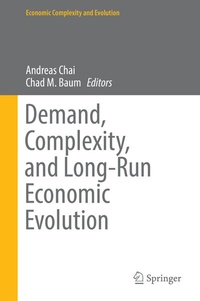
Demand, Complexity, and Long-Run Economic Evolution
Description

The purpose of this contributed volume is to consider how global consumption patterns will develop in the next few decades, and what the consequences of that development will be for the economy, policymakers, and society at large. In the long run, the extent to which economic growth translates into better living conditions strongly depends on how rising affluence and new technologies shape consumer preferences. The ongoing rise in household income in developing countries raises some important questions: Will consumption patterns always continue to expand in the same manner as we have witnessed in the previous two centuries? If not, how might things evolve differently? And what implications would such changes hold for not only our understanding of consumption behavior but also our pursuit of more sustainable societies?
More details
Other editions
Additional editions
Persons
Andreas Chai is an Associate Professor at Griffith University specialising in the study of consumption behaviour from an evolutionary economic perspective and its implications for economic development, measuring poverty, structural change in the economy and climate change adaptation. His work has been published in the Journal of Economic Perspectives, Cambridge Journal of Economics as well as the Journal of Evolutionary Economics.
Chad M. Baum is a Postdoctoral Researcher at the Institute for Food and Resource Economics at the University of Bonn. His main research interests center on the interdisciplinary intersection between consumption theory, evolutionary economics, and public understanding of technological innovation in the food sector. Motivated by the broad pursuit of a sustainable Bioeconomy, his work has appeared in the Journal of Bioeconomics and he has collaborated on a number of interdisciplinary projects exploring the development and acceptanceof emerging technologies.
Content
Introduction: Demand, Complexity, and Long-Run Economic Evolution.- Part I Re-thinking the Economic Possibilities of Our Grandchildren.- Work and Consumption in an Era of Unbalanced Technological Advance.- Institutions Hold Consumption on a Leash: An Evolutionary Economic Approach to the Future of Consumption.- The Mortgage Treadmill Versus Discretionary Spending and Enforced Leisure.- Ars Ultima Spes? Some Notes on the Unsustainability of Today's Capitalism and Culture as a Possible Remedy.- Part II New Perspectives on the Long-Run Evolution of Demand.- Tackling Keynes' Question: A Look Back on 15 years of Learning to Consume.- The Evolution of Consumption and Its Welfare Effects.- How Where I Shop Influences What I Buy: The Importance of the Retail Format in Sustainable Tomato Consumption.- Innovation, Structural Change and Multisectoral Economic Growth.
