

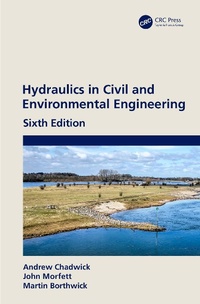
Hydraulics in Civil and Environmental Engineering
6th Edition
Published on 7. June 2021
652 pages
978-1-000-39555-6 (ISBN)
Description

This classic text, now in its sixth edition, combines a thorough coverage of the basic principles of civil engineering hydraulics with a wide-ranging treatment of practical, real-world applications. It now includes a powerful online resource with worked solutions for chapter problems and solution spreadsheets for more complex problems that may be used as templates for similar issues.
Hydraulics in Civil and Environmental Engineering is structured into two parts to deal with principles and more advanced topics. The first part focuses on fundamentals, such as hydrostatics, hydrodynamics, pipe and open channel flow, wave theory, physical modelling, hydrology and sediment transport. The second part illustrates engineering applications of these principles to pipeline system design, hydraulic structures, river and coastal engineering, including up-to-date environmental implications, as well as a chapter on computational modelling, illustrating the application of computational simulation techniques to modern design, in a variety of contexts.
New material and additional problems for solution have been added to the chapters on hydrostatics, pipe flow and dimensional analysis. The hydrology chapter has been revised to reflect updated UK flood estimation methods, data and software. The recommendations regarding the assessment of uncertainty, climate change predictions, impacts and adaptation measures have been updated, as has the guidance on the application of computational simulation techniques to river flood modelling.
Andrew Chadwick is an honorary professor of coastal engineering and the former associate director of the Marine Institute at the University of Plymouth, UK.
John Morfett was the head of hydraulics research and taught at the University of Brighton, UK.
Martin Borthwick is a consultant hydrologist, formerly a flood hydrology advisor at the UK's Environment Agency, and previously an associate professor at the University of Plymouth, UK.
Hydraulics in Civil and Environmental Engineering is structured into two parts to deal with principles and more advanced topics. The first part focuses on fundamentals, such as hydrostatics, hydrodynamics, pipe and open channel flow, wave theory, physical modelling, hydrology and sediment transport. The second part illustrates engineering applications of these principles to pipeline system design, hydraulic structures, river and coastal engineering, including up-to-date environmental implications, as well as a chapter on computational modelling, illustrating the application of computational simulation techniques to modern design, in a variety of contexts.
New material and additional problems for solution have been added to the chapters on hydrostatics, pipe flow and dimensional analysis. The hydrology chapter has been revised to reflect updated UK flood estimation methods, data and software. The recommendations regarding the assessment of uncertainty, climate change predictions, impacts and adaptation measures have been updated, as has the guidance on the application of computational simulation techniques to river flood modelling.
Andrew Chadwick is an honorary professor of coastal engineering and the former associate director of the Marine Institute at the University of Plymouth, UK.
John Morfett was the head of hydraulics research and taught at the University of Brighton, UK.
Martin Borthwick is a consultant hydrologist, formerly a flood hydrology advisor at the UK's Environment Agency, and previously an associate professor at the University of Plymouth, UK.
More details
Edition
6th edition
Language
English
Place of publication
London
United Kingdom
Publishing group
Taylor & Francis Ltd
Target group
College/higher education
Illustrations
27 Tables, black and white; 231 Line drawings, black and white; 7 Halftones, black and white; 238 Illustrations, black and white
ISBN-13
978-1-000-39555-6 (9781000395556)
Copyright in bibliographic data and cover images is held by Nielsen Book Services Limited or by the publishers or by their respective licensors: all rights reserved.
Schweitzer Classification
Other editions
Additional editions
Andrew Chadwick | John Morfett | Martin Borthwick
Hydraulics in Civil and Environmental Engineering
Book
06/2021
6th Edition
CRC Press
€152.00
Shipment within 15-20 days
Andrew Chadwick | John Morfett | Martin Borthwick
Hydraulics in Civil and Environmental Engineering
Book
06/2021
6th Edition
CRC Press
€293.10
Shipment within 15-20 days
Persons
Andrew Chadwick is Honorary Professor of Coastal Engineering at the University of Plymouth. From 2006 to 2009, he led the UK contribution to the European Network for Coastal Research. He subsequently worked in the Caribbean, establishing coastal management tools and investigating engineering adaptation options to climate change. He has a substantive publication record and has been a member of the editorial Panel for Maritime Engineering, the review board for the Journal of Hydraulic Research, and the EPSRC Peer Review College.
John Morfett was head of hydraulics research and taught at the University of Brighton, UK.
Martin Borthwick is a consultant flood hydrologist and Visiting Research Fellow at the University of Plymouth. He is a Chartered Civil Engineer with over 25 years' experience as a former lecturer and Associate Professor in hydrology, river engineering, and hydraulics at the University of Plymouth, following professional practice in flood risk management. From 2019 - 2020, he was an Advisor in the National Flood Hydrology Team at the Environment Agency, UK.
John Morfett was head of hydraulics research and taught at the University of Brighton, UK.
Martin Borthwick is a consultant flood hydrologist and Visiting Research Fellow at the University of Plymouth. He is a Chartered Civil Engineer with over 25 years' experience as a former lecturer and Associate Professor in hydrology, river engineering, and hydraulics at the University of Plymouth, following professional practice in flood risk management. From 2019 - 2020, he was an Advisor in the National Flood Hydrology Team at the Environment Agency, UK.
Content
Part 1 Principles and basic applications 1. Hydrostatics 2. Principles of fluid flow 3. Behaviour of real fluids 4. Flow in pipes and closed conduits 5. Open channel flow 6. Pressure surge in pipelines 7. Hydraulic machines 8. Wave theory 9. Sediment transport 10. Flood hydrology 11. Dimensional analysis and the theory of physical models Part 2 Aspects of hydraulic engineering 12. Pipeline systems 13. Hydraulic structures 14. Computational hydraulics 15. River and canal engineering 16. Coastal engineering
