

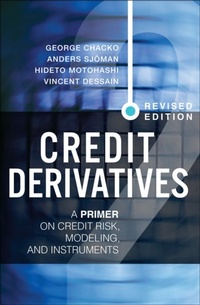
Credit Derivatives, Revised Edition
A Primer on Credit Risk, Modeling, and Instruments
2nd Edition
Published on 18. December 2015
304 pages
978-0-13-324919-4 (ISBN)
Description

Every company faces credit risk. Credit derivatives are among the most powerful tools available for managing it. Once restricted to the financial industry, they are now widely used by businesses of all kinds-and all financial professionals need to understand them. Credit Derivatives, Revised Edition, explains these tools simply, clearly, and rigorously: what they do, how they work, and how to use them in today's applications.
The authors first show how credit risk can be measured and valued. They explain key ideas, such as recovery rates and credit spreads, and show how derivatives transfer credit risk to external investors. Next, they systematically demonstrate how credit risk models can describe and predict credit risk events. They cover structural models, including Merton and Black and Cox; empirical models, such as the Z-score model; and reduced-form models, such as Jarrow-Turnbull. The authors also present detailed explanations of two widely used instruments: credit default swaps (CDSs) and collateralized debt obligations (CDOs).
Finally, building on what you've learned, the authors offer a brand-new primer on today's applications for financial instruments with embedded credit risk.
FINANCIAL STATEMENT ANALYSIS
Perform preliminary financial analysis on any potential project
UNDERSTAND, MEASURE, AND ASSESS CREDIT RISK
Master core concepts, from credit spreads to default probabilities
MASTER POWERFUL CREDIT RISK MODELING APPROACHES
Learn structural, empirical, and reduced-form credit risk modeling
GAIN DEEP INSIGHT INTO TODAY'S INSTRUMENTS AND APPLICATIONS
Understand CDSs, CDOs, and how credit-sensitive products are now used
FOR EVERY FINANCIAL PRACTITIONER: BUY-SIDE AND SELL-SIDE
For CFOs, treasurers, and other practitioners-everywhere from pension funds to commercial corporations
The authors first show how credit risk can be measured and valued. They explain key ideas, such as recovery rates and credit spreads, and show how derivatives transfer credit risk to external investors. Next, they systematically demonstrate how credit risk models can describe and predict credit risk events. They cover structural models, including Merton and Black and Cox; empirical models, such as the Z-score model; and reduced-form models, such as Jarrow-Turnbull. The authors also present detailed explanations of two widely used instruments: credit default swaps (CDSs) and collateralized debt obligations (CDOs).
Finally, building on what you've learned, the authors offer a brand-new primer on today's applications for financial instruments with embedded credit risk.
FINANCIAL STATEMENT ANALYSIS
Perform preliminary financial analysis on any potential project
UNDERSTAND, MEASURE, AND ASSESS CREDIT RISK
Master core concepts, from credit spreads to default probabilities
MASTER POWERFUL CREDIT RISK MODELING APPROACHES
Learn structural, empirical, and reduced-form credit risk modeling
GAIN DEEP INSIGHT INTO TODAY'S INSTRUMENTS AND APPLICATIONS
Understand CDSs, CDOs, and how credit-sensitive products are now used
FOR EVERY FINANCIAL PRACTITIONER: BUY-SIDE AND SELL-SIDE
For CFOs, treasurers, and other practitioners-everywhere from pension funds to commercial corporations
More details
Edition
2nd edition
Language
English
Place of publication
NJ
United States
Publishing group
Pearson Education (US)
Target group
College/higher education
ISBN-13
978-0-13-324919-4 (9780133249194)
Copyright in bibliographic data and cover images is held by Nielsen Book Services Limited or by the publishers or by their respective licensors: all rights reserved.
Schweitzer Classification
Other editions
Additional editions
George Chacko | Anders Sjoman | Hideto Motohashi
Credit Derivatives, Revised Edition
A Primer on Credit Risk, Modeling, and Instruments
Book
02/2016
2nd Edition
Pearson FT Press
€64.47
Shipment within 15-20 days
Persons
George C. Chacko is an Associate Professor and Chair of the Finance Department at Santa Clara University. Professor Chacko's research has focused on three areas: (1) transaction costs and liquidity risk in capital markets, particularly in the fixed income markets; (2) portfolio construction by institutions and individuals; and (3) the analysis and application of derivative securities. He was formerly an Associate Professor at Harvard Business School (HBS) in the Finance Department. On the commercial side, he is currently a Partner with HNC Advisors. He was formerly a Chief Investment Officer at Auda Alternative Investments, a Managing Director at IFL, and a Managing Director with State Street Bank. Professor Chacko holds a Ph.D. in business economics from Harvard University and dual master's degrees in business economics (Harvard University) and business administration (University of Chicago). He holds a bachelor's degree in electrical engineering from the Massachusetts Institute of Technology.
Anders Sjoeman is the Head of the Communications Department at the Centre for Business History in Stockholm, Sweden. He has also served as a Vice President of Communications at Voddler and a senior researcher for Harvard Business School at its Paris-based Europe Research Center. Prior, Mr. Sjoe man worked five years in Boston for Englishtown.com as Director of Production. A M.Sc. graduate of the Stockholm School of Economics in his native Sweden, and initially specialized in information management and international business, Mr. Sjoe man speaks Swedish, English, French, and Spanish.
Hideto Motohashi is a senior manager at NTT DoCoMo. He has held several positions at NTT during his career. He was manager in the Financial System Division at NTT COMWARE Corporation, where he helped financial institutions with their risk management systems. His experience at NTT COMWARE also includes systems analysis for the financial and telecommunications industries. He was also a Vice President of Strategic Finance and Financial Planning at Tata Teleservices. Mr. Motohashi completed the Advanced Study Program at Massachusetts Institute of Technology as a fellow. He holds a master's degree in international management from Thunderbird, the Garvin School of International Management, and a bachelor's degree in chemistry from Keio University, Japan.
Vincent Dessain was appointed executive director of the Europe Research Center for Harvard Business School, based in Paris, in November 2001. The center works with HBS faculty members on research and course development projects across the European continent. Prior, he was senior director of corporate relationships at INSEAD in Fontainebleau and on the school's board of directors. Mr. Dessain has been active as a management consultant with Booz-Allen & Hamilton in New York and Paris in the financial services field. His field of consulting was international market entry strategies, financial products, strategy, negotiation and implementation of cross-border alliances, financial restructuring, mergers, and acquisitions. He has also been active as a foreign associate with the law firm Shearman & Sterling in New York in banking and finance and as an advisor to the president of the College of Europe in Bruges, Belgium. A speaker of five European languages (French, English, German, Dutch, and Italian), Mr. Dessain holds a law degree from Leuven University (Belgium), a business administration degree from Louvain University (Belgium), and an MBA from Harvard Business School. Mr. Dessain is an avid mountain climber, marathon runner, and tennis player, and will not miss a good art exhibition.
Anders Sjoeman is the Head of the Communications Department at the Centre for Business History in Stockholm, Sweden. He has also served as a Vice President of Communications at Voddler and a senior researcher for Harvard Business School at its Paris-based Europe Research Center. Prior, Mr. Sjoe man worked five years in Boston for Englishtown.com as Director of Production. A M.Sc. graduate of the Stockholm School of Economics in his native Sweden, and initially specialized in information management and international business, Mr. Sjoe man speaks Swedish, English, French, and Spanish.
Hideto Motohashi is a senior manager at NTT DoCoMo. He has held several positions at NTT during his career. He was manager in the Financial System Division at NTT COMWARE Corporation, where he helped financial institutions with their risk management systems. His experience at NTT COMWARE also includes systems analysis for the financial and telecommunications industries. He was also a Vice President of Strategic Finance and Financial Planning at Tata Teleservices. Mr. Motohashi completed the Advanced Study Program at Massachusetts Institute of Technology as a fellow. He holds a master's degree in international management from Thunderbird, the Garvin School of International Management, and a bachelor's degree in chemistry from Keio University, Japan.
Vincent Dessain was appointed executive director of the Europe Research Center for Harvard Business School, based in Paris, in November 2001. The center works with HBS faculty members on research and course development projects across the European continent. Prior, he was senior director of corporate relationships at INSEAD in Fontainebleau and on the school's board of directors. Mr. Dessain has been active as a management consultant with Booz-Allen & Hamilton in New York and Paris in the financial services field. His field of consulting was international market entry strategies, financial products, strategy, negotiation and implementation of cross-border alliances, financial restructuring, mergers, and acquisitions. He has also been active as a foreign associate with the law firm Shearman & Sterling in New York in banking and finance and as an advisor to the president of the College of Europe in Bruges, Belgium. A speaker of five European languages (French, English, German, Dutch, and Italian), Mr. Dessain holds a law degree from Leuven University (Belgium), a business administration degree from Louvain University (Belgium), and an MBA from Harvard Business School. Mr. Dessain is an avid mountain climber, marathon runner, and tennis player, and will not miss a good art exhibition.
Content
Part I: What Is Credit Risk?
1 Introduction
2 About Credit Risk
Part II: Credit Risk Modeling
3 Modeling Credit Risk: Structural Approach
4 Modeling Credit Risk: Alternative Approaches
Part III: Typical Credit Derivatives
5 Credit Default Swaps
6 Collateralized Debt Obligations
7 Applications of Credit Derivatives and Financial Engineering
Index
1 Introduction
2 About Credit Risk
Part II: Credit Risk Modeling
3 Modeling Credit Risk: Structural Approach
4 Modeling Credit Risk: Alternative Approaches
Part III: Typical Credit Derivatives
5 Credit Default Swaps
6 Collateralized Debt Obligations
7 Applications of Credit Derivatives and Financial Engineering
Index
