

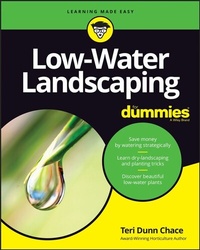
Low-Water Landscaping For Dummies
Description

Low-Water Landscaping For Dummies will teach you to preserve one of our most critical natural resources while simultaneously maximizing your curb appeal. Ditch wasteful, inefficient irrigation methods like sprinkler systems and learn how to embrace designs that save water. This book guides you through different styles of landscaping, introduces you to uniquely drought-tolerant plants, and provides solutions for even the trickiest terrains. You can break the cycle of constant watering, without sacrificing the relaxing atmosphere and aesthetic appeal of your outdoor space. Learn how it's possible to have vibrant, unique, gorgeous landscapes that incorporate grasses, perennials, shrubs, trees, groundcovers, and succulents without wasting hundreds of gallons of water each day. Packed with useful tips, achievable plans, and easy-to-understand instructions, Low-Water Landscaping For Dummies is the only resource eco-conscious gardeners need to design, plant, and enjoy the landscape of their dreams.
* Design a landscape that fits your space and budget
* Discover beautiful, drought-tolerant plants
* Get regional tips to ensure success
* Troubleshoot common gardening problems
If you want to protect the environment, save money on water bills, and learn more about drought-tolerant plants, this is the friendly Dummies guide for you.
More details
Other editions
Additional editions
Content
Part 1: Getting Started with Low-Water Landscaping 5
Chapter 1: Lacking Water? No Problem 7
Chapter 2: Conserving and Harvesting Water 21
Chapter 3: Waste Not, Want Not: Watering Strategically 41
Chapter 4: Making Soil Your Ally 61
Chapter 5: Watering with Irrigation Systems 83
Part 2: Making Smart Plant Choices 101
Chapter 6: Choosing Flowers 103
Chapter 7: Selecting Succulents 121
Chapter 8: In It for the Long Haul: Shrubs, Vines, and Trees 139
Chapter 9: Raising Edible Foods 157
Chapter 10: Planting and Caring for Low-Water Plants 175
Part 3: Leaving Your Lawn Behind 203
Chapter 11: Taking Out a Lawn 205
Chapter 12: Replacing Grass with Low-Water Solutions 221
Chapter 13: Considering Artificial Turf 241
Chapter 14: Pondering Rock Gardening 249
Part 4: Landscaping with Watering Needs in Mind 263
Chapter 15: Appreciating Mulch and Other Helpful Products 265
Chapter 16: Keeping Water in Your Yard 283
Chapter 17: Succeeding with Potted Plants 297
Chapter 18: Including Water Features in Your Landscape 307
Chapter 19: Updating Xeriscaping for Today's Low-Water Landscapes 317
Part 5: The Parts of Tens 325
Chapter 20: Ten Ways to Avoid Wasting Landscape Water 327
Chapter 21: Ten Great-Looking, Low-Water Plants 333
Index 341
Chapter 1
Lacking Water? No Problem
IN THIS CHAPTER
Coming to terms with low-water realities
Landscaping to conserve precious water
Letting go of the traditional lawn
Discovering suitable plants and savvy landscaping ideas
This book is all about landscaping with less water. No matter whether you're trying to sustain an established yard in a desertlike climate or you're wishing to make changes while adjusting to a limited or unpredictable water supply, the message is the same: You can do it!
Having a beautiful landscape isn't just nice, it's also important. The plants in and around the area are more than décor, they're alive - even in times when water is scarce. We humans are bound in a relationship with them, not just for the pleasurable beauty or fragrance they may provide as we come and go from our home or hang out in the yard, and not just for the other creatures they help sustain (from pollinators to birds). We're also elementally bound together by the shared, interdependent, natural cycles of air - the exchange of carbon dioxide and oxygen - and water, the stuff of life as we know it.
When water is rationed or in short supply, when rain is a rare event, when we constantly hear dire stories about falling reservoirs and depleted aquifers, we worry. We should worry. Water is precious and vulnerable to human demands as well as forces that feel beyond our control, like weather patterns and macro-climate change.
And yet, having an attractive yard isn't a foolish wish, nor is it a luxury. Your yard is part of your home and part of the big picture of the larger landscape.
Rather than giving up, adapt. Become a good steward. This chapter gives you a brief overview of what you can do. Find out how to conserve water, how to better deliver it to wisely chosen plants, and how to keep it all healthy and beautiful.
Defining Low-Water Landscaping
Low-water landscaping is using less water, more efficiently.
Sustaining home landscaping on less water isn't mysterious. Many excellent techniques and ideas come from farming and agriculture. And of course research is continuing.
Certain water-conserving ideas from agriculture translate well to smaller and more intimate settings, whether you only have a courtyard or balcony, or you're trying to maintain a half-acre or more around your home. Also other gardeners have developed clever, effective ways to successfully nurture many plants with less water.
This book is here to help. I explore low-tech watering aids and ideas in Chapter 3 and delve into various irrigation systems you may wish to consider in Chapter 5.
You don't need to reinvent the wheel, so to speak. Plenty of trial and error and research, worldwide and over many centuries, has yielded innovative and practical ways to install and care for plants.
Here I begin by taking a closer look at where you can reduce water use and how. Not every suggestion will apply - but many will! Conserving is a matter of examining every opportunity.
Seeing where it makes sense to implement
There are many places and times where saving water can (and should) be possible. These include the following:
- Where getting water to your yard and plants is difficult or complex
- Where the water supply is expensive/where water bills just keep going up and up
- Where the water source is uncertain: unreliable, depleted, or drying up
- Where rainfall is unpredictable, sparse, or briefly seasonal
- Where water rationing is mandated and enforced
- Where the landscaping you do have is suffering from lack of water
- When you don't have time, funds, or the energy to fuss over your yard
- When you're ready for a change to more responsible and creative landscaping
Understanding why being water-wise is important
Global climate-change weather models suggest that severe droughts may not be occasional anomalies to endure but become the norm - sobering news. Therefore confronting the situation and being proactive about your water use is imperative.
Should things improve or monsoon rains be generous, well, the good habits and practices you develop ought to stay in place anyway. Wasting water is a careless habit; conserving water shows respect for life itself, starting with the plants and creatures inhabiting your yard and also respect for your neighbors and neighborhood, your municipality, and your bioregion.
Leveraging your water sources
Part of water-wise gardening is gathering all the water you can and sometimes storing it to use with care later - in other words, maximizing your supply. You may be surprised by some of these useful ideas (check out Chapter 2 for starters):
- Start monitoring how much water your garden needs and uses.
- Install one or more rain barrels.
- Collect and store water in a cistern or tank.
- Use gray water. Gray water isn't all of your household water, but rather the sources of relatively clean consumption, such as sinks, showers, bathtubs, and even the washing machine (not the toilet or utility sink). Some municipalities regulate the use of gray water and, of course, you don't want to use certain soaps or cleaning agents, which would make the re-used water unsafe or unsuitable for your plants or soil.
- Route or reroute drainage from your roof. Study and route or reroute drainage out in your yard (see Chapter 16).
- Put in a rain garden, a garden area set up in a low area where rain pools or where you can divert your rain gutters (details in Chapter 16).
- Find out whether your municipality has reclaimed water, which is water that has been treated but isn't meant for drinking/not potable. They may be using it to irrigate city parks and other public places, but it may also be possible to access it for your personal landscape.
Eliminating wasteful watering practices
A series of seemingly minor changes in your watering habits can help. Here are a few suggestions:
- Prevent runoff. Don't overwater, don't water too long, and help water soak in so plants can use it. It begins with good soil, actually; read and heed Chapters 4 and 16.
- Create watering basins around individual plants. Chapter 3 explains how to make one, with a helpful illustration.
- Create water-need zones by grouping plants with similar needs together so you can water them together. More in Chapters 3 and 10.
- Water when chance of evaporation is lowest. A full explanation and discussion - including myth-busting - is in Chapter 3.
-
Hold water in the ground around your plants by mulching. It's cheap, it's easy, and it's tremendously effective. Consult Chapter 15.
Just to get on the Mulch Soapbox for a moment: Anyone can mulch their plants and everyone, especially those needing to conserve water, should! Mulch has profound benefits. Mulch prevents evaporation, which is huge because most plant roots are fairly close to the soil surface. Mulched plants need water less frequently and stay fresh-looking longer after a watering. Mulch also helps keep weeds at bay, and weeds are notorious for stealing water and nutrients from your desired plants.
- Choose watering gear wisely. Replace old-model sprinklers and sprinkler systems with some amazingly efficient new technology. A wide range of items and networks deliver water directly to the roots of your plants (and not to the sidewalk and gutter!). Review your options in Chapters 3 and 5.
Like to grow and display plants in containers, but you've definitely noticed that they're more water-intensive than plants in the ground? Good news: You can get the needed water to potted plants without waste or worry. Among the options are clever self-watering pots and water-holding crystals added to potting soil. See Chapters 15 and 17 for more details.
Replacing Impractical Plants with Practical Ones
If you're honest with yourself, you already know that your yard - including but not limited to your lawn - has some plants that aren't doing so well these days. Not enough water is obviously their problem. They're getting to be too much trouble and expense to maintain.
To be blunt, the solution is obvious. Out with the old, in with the new! I want to reassure you that not only can you make changes, but you can also embrace changes by making smart and creative choices that will look great. Keep reading for some general suggestions.
Getting rid of your lawn
Taking out your grass feels like the end of an era . because it's the end of an era. Green lawns suck up a lot of resources, mainly water but also fertilizer and perhaps weedkillers (all of which can be harmful to wildlife, your environs, and groundwater) - not to mention all your own effort and sweat in mowing and clipping. And what's the point if water is limited and no matter how hard you try, it doesn't look as lush as you want?
Completely removing your lawn isn't as hard as you might think. Lawn grass isn't deep-rooted, and you can dig it up and peel it away like...
