

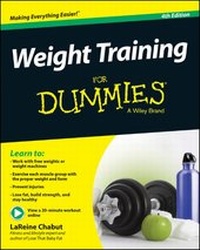
Weight Training For Dummies
Description

More details
Other editions
Additional editions
Person
Content
Part I: Getting Started with Weight Training 5
Chapter 1: Weight Training for Life 7
Chapter 2: The Principles of Training: Concepts and Terminology 13
Chapter 3: Testing Your Strength, Setting Goals, and Tracking Your Progress 27
Chapter 4: Weight-Training Tools and Equipment 39
Chapter 5: Safety First: Protecting Yourself and Preventing Injury 55
Part II: Gaining Weight-Training Wisdom 69
Chapter 6: Set ting Up Your Own Gym at Home 71
Chapter 7: Exercising Away from Home: Clubs, Trainers, and Classes 81
Chapter 8: Your Muscles and How to Use Them Properly 97
Part III: Tackling the Exercises 105
Chapter 9: Working Your Back 107
Chapter 10: Working Your Chest 129
Chapter 11: Working Your Shoulders 145
Chapter 12: Working Your Arms 161
Chapter 13: Working Your Abdominals 175
Chapter 14: Working Your Butt and Legs 187
Chapter 15: Weights for Core Strength 209
Chapter 16: Stretching: The Truth 223
Part IV: Setting Up Your Workout Programs 239
Chapter 17: Basic Workouts to Get Started 241
Chapter 18: 20-Minute Workouts for the Time Challenged 251
Chapter 19: Tackling More-Advanced Programs 261
Chapter 20: Workouts for the Family: New Moms, Moms-to-Be, Kids, and Teens 275
Chapter 21: Workouts for Baby Boomers and Beyond 297
Chapter 22: Adding Yoga and Pilates for Flexibility 309
Part V: The Part of Tens 321
Chapter 23: Ten (Or So) Ways to Use Exercise Bands to Tone and Tighten 323
Chapter 24: Ten (Or So) Ways to Have a Ball with Exercise Balls 335
Index 351
Introduction
When the first edition of Weight Training For Dummies was published, lifting weights was on the verge of becoming a mainstream phenomenon. Women, Baby Boomers, teens - all these groups were starting to get the message: Using weights benefits everyone, not just bodybuilders, and helps you stay fit and healthy for life. Fast-forward almost a decade, and weight training has become more popular than ever. Any health club you may join offers personal training (compared to 66 percent in 1996). In the same period, health club memberships have more than doubled for people over age 55. With people living longer, it's more important than ever to incorporate weight training into daily workouts.
However, just because weight training has become more popular doesn't mean it has become any less intimidating for novices. It's only natural for a beginner to be baffled by the equipment and the lingo. You may look at a barbell and not know the difference between it and a dumbbell (and you may feel like the latter). You may wonder how you're going to lift any weight while remaining on good terms with your lower-back muscles. You may stare at a weight machine and wonder how you're ever going to learn how to use it. You may wonder what it means when a trainer says, "Do three sets of eight reps on the lat pull-down and then super set with the seated row."
Good thing you bought this book, because here we give you the knowledge and confidence to start a weight-training program, either at home or at the gym. We describe exercises suitable for rookies and veterans alike. This new edition has been updated with information on training over a lifetime. We include training tips for kids, teens, prenatal and postpartum moms, and older adults. And we demystify the latest trends in fitness, core training, yoga, and Pilates. This edition is packed with workouts for every circumstance; whether you're on vacation or you only have 20 minutes to spare, you can fit a weight-training workout into your day.
In Weight Training For Dummies, we tell you about safe weight-lifting techniques, steer you toward equipment bargains, entertain you with stories about fellow lifters, and inspire you to keep pumping iron when you'd rather spend your Sunday watching sports. In fact, we take care of just about everything except lifting the weights. We save that job for you.
About This Book
Everyone has different reasons for wanting to lift weights. Undoubtedly, many of these reasons have to do with looking better. Sculpted arms and toned abs have become somewhat of a fashion statement among certain age groups. But we can think of more compelling and, ultimately, more satisfying reasons to lift weights. Here's a reminder of how much weight training can benefit you:
- Keeping your bones healthy: The average woman loses about 1 percent of her bone mass each year after age 35. Men are susceptible to brittle bones, too. Lifting weights can drastically slow the rate of bone loss and may even reverse the process. With strong bones, you won't become hunched over as you age, and you'll lower your risk of life-threatening fractures. No matter your age, it's never too late to start strengthening your bones.
- Helping control your weight: When you lose weight through dieting alone or together with some aerobic exercise (such as walking or cycling), you lose muscle along with fat. This can be a problem - when you lose muscle, your metabolism slows down, so you're more likely to regain the weight. By adding weight training to the mix, you can maintain (or increase) your muscle and thereby maintain (or even boost) your metabolism. Although weight training is no magic bullet for weight loss, many obesity experts consider it to be an essential part of any weight-control program.
- Increasing your strength: Lifting more than 10 to 20 pounds may not be among your goals in life, but a certain amount of muscle strength does come in handy. Weight training makes it easier to haul bottles and cans to the recycling bin and carry and put away your groceries. It can also keep you out of a nursing home in your older age and help you maintain your balance and independence. Studies show that even 90-year-olds can gain significant strength from lifting weights and regain the ability to walk and dress themselves.
- Boosting your energy: Forget about hokey dietary supplements. One of the best energy boosters around comes not in a bottle but on a weight rack. When you lift weights, you have more pep in your step. You can bound to the bus stop, sail through your company's annual charity walk-a-thon, and make it to the end of the day without feeling exhausted.
- Improving your heart health: For years, doctors have known that aerobic exercise and cardio workouts such as walking, jogging, and cycling can lower your risk of heart disease and high blood pressure. But new research suggests that weight training may offer these benefits as well. Specifically, studies show that lifting weights can lower your risk of having a heart attack or stroke by lowering your LDL ("bad") cholesterol and reducing blood pressure.
- Improving your quality of life: Any activity that accomplishes all the above makes you a happier, more productive, and more confident person. (Research suggests that weight training can even relieve clinical depression.) Of course, lifting weights is no instant cure-all, but you'd be surprised how much satisfaction a pair of 10-pound dumbbells can bring into your life, which also benefits the lives of everyone else around you.
In this book, we give you the information you need to reap all these rewards.
No matter what your level of knowledge about weight training, you can always use this book as a reference. Flip to the index or table of contents and look up the specific topic you're interested in today.
Foolish Assumptions
Each of us owns a body, but we don't necessarily understand how best to train it. To write this book and make it truly friendly to anyone new to weight training, we assume that you're completely unfamiliar with weight training. Because of this, some of the information presented may be review for people with more experience.
We also assume that you've been exposed to a number of popular myths about weight training - the "urban legends" of the weight room. We do our best to correct these myths and explain why they aren't true.
Icons Used in This Book
Icons are the small images in the margins of this book. They're designed to draw your attention to specific topics, and they serve as guides to the kind of information being provided.
The Myth Buster icon rescues you from misleading notions, fighting for truth, justice, and a good weight-training workout. For example, this icon may point out that high-protein diets are not the key to weight loss and that abdominal training will not eliminate your love handles.
This icon reminds you about good technique so that you don't injure yourself. It points out when to keep your shoulders relaxed, your abdominal muscles tight, and your knees bent.
The Remember icon reminds you of key pieces of advice that you should keep in mind even after you've put down this book.
When you see the Tip icon, you know that we're pointing out an especially helpful weight-training hint or giving you a heads-up on an effective strategy.
The Warning icon cautions you of potential dangers to beware of while weight training, including the hucksters lurking at the depths of the fitness industry, hawking useless gadgets like electronic muscle stimulators. We also use this icon to signal mistakes that can cause injury, such as bending your knees too far or lifting too much weight.
Beyond the Book
Check out the new weight training video online at www.dummies.com/extras/weighttraining to try a 20-minute workout from Chapter 17.
You can find a free Cheat Sheet at www.dummies.com/cheatsheet/weighttraining for resources not found in this book. There, we tell you about some extra weight-training equipment you may want to invest in, how to be a good personal-training client, how to talk the weight-training talk, and more.
In addition, www.dummies.com/extras/weighttraining contains related articles such as myths about abdominal exercises and common weight-training mistakes to avoid.
Where to Go from Here
If you're a novice, we suggest you start by reading Parts I and II. These parts get you comfortable with the equipment, the lingo, the safety basics, and the etiquette. Then skip to Part IV, which explains how to design a weight routine that meets your needs. (You may want to refer back to this part every now and then.) Then go back to Part III, which shows you the exercises. In your spare time, like when you're not busy lifting weights, hit Part V.
If you already know free weights are different from dumbbells and barbells, and know that in the weight-training world, a circuit has nothing to do with electrical currents, you can go straight to Part III and find numerous exercises for each body part. You may also want to focus on Part IV, which describes how to combine these exercises into a variety of routines that...
