

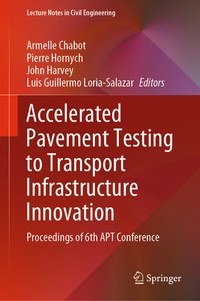
Accelerated Pavement Testing to Transport Infrastructure Innovation
Description

This volume gathers the latest advances, innovations, and applications in the field of accelerated pavement testing (APT), presented at the 6th International Conference on Accelerated Pavement Testing, in Nantes, France, in April 2022. Discussing APT, which involves rapid testing of full-scale pavement constructions for structural deterioration, the book covers topics such as APT facilities, APT of asphalt concrete and sustainable/innovative materials, APT for airfield pavements, testing of maintenance and rehabilitation solutions, testing of smart and multi-functional pavements, data analysis and modeling, monitoring and non-destructive testing, and efficient means of calibrating/developing pavement design methods. Featuring peer-reviewed contributions by leading international researchers and engineers, the book is a timely and highly relevant resource for materials scientists and engineers interested in determining the performance of pavement structures during their service life (10+ years) in a few weeks or months.
More details
Other editions
Additional editions
Content
- Intro
- Preface
- Organization
- International Scientific Committee
- Conference Committee of the 6th International APT Conference
- Chairman
- Co-chairs
- Local Organizing Committee of the 6th International APT Conference
- President
- Members
- Contents
- Establishing APT Facilities
- Promoting Implementation of Significant Findings from the NCAT Pavement Test Track
- Abstract
- 1 Background
- 2 Methodology
- 3 Significant Findings
- 3.1 Highest Readiness Level
- 3.1.1 Recalibrated Layer Coefficient for Modern Materials/Methods
- 3.1.2 Maximum Thickness for Perpetual Pavement
- 3.1.3 Strategic Use of Polymer Modification for Lower Life Cycle Cost
- 3.1.4 Arizona Rubber Mix for Durable and Crack Resistant Pavements
- 3.2 Medium Readiness Level
- 3.2.1 Balanced Mix Design (BMD) Testing for Construction and Design
- 3.2.2 Implementation of Pavement Preservation Benefit Curves
- 3.2.3 Use of Smaller/Finer "Screenings" Mixes for Pavement Preservation
- 3.2.4 Better Design and Construction of OGFC Drainable Surface Mixes
- 3.2.5 Expanded Use of Locally Available Virgin and Recycled Aggregates
- 3.3 Lower Readiness Level
- 3.3.1 100% Utilization of All RAP Generated
- 3.3.2 Asphalt Based Enhanced Friction Surfaces
- 3.3.3 Quality Tack Practices, Products, and Equipment
- 3.3.4 Producing 100% RAP Recycle Mix from a Cold Hot-Mix Plant
- 3.3.5 Using Small NMAS "Screenings" Mix for Crack Relief Under OGFC
- 4 Industry Feedback
- 5 Implementation Workshops
- 5.1 AM Commitment by Decision Makers with Technical Experts
- 5.2 PM Roadmap and Timeline with Technical Experts
- 6 Summary and Takeaways
- Acknowledgements
- References
- The Design, Construction and Operation of the APT Facility at the University of Texas at Arlington
- Abstract
- 1 Introduction
- 2 Test Site
- 3 Pavement Testing Equipment
- 4 Instrumentation
- 5 Summary
- References
- Research Progress of RIOHTRACK in China
- Abstract
- 1 Introduction
- 1.1 Design Scheme of Testing Road
- 1.2 Loading
- 1.3 Performance Detection
- 2 Performance and Research Findings
- 2.1 Carrying Capacity of Structures
- 2.2 Rutting
- 2.3 Crack
- 2.4 Performance of Skid Resistance
- 2.5 International Roughness Index (IRI)
- 3 Conclusions
- Acknowledgement
- References
- Two Years of APT Program on the New Test Site duraBASt
- Abstract
- 1 Introduction
- 2 Demonstration, Investigation and Reference Areal of BASt
- 3 Accelerated Pavement Testing
- 3.1 HEALROAD
- 3.2 SEDa
- 3.3 Relaxed Hybrid
- 4 Conclusion
- References
- Guidance for the Next Generation Accelerated Pavement Testing Facilities
- Abstract
- 1 Introduction and Background
- 2 Objective and Scope
- 3 Individual Acting Test Track Limitations
- 4 Types of Customer Needs
- 4.1 Government Transportation Agency Research
- 4.2 Private Industry Research
- 4.3 Academic Research
- 5 MnROAD and NCAT Partnership
- 6 MnROAD's Individual Partnerships
- 7 NCAT's Individual Partnerships
- 8 Future Needs and Support
- 9 Summary and Conclusions
- References
- APT of Asphalt Concrete
- Laboratory Investigation of Cracked Asphalt Pavement Structure Using Accelerated Loading System
- Abstract
- 1 Introduction
- 2 Experiment Description
- 2.1 ATLAS
- 2.2 Methodology
- 2.2.1 Pavement Structure and Material Properties
- 2.2.2 Thermomechanical Properties and Fatigue Pavement Design
- 2.2.3 Sensors
- 2.2.4 Experimental Protocol
- 3 Preliminary Results
- 3.1 TML Response Before the Creation of the Idealized Transverse Crack
- 3.2 Tensile Strain at the Base of the HMA Layer After the Creation of the Idealized Transverse Crack
- 3.3 Influence of the Temperature of the HMA Layer on the Tensile Strain
- 4 Conclusion
- References
- Analysis of Dynamic Response for Semi-rigid Base Asphalt Pavement Using Accelerated Pavement Test
- Abstract
- 1 Introduction
- 2 Test Section and Instrumentation
- 3 MLS66 Setup and Strain Analysis Method
- 4 Results and Analysis
- 4.1 Vertical Strain
- 4.2 Longitudinal Strain
- 5 Conclusion
- Acknowledgement
- References
- Performance of Unbound Pavement Materials in Changing Moisture Conditions
- Abstract
- 1 Introduction
- 2 Materials and Methods
- 2.1 Pavement Structure
- 2.2 Accelerated Pavement Test
- 2.3 Groundwater Table
- 3 Results
- 3.1 Water Content
- 3.2 FWD Back-Calculation
- 3.3 Stress
- 3.4 Strain
- 3.5 Rut Development
- 4 Conclusions
- Acknowledgements
- References
- Performance Evaluation of Asphalt Pavement with Semi-rigid Base and Fine-sand Subgrade by Indoor Large-Scale Accelerated Pavement Testing
- Abstract
- 1 Introduction
- 2 Materials and Methods
- 2.1 Pavement Structure
- 2.2 Loading Test Parameters
- 3 Asphalt Pavement Results Analysis
- 3.1 Rutting Deformation Analysis
- 3.1.1 Rutting Deformation
- 3.1.2 Rutting Deformation Rate
- 3.1.3 Upheaval Coefficient
- 3.2 Seismic Modulus Analysis
- 3.3 Excavation and Core Samples Analysis
- 4 Fine-sand Subgrade Analysis
- 4.1 Dynamic Stress Response
- 4.2 Permanent Deformation
- 5 Conclusions and Discussions
- References
- Accelerated Fatigue Damage Profile of Asphalt Concrete Placed on Semi-rigid Layer
- Abstract
- 1 Introduction
- 2 Experimental Method
- 2.1 Full-Scaled Accelerated Pavement Test
- 2.2 Portable Seismic Pavement Analyzer (PSPA) Test
- 3 Results and Discussion
- 3.1 Development of Cumulative Fatigue Damage
- 3.2 Developed Model for Modulus Ratios
- 4 Conclusions
- Acknowledgements
- References
- Optimization of Truck Platoon Wander Patterns Based on Thermo-Viscoelastic Simulations to Mitigate the Damage Effects on Road Structures
- Abstract
- 1 Introduction
- 2 Numerical Simulations
- 2.1 Overview of ViscoRoute© 2.0
- 2.2 Road Structure
- 2.3 Loading Configuration
- 2.4 Strain Field Results
- 3 Damage Effect Calculation
- 4 Conclusion
- Acknowledgements
- References
- Impact of Mix Design Optimization on HMA Rutting Performance Under Accelerated Pavement Testing
- Abstract
- 1 Introduction
- 2 Objective
- 3 Equipment
- 4 Method
- 5 Materials Laboratory Characterization
- 6 Instrumentation Response
- 7 Rutting Performance
- 8 Conclusions
- References
- Characterisation of Laboratory and Field Foamed Bitumen Stabilised Beams from Accelerated Pavement Testing Trial
- Abstract
- 1 Introduction
- 2 Material Characterisation of Both Field and Laboratory FBS Samples
- 2.1 Host Aggregate
- 2.2 Bituminous Binder and Foaming Agent
- 2.3 Mix Design of FBS Material Characteristics
- 3 Experimental Results
- 3.1 Temperature and Frequency Sensitivity Evaluation Using Dynamic Modulus Master Curves
- 3.2 Visual and Digital Microscopic Analysis of Laboratory Manufactured Beams and Field Extracted Beams
- 3.3 Comparison of X-Ray CT Images of Laboratory and Field Manufactured Beams
- 3.3.1 Laboratory Manufactured FBS Beams
- 3.3.2 Field Extracted FBS Beams
- 4 Conclusions
- References
- Effect of the Incremental Loading Conditions in the Permanent Deformation in Heavy Vehicle Simulator Tests
- Abstract
- 1 Introduction
- 2 Test-Site, Materials and Instrumentation
- 3 Methodology
- 4 Results and Discussion
- 4.1 Total Deformation, Discretized by Load Magnitude
- 4.2 Deformation in Layers, Discretized by Stress State
- 5 Conclusions
- Acknowledgment
- References
- Comparison of In-situ Response from Companion Asphalt Pavement Sections in Different Climates
- Abstract
- 1 Background and Introduction
- 2 Objective and Scope
- 3 Section Description and Instrumentation Layout
- 3.1 NCAT Test Track
- 3.2 MnROAD
- 4 Data Collection and Processing
- 5 Pressure Response Results
- 6 Field Performance Results
- 7 Summary and Conclusions
- Acknowledgements
- References
- Investigation of Optimum Hot-Mix Asphalt Pavement Overlay Tack Coat Rate via Full-Scale Accelerated Testing
- Abstract
- 1 Introduction
- 2 Study of HMA Interface Bond Strength
- 3 In-Situ Test Construction and Tack Coat Layout
- 4 APT Programing
- 5 Interface Bond Strength Test
- 6 Results and Discussion
- 6.1 Permanent Deformation and Rut Depth
- 6.2 Resilient Strain
- 6.3 Bond Strength
- 7 Conclusions
- References
- Experimental Methods for Material Selection, Quality Control, and Forensic Investigations of Asphalt Paving Materials
- Abstract
- 1 Introduction
- 2 Materials
- 3 Test Methods and Results
- 4 Data Analysis
- 4.1 Analysis of Variance
- 4.2 Tukey Analysis
- 5 Discussion
- 6 Preliminary Field Performance Data
- 7 Conclusions
- References
- APT of Portland Cement Concrete
- Accelerated Pavement Test to Evaluate the Performance of Concrete Reinforced with Metal Fibers
- Abstract
- 1 Background
- 2 Construction
- 3 Quality Control During Construction
- 4 Experiment Features
- 5 Structural Performance
- 5.1 Structural Evaluation with Deflectometry
- 5.2 Surface Deflections and StrainsMeasured During Load Applications
- 6 Conclusions
- References
- The Challenges of the Accelerated Testing of Jointed Concrete Pavements
- Abstract
- 1 Introduction
- 2 Identification of Limitations of the APT of Jointed Concrete Pavements
- 2.1 Simulation of Thermal Actions
- 2.2 Simulation of Hygral Actions
- 2.3 Transverse Joints Opening
- 2.4 Faulting of Transverse Joints
- 2.5 Top-Down Cracking
- 3 Discussion
- 4 Conclusions
- Acknowledgements
- Disclaimer
- References
- Accelerated Pavement Testing for the Evaluations of Structural Design and Safety Performance of an Innovative Road Coating
- Abstract
- 1 Introduction
- 2 Material Properties
- 3 FABAC Traffic Simulator and APT Pavement Structure
- 4 Test Program
- 5 Results
- 5.1 Bonding Strength
- 5.2 APT Structure Analysis
- 5.2.1 Temperature Measurements and Visual Inspections
- 5.2.2 Transverse Profile Measurements
- 5.2.3 Service Life of the Evaluated Structure
- 5.3 Skid Resistance Evolution
- 6 Conclusions
- References
- Experimental Investigation of Wheel-Load Induced Strain Responses in Roller Compacted Concrete Pavements
- Abstract
- 1 Introduction
- 2 Experimental Design
- 2.1 Pavement Instrumentation
- 2.1.1 Effect of Plate Installation on the Pavement Structure
- 2.2 Strain Responses Under Accelerated Loading
- 2.2.1 Static and Dynamic Loading Condition
- 3 Finite Element Modeling and Preliminary Fatigue Analysis
- 4 Summary
- Acknowledgement
- References
- APT for Airfield Pavements
- Failure Modes of Rapid-Setting Concrete Repairs Under Accelerated Aircraft Traffic
- Abstract
- 1 Background
- 2 PCC Repair Materials
- 3 Repair Procedures
- 3.1 Large Patches
- 3.2 Full Slab Replacements
- 4 Accelerated Traffic Simulation
- 5 Failure Criteria
- 6 Repair Performance Results
- 6.1 Large Patches
- 6.2 Full Slab Replacements
- 7 Summary and Conclusions
- Acknowledgement
- References
- Evaluation of Warm Mix Asphalt (WMA) Technologies for Use in Airport Pavements
- Abstract
- 1 Introduction
- 2 National Airport Pavement and Materials Research Center
- 3 Mix Designs
- 4 Results from HWD Tests
- 5 Results from Response Tests
- 6 Summary and Conclusion
- References
- Impact of Heavy Airplanes on Asphalt Surface Behaviour, a Need for a Different Material Design
- Abstract
- 1 Introduction
- 2 Pavement and Loading Models
- 2.1 Pavement Structural Model
- 2.2 Loading Model
- 3 Impact of Different Gear Configurations
- 4 Impact of Asphalt Characteristics
- 5 Suitable Asphalt Materials
- 6 Conclusion
- References
- The Evolution of Accelerated Pavement Testing for U. S. Military Airfield Pavements at the Waterways Experiment Station
- Abstract
- 1 Introduction
- 2 First Uses of APT in the 1940s
- 3 Massive Aircraft of the 1950s Through 1960s
- 4 Modern APT Devices Emerge from 1970s Through 1990s
- 5 Conclusion
- References
- APT of Sustainable and Innovative Materials
- Heavy Vehicle Simulator (HVS) Testing of Innovative Pavement Structures in South Africa
- Abstract
- 1 Introduction to NME Pavement Structures in South Africa
- 2 NME HVS Sections
- 2.1 Site Locations and Section Designs
- 2.1.1 Rehabilitation of Provincial Road D1884 in Meyerton (GPDRT)
- 2.1.2 Construction of Provincial Road K46 Near Diepsloot (GPDRT)
- 3 HVS Test Results for NME Demonstration Sections
- 3.1 Provincial Road D1884 (ES3 Traffic Design: 1 to 3 MESA)
- 3.2 Provincial Road K46 (ES10 Traffic Design: 3 to 10 MESA)
- 3.2.1 HVS Section Layout for Provincial Road K46
- 3.3 Provincial Road K46 HVS Measurements
- 3.4 Comparison of HVS Initial Results from Provincial Road K46 vs Provincial Road D1884
- 3.4.1 DCP Test Results
- 3.4.2 MDD Back-Calculated Moduli Comparison
- 4 Conclusions and Recommendations
- Acknowledgements
- References
- From Laboratory Mixes Evaluation to Full Scale Test: Fatigue Behavior of Bio-Materials Recycled Asphalt Mixtures
- Abstract
- 1 Tested Materials
- 2 Accelerated Pavement Test
- 2.1 Characteristics of the IFSTTAR Accelerated Pavement Testing Facility
- 2.2 Characteristics of the Experimental Structures
- 2.3 Pavement Instrumentation and Monitoring
- 3 Performance of the Tested Structures
- 3.1 Visual Crack Monitoring
- 3.2 FWD Measurements
- 3.3 Strain Gauge Measurements
- 4 Conclusions
- Acknowledgements
- References
- Evaluation of Cold Central-Plant Recycling (CCPR) Technique Using Full-Scale Accelerated Pavement Testing
- Abstract
- 1 Introduction
- 2 Experiment
- 3 Pavement Responses
- 3.1 Longitudinal Strain
- 3.2 Pressure
- 4 Discussion and Conclusion
- References
- Structural Performance Evaluation of Block Pavements Using Heavy Vehicle Simulator
- Abstract
- 1 Background
- 2 Objectives
- 3 HVS Testing
- 4 Test Structures
- 5 Results and Discussions
- 6 Development of Design Tables
- 7 Conclusions
- Acknowledgements
- References
- Testing of Maintenance and Rehabilitation Solutions
- Downscaled Accelerated Trafficking of Novel Asphalt Joints Based on the Induction Heating Technology
- Abstract
- 1 Introduction
- 2 Experimental Plan
- 2.1 Induction Heating Setup
- 2.2 Materials and Manufacture of Slabs
- 2.3 MMLS3 Testing Setup
- 2.4 Data Analysis
- 3 Results
- 4 Conclusions
- References
- Deformation Performance of Foamed Bitumen Stabilised Pavements Under ALF Full-Scale Accelerated Loading
- Abstract
- 1 Introduction
- 2 Materials
- 3 Test Pavement Configuration
- 4 Accelerated Loading Program
- 5 Performance Results
- 5.1 Early-Life Performance
- 5.2 Performance of Cured Pavement
- 6 Conclusions
- Acknowledgements
- References
- Lessons Learnt from Accelerated Pavement Testing of Full-Depth Recycled Material Stabilized with Portland Cement
- Abstract
- 1 Introduction
- 2 Test Track Design and Construction
- 2.1 Test Track Instrumentation and Measurements
- 3 Accelerated Load Testing Program
- 4 FWD Test Results
- 5 Forensic Investigations
- 5.1 Visual Assessment
- 5.2 Test Pit Assessment
- 5.3 Test Pit Cracks
- 5.4 Relationship Between Cracks and Backcalculated Stiffness
- 5.5 Implications for Performance Modeling of Pavements with FDR-PC Layers
- 6 Conclusion
- Acknowledgements
- References
- Evaluating the Feasibility of Using an Engineered Cementitious Composite in the Rehabilitation of Pavements by Means of APT and Laboratory Tests
- Abstract
- 1 Introduction
- 2 Laboratory Testing
- 2.1 Materials and Specimens
- 2.2 Apparatus and Testing Procedures
- 2.3 Static Test Results
- 2.4 Fatigue Test Results
- 3 Accelerated Pavement Testing
- 3.1 APT in Southern Brazil
- 3.2 The UFRGS-DAER Traffic Simulator
- 3.3 Test Sections
- 3.4 Workability Assessment
- 3.5 Cracking Due to Traffic
- 4 Conclusions
- References
- Design of Reinforced Pavements with Glass Fiber Grids: From Laboratory Evaluation of the Fatigue Life to Accelerated Full-Scale Test
- Abstract
- 1 Introduction
- 2 Laboratory Evaluation of Fatigue Life
- 2.1 4PB Device and Sample Preparation
- 2.2 4PB Fatigue Test Results
- 3 Full-Scale Accelerated Test
- 3.1 Description of the APT Experiment
- 3.2 Synthesis of APT Results
- 3.2.1 Deflection Measurements
- 3.2.2 Pavement Cracking and Rut Depth Monitoring
- 3.2.3 Associated Laboratory Tests
- 3.3 Proposal of Design Procedure for New Pavement Reinforced with Glass Fiber Grid
- 3.3.1 Principle of Pavement Design Procedure
- 3.3.2 Effects of Fatigue Resistance and Asphalt Layers Interface Bonding
- 3.3.3 Calibration of Design Parameters Using Inverse Analysis
- 4 Conclusions and Perspectives
- Acknowledgment
- References
- Full-Scale Evaluation of Balanced Cold in-Place Recycling (CIR) Asphalt Mixtures Using a Heavy Vehicle Simulator
- Abstract
- 1 Introduction
- 2 Goal and Objectives
- 3 Experimental Program
- 4 Results and Discussions
- 4.1 Permanent Deformation
- 5 Conclusions
- Acknowledgments
- References
- Micro Surfacing Performance Under Accelerated Pavement Testing
- Abstract
- 1 Introduction
- 1.1 Objective and Scope
- 2 NCAT Test Track
- 2.1 Test Sections
- 2.1.1 Micro Surfacing Treatment
- 3 Performance
- 3.1 Initial Condition
- 3.2 Accelerated Field Performance
- 3.2.1 Cracking
- 3.2.2 Rutting
- 3.2.3 Roughness
- 3.2.4 Macrotexture and Friction
- 4 Conclusions
- Acknowledgements
- References
- Large-Scale Test to Determine the Crack Retarding Ability of Asphalt Reinforcements
- Abstract
- 1 Introduction
- 2 Experimental Design
- 2.1 Pavement Design Following German Standard (RStO)
- 2.2 Measuring System
- 3 Construction of the Pavement
- 3.1 Asphalt Layers
- 3.2 Implementation of the Inlay Systems and Strain Gauges
- 3.3 Mechanical Loading and Temperature Control
- 4 Results
- 4.1 Asphalt Properties
- 4.2 Results of Strain Gauge Measurements
- 5 Conclusion
- References
- Data Analysis and Modelling
- Development and Calibration of Performance Models Based on APT Data
- Abstract
- 1 Introduction
- 2 Materials and Methodology
- 2.1 Test Conditions
- 3 Performance Models
- 3.1 Permanent Deformation Models for Each Layer (Leiva et al. 2016)
- 3.2 Fatigue Model (Arias et al. 2018)
- 3.3 Surface Roughness Models (Aguiar et al. 2016)
- 4 Final Remarks
- References
- Back-Calculation of the Moduli of Asphalt Pavement Layer Using Accelerated Pavement Testing Data
- Abstract
- 1 Introduction
- 2 Experiments
- 3 FE Model of the Pavement
- 4 Back-Calculation of the Modulus Master Curve of Field Asphalt Layer
- 5 Comparisons Between Field and Laboratory Modulus Master Curves
- 6 Conclusions
- Acknowledgments
- References
- Simulation of Damage Scenarios in a Bituminous Pavement Tested Under FABAC ALT Using M4-5n
- Abstract
- 1 Introduction
- 2 The FABAC ALT Test
- 3 Main Facts Observed Between Cycles #0 and #350,000
- 4 Modeling of the FABAC and FWD Results
- 4.1 Description of the Selected Damage Scenario
- 4.2 Comparison Between Experimental and M4-5n Results for the FWD Test Campaigns
- 4.3 Comparison Between Experimental and M4-5n Results for the FABAC Loads
- 5 Conclusion
- References
- Evaluation of Permanent Deformation Models for Flexible Pavements Using Accelerated Pavement Testing
- Abstract
- 1 Introduction
- 2 Methodology
- 2.1 Permanent Deformation Prediction Models
- 2.1.1 Permanent Deformation Modelling in Asphalt Concrete
- 2.1.2 Permanent Deformation Modelling in Unbound Granular Materials
- 2.2 Testing Facility and Test Section
- 3 Results and Discussion
- 3.1 Falling Weight Deflectometer (FWD) Measurements
- 3.2 Response Measurements
- 3.3 Permanent Deformation Prediction
- 4 Conclusions
- References
- Application of a General Methodology to Analyze Strain Data Obtained from Accelerated Pavement Testing
- Abstract
- 1 Introduction
- 2 Goals and Scope
- 3 Experimental Program and Data Collection
- 3.1 Pavement Structure and Instrumentation of Test Sections
- 3.2 Loading Program and Data Collection Frequency
- 4 Summary of Asphalt Strain Gauge Analysis Procedure
- 5 Comparing Reflection Cracking Susceptibility of Overlays
- 6 Summary and Conclusion
- References
- Bayesian Calibration of ILLI-THERM for Temperature Prediction Within Airfield Concrete Pavement
- Abstract
- 1 Introduction
- 2 Data Description
- 3 EICM and ILLI-THERM
- 4 Bayesian Calibration and Markov Chain Monte Carlo
- 5 Implementation
- 5.1 Input and Prior Selection
- 5.2 Likelihood Selection and Computation
- 5.3 Likelihood Selection and Computation
- 6 Results and Discussion
- 6.1 Convergence of MCMC
- 6.2 Posterior Distribution and MAP Estimation
- 6.3 Calibration Results
- 7 Summary and Conclusion
- References
- Development of a Distress Prediction Model Based on Deflection Parameters
- Abstract
- 1 Introduction
- 2 Background
- 3 Analysis of the APT Test Data
- 3.1 Performance Models Based on Structural Parameters
- 3.1.1 Permanent Deformation Model
- 3.1.2 Asphalt Concrete Modulus Model
- 4 Conclusions
- References
- Modelling Asphalt Pavement Responses Based on Field and Laboratory Data
- Abstract
- 1 Introduction
- 2 Objectives and Methodology
- 3 Experimental Process
- 3.1 Asphalt Materials
- 3.2 Field and Laboratory Testing
- 3.3 Response Modelling
- 4 Results
- 4.1 Huet-Sayegh Model Fit
- 4.2 Elastic and Viscoelastic Responses
- 4.3 Modelling Approach for Viscoelastic Strains
- 5 Conclusions
- References
- Data Gathering and Evaluation of Tensile Strains Measured in APT with Mathematical Computation Method
- Abstract
- 1 Introduction
- 2 Tensile Strain Measurement in the APT 105-03-01 Facility
- 3 Experimental Verification
- 3.1 Experimental Measurement of Tire Load Area
- 3.2 Complex Stiffness Modulus
- 4 Numerical Model Based on FEM
- 4.1 Description of the Numerical Solver
- 4.2 Material Characteristics of the Pavement Layers
- 4.3 Description of the Numerical Model
- 5 Results and Discussion
- 5.1 Results of Experimental Measurements of Tire Load Area
- 5.2 Experiment Results
- 5.3 Results of Finite Element Analyses
- 6 Results
- References
- Use of Heavy Vehicle Simulator-Aircraft in the Development of the CBR-Beta Procedure
- Abstract
- 1 Introduction
- 2 Origins of the CBR Equation
- 3 Reformulation of the CBR Procedure
- 4 Calibration of the CBR-Beta Model
- 5 Validation of the CBR-Beta Model
- 6 Conclusions
- References
- Full Scale Testing with the Mobile Load Simulator: Advanced Measurements Related to Pavement Behavior and Surface Layer Damage
- Abstract
- 1 Introduction
- 2 Accelerated Pavement Testing Configuration
- 2.1 Pavement Structure
- 2.2 MLS10 Configuration
- 2.3 Load Calibration and Test Configuration
- 3 Measurements and Results
- 3.1 Longitudinal and Transversal Strains
- 3.2 Deflection Measurements
- 3.3 Pavement Permanent Deformation
- 4 Conclusion
- Acknowledgements
- References
- Instrumentation and Data Processing
- Water Pressures in Porous Asphalt
- Abstract
- 1 Introduction
- 2 Methodology
- 3 Experimental Results
- 3.1 Water Pressure Test Results
- 3.2 Surface Failure Results
- 3.3 Air Pressure Permeability Test Results
- 3.4 Pull off Test Results
- 4 Conclusions
- References
- Procedure for Temperature Correction of Strains Measured in a Road Pavement
- Abstract
- 1 Introduction
- 2 Full Scale Experiment
- 3 Sensor Results
- 4 Temperature Correction Methodology
- 5 Conclusions
- Acknowledgments
- References
- Relationship Between Pavement Damage and the Combined Action of Frost Penetration and Axle Load
- Abstract
- 1 Introduction
- 2 Experimental Setup
- 3 Results and Analysis
- 4 Conclusion
- Acknowledgements
- References
- APT Instrumentation - Where Do I Begin?
- Abstract
- 1 Introduction
- 2 Sensors - Basic Concepts
- 3 Sensor Installation
- 3.1 Earth Pressure Cells (EPC)
- 3.2 Asphalt Strain Gauge (ASG)
- 3.3 Single-Depth Deflectometer (SDD)
- 4 Data Acquisition and Storage
- 5 Data Interpretation
- 6 Summary
- References
- Towards an Adapted Ovalization System for Flexible Airfield Pavement Interface Characterization Using Rolling-Wheel or HWD Loads
- Abstract
- 1 Introduction
- 2 Description of the Two New Ovalization Devices
- 2.1 Prototype 1
- 2.2 Prototype 2
- 3 Experimental Tests and Results
- 4 A 3D Finite Element Modelling of the Ovalization Test
- 5 Conclusion
- References
- Evaluation of the Use of Geophones and Accelerometers for Monitoring Pavement Deflections, Using Accelerated Pavement Tests
- Abstract
- 1 Introduction
- 2 Laboratory Evaluation of the Sensors
- 3 Sensor Signal Treatment
- 4 Full Scale APT Experiment
- 4.1 The IFSTTAR APT Facility and the Experimental Pavement
- 4.2 Test Program
- 5 Comparison of the Accelerometer and Geophone Measurements with the Reference Deflection Values
- 6 Conclusions
- References
- Dynamic Response Monitoring and Analysis of In-Service Asphalt Pavement Based on FBG Measuring Technology
- Abstract
- 1 Introduction
- 2 Monitoring System
- 2.1 Test Road
- 2.2 Sensors Layout
- 2.3 Asphalt Pavement Structural Information Monitoring System
- 3 Dynamic Response Analysis of Asphalt Pavement Due to Vehicle Axle Load
- 3.1 Asphalt Pavement Strain Distribution
- 3.2 Dynamic Response Under Different Vehicle Speeds
- 3.3 Dynamic Response Under Different Axle Loads
- 3.4 Dynamic Response Under Different Temperatures
- 3.5 Comparison Among Different Pavement Structures
- 4 Conclusions
- Acknowledgements
- References
- Monitoring Road Pavement Performance Through a Novel Data Processing Approach, Accelerated Pavement Test Results
- Abstract
- 1 Introduction
- 2 Novel Piezoelectric Sensors for Pavement Monitoring
- 3 Full-Scale Test Definition
- 4 Strain Gauges and Piezoelectric Sensor Measurements
- 5 Data Analysis
- 6 Conclusions
- Acknowledgment
- References
- Pavement Instrumentation and WIM Data from a Test Track on the BR-101 Highway in South of Brazil
- Abstract
- 1 Introduction
- 2 Description of the Experimental Site
- 3 Test Campaign with Reference Vehicles
- 4 Pavement Viscoelastic Model
- 5 Physical Interpretation of Sensor Signals
- 5.1 WIM Sensor Response
- 5.2 Strain-Gauge Sensor Response
- 5.3 Geophone Sensor Response
- 6 Conclusions
- References
- Instrumentation Response of Full-Scale Multi-axial Geogrid Stabilized Flexible Pavements
- Abstract
- 1 Introduction
- 2 Full-Scale Test Section
- 3 Instrumentation
- 4 Earth Pressure Cell Results
- 5 Single-Depth Deflectometer Results
- 6 Asphalt Strain Gauge Results
- 7 Conclusions
- Acknowledgements
- References
- Temperature Normalization of Flexible Pavement Response Measurements
- Abstract
- 1 Introduction
- 2 Objectives and Scope
- 3 Temperature Correction Methodology
- 4 Application of Temperature-Corrected Response Analysis
- 4.1 Heavier Tack Coat Application Study
- 4.2 Green Group Study
- 5 Summary
- References
- Capacitance Type Moisture Sensors in Unbound Granular Material of Pavement Structures
- Abstract
- 1 Background and Introduction
- 2 Objective and Scope
- 3 Sensor Description
- 4 Calibration Procedure
- 5 Calibration Results
- 6 Installation Procedures
- 7 Summary and Conclusions
- Disclaimer
- References
- Inverse Analysis of Pavement Layer Moduli Based on Data Collected by Buried Accelerometers and Geophones
- Abstract
- 1 Introduction
- 2 Experimental Setup
- 2.1 Instrumentation
- 3 Data Analysis Methodology
- 3.1 Pavement Response Calculation Methodology
- 3.2 Optimization of Layer Moduli
- 4 Comparison of Measurements and Model Prediction and Estimation of Pavement Layer Moduli
- 5 Conclusion
- Acknowledgements
- References
- Temperature Correction Method of Deflection Basin and Stress/Strain Response of Asphalt Pavement
- Abstract
- 1 Introduction
- 2 Field Testing
- 3 Temperature Correction of FWD Deflection Basin
- 3.1 Deflection Basin Parameters
- 3.2 Temperature Correction Model of FWD Deflection Basin
- 3.3 Analysis of Correction Results
- 4 Temperature Correction of Stress/Strain
- 5 Conclusions
- Acknowledgements
- References
- Monitoring and non Destructive Testing
- Thin-Bed Data Model for the Processing of GPR Data over Debonded Pavement Structures
- Abstract
- 1 Introduction
- 2 GPR Data Modeling
- 2.1 Data Model over Perfect Tack-Coat Interface
- 2.2 Data Model over Debonding Using Asymmetric Thin-Bed
- 3 Thin-Bed Signatures
- 4 Conclusion
- Acknowledgements
- References
- Remote Monitoring System for Road Constructions
- Abstract
- 1 Introduction
- 2 Development of Remote Monitoring Systems
- 3 Conclusion
- References
- Radar Database Collected over Artificial Debonding Pavement Structures During APT at the IFSTTAR's Fatigue Carrousel
- Abstract
- 1 Introduction
- 2 The Fatigue Carrousel
- 3 GPR Techniques
- 3.1 Ground-Coupled Impulse Radar
- 3.2 Bistatic Air-Coupled Stepped-Frequency Radar
- 3.3 Stepped-Frequency Ground-Coupled Antenna Array System
- 4 Database Format and Parameters
- 5 Conclusion
- Acknowledgments
- References
- Improvements to Backcalculation Procedure by Means of Structural Analysis Based on Deflection Parameters
- Abstract
- 1 Introduction
- 2 Background
- 3 Analysis of the APT Test Data
- 3.1 Models to Determine the Layer Moduli Based on Structural Parameters
- 4 Conclusions
- References
- Rapid and Continuous Imaging for Crack Monitoring During APT Experiments
- Abstract
- 1 Introduction
- 1.1 Objectives
- 2 Presentation of the APT Facility at IFSTTAR
- 3 Development of the RCI Technique for Crack Monitoring
- 3.1 Preparing
- 3.2 Registering Images Data
- 3.3 Image Filtering
- 3.4 Crack Mapping
- 4 Case Study
- 5 Conclusions and Perspectives
- Acknowledgment
- References
- Spectral Element Simulation of Heavy Weight Deflectometer Test Including Layer Interface Conditions and Linear Viscoelastic Behaviour of Bituminous Materials
- Abstract
- 1 Introduction
- 2 Simulation Methods
- 2.1 Dynamic Simulation of Heavy Weight Deflectometer Test with the Spectral Element Method
- 2.2 Bituminous Materials Linear Viscoelasticity Modelling
- 2.3 Layer Interfaces Conditions Modelling
- 3 Application to a Four-Layered Pavement Structure
- 3.1 Pavement Structure and Materials Properties
- 3.2 Interface Influence on the Radial Strain
- 3.3 Interface Effects on Deflection Basins
- 4 Conclusion
- References
- Backcalculation of Airfield Pavement Layer Moduli Under HWD Testing
- Abstract
- 1 Introduction
- 2 Development and Validation of Finite Element Model
- 3 HWD Testing at Airfield Pavement Sections
- 4 Analysis of Backcalculation Results
- 4.1 Comparison of Backcalculated Moduli from Different Methods
- 4.2 Comparison Between Backcalculated and Laboratory Measured Moduli
- 5 Conclusions
- References
- SMS Structure Measurement System to Optimize Accelerated Pavement Testing APT
- Abstract
- 1 Introduction
- 2 Current APT Programs
- 3 Improve APT Programs with Structure Measurement Systems SMS
- 3.1 Idea
- 3.2 Realization
- 3.3 Functional Test
- 3.4 Implementation in APT Programs
- 4 Conclusion
- References
- New Pavement Concepts and APT Challenges
- Evaluation of a Solution for Electric Supply of Vehicles by the Road, at Laboratory and Full Scale
- Abstract
- 1 Introduction
- 2 Laboratory Testing
- 2.1 Wheel Tracking Tests
- 2.2 Thermal Cycling Tests
- 3 Full Scale Testing
- 3.1 Experimental Pavement Section and Test Program
- 3.2 Temperature Measurements
- 3.3 Transversal Profile Measurements and Visual Inspections
- 3.4 Deflection Measurements
- 4 Conclusions
- References
- Full Scale Testing of an Energy Harvesting Test Road Integrating Tubes
- Abstract
- 1 Introduction
- 2 Experimental Site Description
- 2.1 Power Road Description
- 2.2 Site Location
- 2.3 Experimental Track Description
- 3 Experimental Setup Description
- 3.1 FABAC Traffic Simulator and Test Program
- 3.2 Survey Methods
- 4 Experimental Results
- 4.1 Performance of Section Z1
- 4.2 Performance of Section Z2
- 5 Conclusions
- Acknowledgements
- References
- Future APT - Thoughts on Future Evolution of APT
- Abstract
- 1 Introduction
- 2 4IR and the Environment
- 2.1 4th Industrial Revolution
- 2.2 Environment
- 3 Accelerated Pavement Testing (APT)
- 3.1 Philosophy and Principles
- 3.2 Traditional APT
- 4 Future APT
- 4.1 Connection Between APT, LTPP Programmes and PMS Data
- 4.2 Incorporation of Sensor Network Data
- 4.3 Data Mining
- 4.4 Text Data Mining
- 4.5 Skills Required
- 5 Conclusions
- References
- Author Index
