

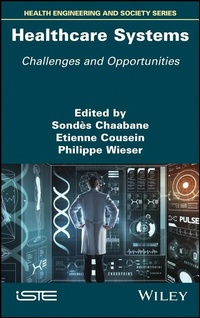
Healthcare Systems
Challenges and Opportunities
1st Edition
Published on 11. February 2022
288 pages
978-1-119-90259-1 (ISBN)
Description

This book is centered around the development of agile, high-performing healthcare institutions that are well integrated into their environment. The aim is to take advantage of artificial intelligence, optimization and simulation methods to provide solutions to prevent, anticipate, monitor and follow public health developments in order to intervene at the right time, using tools and resources that are both appropriate and effective.
The focus is on the people involved - the patients, as well as medical, technical and administrative staff - in an effort to provide an efficient healthcare and working environment that meets safety, quality and productivity requirements.
Heathcare Systems has been written by healthcare professionals, researchers in science and technology as well as in the social sciences and humanities from various French-speaking countries. It explores the challenges and opportunities presented by digital technology in our practices, organizations and management techniques.
Sondes Chaabane is a researcher at the Laboratory of Automation, Mechanics and Industrial and Human Computer Science (LAMIH UMR CNRS 8201) at Université Polytechnique Hauts-de-France and a lecturer at INSA Hauts-de-France. Her research focuses on the control and resilience of complex systems that combine optimization, simulation and artificial intelligence techniques.
Etienne Cousein is Head of the Pharmacy Department at the Valenciennes Hospital Center, France, and Vice President of the Commission Médicale d'Établissement. His main research interests include automated distribution solutions and medicine management within electronic patient records.
Philippe Wieser is Honorary Professor at EPFL, Switzerland, and Professor at the École des Ponts ParisTech, France. His fields of research are predominantly related to project management, industrial supply chain management and hospital logistics.
The focus is on the people involved - the patients, as well as medical, technical and administrative staff - in an effort to provide an efficient healthcare and working environment that meets safety, quality and productivity requirements.
Heathcare Systems has been written by healthcare professionals, researchers in science and technology as well as in the social sciences and humanities from various French-speaking countries. It explores the challenges and opportunities presented by digital technology in our practices, organizations and management techniques.
Sondes Chaabane is a researcher at the Laboratory of Automation, Mechanics and Industrial and Human Computer Science (LAMIH UMR CNRS 8201) at Université Polytechnique Hauts-de-France and a lecturer at INSA Hauts-de-France. Her research focuses on the control and resilience of complex systems that combine optimization, simulation and artificial intelligence techniques.
Etienne Cousein is Head of the Pharmacy Department at the Valenciennes Hospital Center, France, and Vice President of the Commission Médicale d'Établissement. His main research interests include automated distribution solutions and medicine management within electronic patient records.
Philippe Wieser is Honorary Professor at EPFL, Switzerland, and Professor at the École des Ponts ParisTech, France. His fields of research are predominantly related to project management, industrial supply chain management and hospital logistics.
More details
Other editions
Additional editions
Book
04/2022
1st Edition
ISTE Ltd
€164.50
Article not available at the moment
Persons
Sondes Chaabane is a researcher at the Laboratory of Automation, Mechanics and Industrial and Human Computer Science (LAMIH UMR CNRS 8201) at Université Polytechnique Hauts-de-France and a lecturer at INSA Hauts-de-France. Her research focuses on the control and resilience of complex systems that combine optimization, simulation and artificial intelligence techniques.
Etienne Cousein is Head of the Pharmacy Department at the Valenciennes Hospital Center, France, and Vice President of the Commission Médicale d'Établissement. His main research interests include automated distribution solutions and medicine management within electronic patient records.
Philippe Wieser is Honorary Professor at EPFL, Switzerland, and Professor at the École des Ponts ParisTech, France. His fields of research are predominantly related to project management, industrial supply chain management and hospital logistics.
Etienne Cousein is Head of the Pharmacy Department at the Valenciennes Hospital Center, France, and Vice President of the Commission Médicale d'Établissement. His main research interests include automated distribution solutions and medicine management within electronic patient records.
Philippe Wieser is Honorary Professor at EPFL, Switzerland, and Professor at the École des Ponts ParisTech, France. His fields of research are predominantly related to project management, industrial supply chain management and hospital logistics.
Content
- Cover
- Half-Title Page
- Title Page
- Copyright Page
- Contents
- Foreword
- Preface
- PART 1: Optimization and Simulation of Healthcare Systems
- Summary of Contributions - Part 1
- Towards a Prototype for the Strategic Recomputing of Schedules in Home Care Services
- Home Healthcare Scheduling Activities
- Optimal Sizing of an Automated Dispensing Cabinet under Adjacency Constraints
- Validation of an Automated and Targeted Pharmaceutical Analysis Tool at the CHU de Liège
- Simulation of Countermeasures in the Face of Covid-19 Using a Linear Compartmental Model
- 1. Towards a Prototype for the Strategic Recomputing of Schedules in Home Care Services
- 1.1. Introduction
- 1.2. Literature review
- 1.3. Description of the problem
- 1.3.1. Constraints
- 1.3.2. Objective function
- 1.4. Resolution method
- 1.4.1. Route generation
- 1.4.2. Route selection
- 1.5. Presentation of the prototype
- 1.6. Tests and results
- 1.7. Conclusion and perspectives
- 1.8. References
- 2. Home Healthcare Scheduling Activities
- 2.1. Introduction
- 2.2. State of the art
- 2.3. Description of the proposed approach
- 2.3.1. Home healthcare planning "offline phase"
- 2.3.2. Rescheduling in online mode
- 2.4. Experiments and results
- 2.5. Conclusions and perspectives
- 2.6. References
- 3. Optimal Sizing of an Automated Dispensing Cabinet Under Adjacency Constraints
- 3.1. Introduction
- 3.2. Problem statement
- 3.2.1. Description of the assignment problem
- 3.2.2. Notations and definitions
- 3.3. Mathematical formulation
- 3.3.1. Determination of boundary conditions
- 3.3.2. Problem solving approach
- 3.4. Application example
- 3.5. Conclusion
- 3.6. References
- 4. Validation of an Automated and Targeted Pharmaceutical Analysis Tool at the CHU de Liège
- 4.1. Introduction
- 4.2. Methods
- 4.3. Results
- 4.3.1. Creation of algorithms
- 4.3.2. IT tool development
- 4.3.3. Tool validation
- 4.4. Discussion and conclusion
- 4.5. References
- 5. Simulation of Countermeasures in the Face of Covid-19 Using a Linear Compartmental Model
- 5.1. Introduction
- 5.2. The compartmental model
- 5.2.1. Model assumptions
- 5.2.2. Model parameters
- 5.3. A linear SIR model
- 5.3.1. Data
- 5.3.2. Variables
- 5.3.3. Objective function
- 5.3.4. Constraints
- 5.4. Results
- 5.5. Conclusion
- 5.6. References
- PART 2: Digital and New Technologies for Health Services
- Summary of Contributions - Part 2
- Towards a New Classification of Medical Procedures in Belgium
- Digital Toolkit for the Ergonomic Evaluation of Workstations
- Simulation on an RFID Interactive Tabletop with Tangible Objects of Future Working Conditions: Prospects for Implementation in the Hospital Sector
- Robotic Geriatric Assistant: A Pilot Assessment in a Real-World Hospital
- Perspectives on the Patient Experience (PX) of People with Disabilities in the Digital Age: From UX to PX
- 6. Towards a New Classification of Medical Procedures in Belgium
- 6.1. Introduction
- 6.1.1. An essential but obsolete medical healthcare nomenclature
- 6.1.2. Decision to initiate a structural reform of the Belgian healthcare nomenclature
- 6.1.3. The NPS V0 nomenclature in a few figures
- 6.1.4. Purpose of the presentation
- 6.2. Methodology
- 6.2.1. Term analysis and standardization (NPS ATMC V1-1)
- 6.2.2. Medical pre-validation (NPS ATMC V1-2)
- 6.2.3. Matching the WHO International Classification of Health Interventions (NPS ATMC V1-3)
- 6.2.4. Provisional classification of new terms (NPS ATMC V1-3')
- 6.2.5. INAMI administrative work
- 6.2.6. Validation of proposals by expert groups (NPS ATMC V1-4)
- 6.3. Results
- 6.3.1. Planning
- 6.3.2. A summary of the modifications between NPS V0 and NSS V1-3
- 6.3.3. Validation of proposals by experts (NPS ATMC V1-5)
- 6.4. Discussion
- 6.4.1. From the standardization of medical procedures to a common descriptive classification
- 6.4.2. Evaluate the quality for the standardization of medical procedures
- 6.4.3. An estimate of the resources mobilized to arrive at a common descriptive classification
- 6.4.4. Participation of medical experts
- 6.4.5. The implementation of common descriptive classification (CC ATMC V1)
- 6.5. Conclusion
- 6.6. References
- 7. Digital Toolkit for the Ergonomic Evaluation of Workstations
- 7.1. Introduction
- 7.2. ProcSim and ergonomics
- 7.2.1. Origin
- 7.2.2. Our product
- 7.2.3. Examples of applications in different sectors
- 7.2.4. Benefits and value addition
- 7.3. Ergonomic assessment process
- 7.3.1. Data collection
- 7.3.2. Data analysis
- 7.3.3. Workstation modeling
- 7.3.4. Virtual reality testing of possible activities
- 7.3.5. Improvement proposals and recommendations
- 7.4. Conclusion
- 7.5. References
- 8. Simulation on an RFID Interactive Tabletop with Tangible Objects of Future Working Conditions: Prospects for Implementation in the Hospital Sector
- 8.1. Introduction
- 8.2. State-of-the-art on the simulation of future working conditions
- 8.3. Proposal for a simulator on an interactive tabletop
- 8.4. Development of a first version of a simulator on an interactive tabletop
- 8.5. Application opportunities in the healthcare industry
- 8.6. Conclusion and perspectives in the healthcare industry
- 8.7. Acknowledgments
- 8.8. References
- 9. Robotic Geriatric Assistant: A Pilot Assessment in a Real-world Hospital
- 9.1. Introduction
- 9.2. Geriatric assessment: from needs to the proposed solution
- 9.2.1. Data management and the proposed robotic solution
- 9.2.2. The Clara robotic geriatric assistant - research
- 9.2.3. Hypotheses and research objectives
- 9.3. Methodological approach: living lab approach
- 9.3.1. Empowerment in and through interaction
- 9.3.2. Contribution: new analytical framework
- 9.3.3. Mixed methodological approach
- 9.4. Pilot assessment
- 9.4.1. Procedure and test protocol
- 9.4.2. Results
- 9.5. Conclusion
- 9.6. Acknowledgments
- 9.7. References
- 10. Perspectives on the Patient Experience (PX) of People with Disabilities in the Digital Age: From UX to PX
- 10.1. Introduction
- 10.2. State-of-the-art on Patient eXperience (PX)
- 10.3. Research methodology and proposal
- 10.4. Illustrations relating to the "user research" phase of the methodological framework
- 10.5. Case study: digital care journey of a patient with a disability
- 10.6. Conclusion
- 10.7. References
- PART 3: Change Management and Organizational Innovations
- Summary of Contributions - Part 3
- Jointly Improving the Experience of All Stakeholders in Hospital 4.0: The ICSSURP Initiative
- Tool-based Approach to Analyze Operating Room Schedule Execution: Application to Online Managemen
- Planning Patient Journeys in Outpatient Hospitals to Support the Ambulatory Shift
- Treatment Protocols Generated by Machine Learning: Putting a Case Study of Hospitalization at Home into Perspective
- Resilience of Healthcare Teams: Case Study of Two Cardiology Intensive Care Units
- 11. Jointly Improving the Experience of All Stakeholders in Hospital 4.0: The ICSSURP Initiative
- 11.1. Introduction
- 11.2. Digital transformation to Hospital 4.0
- 11.3. Essential qualities of information systems of Hospital 4.0
- 11.3.1. Security in information systems of Hospital 4.0
- 11.3.2. Usability of information systems of Hospital 4.0
- 11.3.3. Resilience of information systems of Hospital 4.0
- 11.3.4. Performance of information systems of Hospital 4.0
- 11.4. Towards a joint security, safety, usability, resilience and performance engineering initiative (ICSSURP)
- 11.4.1. Advanced conceptual model of ICSSURP
- 11.4.2. System of homogeneous metrics
- 11.4.3. Summary of the ICSSURP initiative
- 11.5. Conclusion and perspectives
- 11.6. References
- 12. A Tool-based Approach to Analyze Operating Room Schedule Execution: Application to Online Management
- 12.1. Introduction
- 12.2. Methodology used to generate our approach
- 12.2.1. Preliminary phase: from observation to the approach outline
- 12.2.2. Phase 1: design
- 12.2.3. Phase 2: build
- 12.2.4. Phase 3: test
- 12.3. Current version of the proposed tool-based approach
- 12.3.1. Presentation of the first tool: the dashboard conceptual model
- 12.3.2. Presentation of the second tool: the Logbook
- 12.3.3. Description of the current version of the approach
- 12.4. Applied example of our tool-based approach at the Centre Hospitalier de Narbonne
- 12.4.1. Step 1 - collect and process the data
- 12.4.2. Step 2 - evaluate the feasibility and optimality of the initial schedule
- 12.4.3. Steps 3 and 4 - study the indicators and their deviations for the operating suite and the operating rooms
- 12.4.4. Step 5 - study the indicators and their deviations at the level of the interventions
- 12.4.5. Step 6 - determine root causes, impact on the performed schedule and responsibility for deviations
- 12.4.6. Step 7 - evaluate the quality of the actions implemented
- 12.4.7. Summation
- 12.5. Conclusion and perspectives
- 12.6. References
- 13. Planning Patient Journeys in Outpatient Hospitals to Support the Ambulatory Shift
- 13.1. Introduction
- 13.2. Background and state-of-the-art methods
- 13.2.1. Planning patient journeys at the hospital
- 13.2.2. 4.0 transforming the operational management of hospital flows
- 13.2.3. Research problem
- 13.3. State-of-the-art and field of application
- 13.3.1. Field of application: patient flows in outpatient hospitals
- 13.3.2. Little tactical planning for the state of the art
- 13.3.3. Choosing a planning and workflow management method
- 13.4. Contribution
- 13.4.1. Macro-planning for groups of pathways: an S&Op for ambulatory medicine
- 13.4.2. Feedback
- 13.5. Discussion and perspectives
- 13.5.1. Repeatability and accessibility of the macro-planning approach
- 13.5.2. Beyond the macro-planning for groups of pathways: towards integrated planning
- 13.6. Conclusion
- 13.7. References
- 14. Treatment Protocols Generated by Machine Learning: Putting a Case Study of Hospitalization at Home into Perspective
- 14.1. Introduction
- 14.2. Context and perspective
- 14.2.1. France's healthcare restructuring and the impact for HaH
- 14.2.2. Hospitalization at home and target patients
- 14.2.3. The positioning of hospitalization at home versus traditional medicine
- 14.2.4. The problems facing hospitalization at home
- 14.3. The contribution of protocolization
- 14.3.1. A quality tool for the patient and the healthcare provider
- 14.3.2. The interface protocol between healthcare facilities
- 14.3.3. Protocol facing its limitations
- 14.4. Study and proposed methodology
- 14.4.1. Case study of the cost drivers of a hospitalization at home
- 14.4.2. Patient trajectory forecasting and protocol generation
- 14.5. Conclusion
- 14.6. References
- 15. Resilience of Healthcare Teams: Case Study of Two Cardiology Intensive Care Units
- 15.1. Introduction
- 15.2. Theoretical framework
- 15.2.1. Defining the concept of resilience within the framework of the study
- 15.2.2. Nature of events and situations studied
- 15.2.3. The conceptual framework of the study
- 15.3. Research methodology
- 15.3.1. The narrative of the event
- 15.3.2. The data collection
- 15.4. Research results
- 15.4.1. Identification of stressors
- 15.4.2. The resilience process
- Phase 1: Detection
- Phase 2: Adaptation process
- Phase 3: Results of the collective action
- 15.5. Discussion
- 15.6. Conclusion
- 15.7. References
- Conclusion and Perspectives
- Glossary
- List of Authors
- Index
- Other titles from iSTE in Health Engineering and Society
- EULA
