

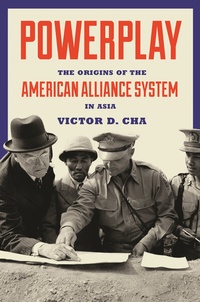
Powerplay
The Origins of the American Alliance System in Asia
1st Edition
Published on 10. October 2016
352 pages
978-1-4008-8343-1 (ISBN)
Description

A close look at the evolution of American political alliances in Asia and their future
While the American alliance system in Asia has been fundamental to the region's security and prosperity for seven decades, today it encounters challenges from the growth of China-based regional organizations. How was the American alliance system originally established in Asia, and is it currently under threat? How are competing security designs being influenced by the United States and China? In Powerplay, Victor Cha draws from theories about alliances, unipolarity, and regime complexity to examine the evolution of the U.S. alliance system and the reasons for its continued importance in Asia and the world.
Cha delves into the fears, motivations, and aspirations of the Truman and Eisenhower presidencies as they contemplated alliances with the Republic of China, Republic of Korea, and Japan at the outset of the Cold War. Their choice of a bilateral "hub and spokes" security design for Asia was entirely different from the system created in Europe, but it was essential for its time. Cha argues that the alliance system's innovations in the twenty-first century contribute to its resiliency in the face of China's increasing prominence, and that the task for the world is not to choose between American and Chinese institutions, but to maximize stability and economic progress amid Asia's increasingly complex political landscape.
Exploring U.S. bilateral relations in Asia after World War II, Powerplay takes an original look at how global alliances are achieved and maintained.
While the American alliance system in Asia has been fundamental to the region's security and prosperity for seven decades, today it encounters challenges from the growth of China-based regional organizations. How was the American alliance system originally established in Asia, and is it currently under threat? How are competing security designs being influenced by the United States and China? In Powerplay, Victor Cha draws from theories about alliances, unipolarity, and regime complexity to examine the evolution of the U.S. alliance system and the reasons for its continued importance in Asia and the world.
Cha delves into the fears, motivations, and aspirations of the Truman and Eisenhower presidencies as they contemplated alliances with the Republic of China, Republic of Korea, and Japan at the outset of the Cold War. Their choice of a bilateral "hub and spokes" security design for Asia was entirely different from the system created in Europe, but it was essential for its time. Cha argues that the alliance system's innovations in the twenty-first century contribute to its resiliency in the face of China's increasing prominence, and that the task for the world is not to choose between American and Chinese institutions, but to maximize stability and economic progress amid Asia's increasingly complex political landscape.
Exploring U.S. bilateral relations in Asia after World War II, Powerplay takes an original look at how global alliances are achieved and maintained.
More details
Language
English
Place of publication
Princeton, NJ
United States
Publishing group
De Gruyter
Target group
Professional and scholarly
Edition type
Digital original
Product notice
Reflowable
Illustrations
11 line illus. 11 tables.
File size
1,51 MB
ISBN-13
978-1-4008-8343-1 (9781400883431)
Schweitzer Classification
Other editions
Additional editions
Book
04/2018
Princeton University Press
€26.50
Shipment within 10-20 days
Book
08/2016
Princeton University Press
€43.33
Shipment within 10-20 days
Person
Victor D. Cha holds the D. S. Song-Korea Foundation Chair in Government and is the director of Asian Studies at Georgetown University. He is also senior adviser at the Center for Strategic and International Studies (CSIS) in Washington, D. C.
Content
List of Illustrations and Tables ix
Preface xi
A Note to the Reader xv
1 The Puzzle 1
2 The Argument: Powerplay 19
3 Origins of the American Alliance System in Asia 40
4 Taiwan: "Chaining Chiang" 65
5 Korea: "Rhee-Straint" 94
6 Japan: "Win Japan" 122
7 Counterarguments 161
8 Conclusion: US Alliances and the Complex Patchwork of Asia's Architecture 185
Notes 221
Bibliography 293
Index 323
Preface xi
A Note to the Reader xv
1 The Puzzle 1
2 The Argument: Powerplay 19
3 Origins of the American Alliance System in Asia 40
4 Taiwan: "Chaining Chiang" 65
5 Korea: "Rhee-Straint" 94
6 Japan: "Win Japan" 122
7 Counterarguments 161
8 Conclusion: US Alliances and the Complex Patchwork of Asia's Architecture 185
Notes 221
Bibliography 293
Index 323
