

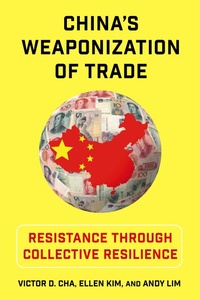
China's Weaponization of Trade
Description

In recent years, China and the United States have each turned economic interdependence into an instrument of coercion, using their dominant positions in international trade to push states and firms to comply with their political goals. What is distinctive about this form of economic pressure, and how can other countries fight back?
This groundbreaking book explores the weaponization of economic interdependence and its implications for the international order through a wealth of new and original data on China's economic statecraft. Victor D. Cha, Ellen Kim, and Andy Lim examine how and in what ways the United States and China have deployed economic coercion, focusing on China's extensive use of this tactic over the past three decades. They analyze a vast data set that includes more than 600 cases of China's economic bullying of states, companies, and individuals in North America, Asia, and Europe. Cha, Kim, and Lim propose a multilateral strategy of "collective resilience" to counter intimidation, showing how targeted states can band together, leverage trading relationships, and threaten retaliation.
Synthesizing new insights from unique trade data with international security expertise, this timely book sheds new light on how China exercises economic power-and it provides a playbook to deter bullies and rebalance the global order.
More details
Other editions
Additional editions
Persons
Victor D. Cha is Distinguished University Professor and D. S. Song-KF Endowed Chair in Government and International Affairs at Georgetown University as well as president of the Geopolitics and Foreign Policy Department and Korea Chair at the Center for Strategic and International Studies. A former director for Asian affairs on the White House National Security Council, he is the author of nine books on Asia and international relations.
Ellen Kim is director of academic affairs at the Korea Economic Institute of America.
Andy Lim is deputy director and fellow with the Korea Chair at the Center for Strategic and International Studies.
Content
List of Illustrations and Tables
Preface
List of Abbreviations
1. What Do Pelosi's Taiwan Trip, Banco Delta Asia, and Trump's Mexico Tariffs Have in Common?
2. The Sources of Predatory Liberalism in the Global Economy
3. China's Economic Coercion
4. Collective Resilience
5. Resilience and the Group of Seven (G7)
6. Collective Resilience in Critical Minerals
7. The Stakes Could Not Be Higher
Postscript
Appendix 1. China's Economic Coercion Against Private-Sector Companies, 1997-2025
Appendix 2. China's High-Dependence Trade with Eighteen Governments Targeted with Economic Coercion (Summary, 2024)
Appendix 3. Itemized List of China's High-Dependence Goods by Country (for Eighteen Governments Targeted with Economic Coercion, 2024)
Appendix 4. China's Vulnerability Interdependence (2024)
Notes
Bibliography
Index
