

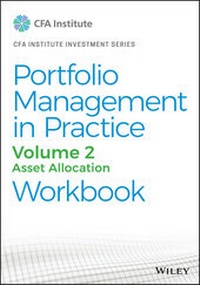
Portfolio Management in Practice, Volume 2
Description

The workbook provides the necessary tools and latest information to help learners advance their skills in this critical facet of portfolio management. Aligning chapter-by-chapter with the main text so readers can easily pair exercises with the appropriate content, this workbook covers:
* Setting capital market expectations to support the asset allocation process
* Principles and processes in the asset allocation process, including handling ESG-integration and client-specific constraints
* Allocation beyond the traditional asset classes to include allocation to alternative investments
* The role of exchange-traded funds can play in implementing investment strategies
The Asset Allocation Workbook has been compiled by experienced CFA members to give learners world-class examples based on scenarios faced by finance professionals every day. For practice on additional aspects of portfolio management, explore Volume 1: Investment Management, Volume 3: Equity Portfolio Management, and their accompanying workbooks to complete the Portfolio Management in Practice series.
More details
Other editions
Additional editions
Person
CFA Institute is the global association of investment professionals that sets the standard for professional excellence and credentials. The organization is a champion for ethical behavior in investment markets and a respected source of knowledge in the global financial community. The end goal: to create an environment where investors' interests come first, markets function at their best, and economies grow. CFA Institute has more than 155,000 members in 165 countries and territories, including 150,000 CFA® charterholders, and 148 member societies. For more information, visit www.cfainstitute.org.
Content
Part I Learning Objectives, Summary Overview, and Problems 1
Chapter I Basics of Portfolio Planning and Construction 3
Learning Outcomes 3
Summary 3
Practice Problems 5
Chapter 2 Security Market Indexes 9
Learning Outcomes 9
Summary 9
Practice Problems 10
Chapter 3 Capital Market Expectations, Part 1: Framework and Macro Considerations 17
Learning Outcomes 17
Summary 18
Practice Problems 21
Chapter 4 Capital Market Expectations, Part 2: Forecasting Asset Class Returns 27
Learning Outcomes 27
Summary 28
Practice Problems 30
Chapter 5 Overview of Asset Allocation 39
Learning Outcomes 39
Summary 40
Practice Problems 41
Chapter 6 Principles of Asset Allocation 45
Learning Outcomes 45
Summary 46
Practice Problems 47
Chapter 7 Asset Allocation with Real-World Constraints 57
Learning Outcomes 57
Summary 57
Practice Problems 59
Chapter 8 Asset Allocation to Alternative Investments 69
Learning Outcomes 69
Summary 69
Practice Problems 72
Chapter 9 Exchange-Traded Funds: Mechanics and Applications 81
Learning Outcomes 81
Summary 81
Practice Problems 83
Chapter 10 Case Study in Portfolio Management: Institutional 89
Learning Outcomes 89
Summary 89
Practice Problems 90
Part II Solutions 95
Chapter 1 Basics of Portfolio Planning and Construction 97
Solutions 97
Chapter 2 Security Market Indexes 101
Solutions 101
Chapter 3 Capital Market Expectations, Part I: Framework and Macro Considerations 105
Solutions 105
Chapter 4 Capital Market Expectations, Part II: Forecasting Asset Class Returns 111
Solutions 111
Chapter 5 Overview of Asset Allocation 119
Solutions 119
Chapter 6 Principles of Asset Allocation 121
Solutions 121
Chapter 7 Asset Allocation with Real-World Constraints 129
Solutions 129
Chapter 8 Asset Allocation to Alternative Investments 135
Solutions 135
Chapter 9 Exchange-Traded Funds: Mechanics and Applications 145
Solutions 145
Chapter 10 Case Study in Portfolio Management: Institutional 151
Solutions 151
About the CFA Program 157
