

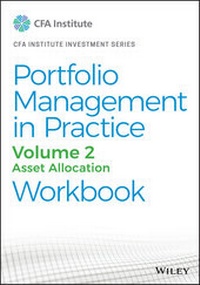
Portfolio Management in Practice, Volume 2
Description

The workbook provides the necessary tools and latest information to help learners advance their skills in this critical facet of portfolio management. Aligning chapter-by-chapter with the main text so readers can easily pair exercises with the appropriate content, this workbook covers:
* Setting capital market expectations to support the asset allocation process
* Principles and processes in the asset allocation process, including handling ESG-integration and client-specific constraints
* Allocation beyond the traditional asset classes to include allocation to alternative investments
* The role of exchange-traded funds can play in implementing investment strategies
The Asset Allocation Workbook has been compiled by experienced CFA members to give learners world-class examples based on scenarios faced by finance professionals every day. For practice on additional aspects of portfolio management, explore Volume 1: Investment Management, Volume 3: Equity Portfolio Management, and their accompanying workbooks to complete the Portfolio Management in Practice series.
More details
Other editions
Additional editions
Person
CFA Institute is the global association of investment professionals that sets the standard for professional excellence and credentials. The organization is a champion for ethical behavior in investment markets and a respected source of knowledge in the global financial community. The end goal: to create an environment where investors' interests come first, markets function at their best, and economies grow. CFA Institute has more than 155,000 members in 165 countries and territories, including 150,000 CFA® charterholders, and 148 member societies. For more information, visit www.cfainstitute.org.
Content
Part I Learning Objectives, Summary Overview, and Problems 1
Chapter I Basics of Portfolio Planning and Construction 3
Learning Outcomes 3
Summary 3
Practice Problems 5
Chapter 2 Security Market Indexes 9
Learning Outcomes 9
Summary 9
Practice Problems 10
Chapter 3 Capital Market Expectations, Part 1: Framework and Macro Considerations 17
Learning Outcomes 17
Summary 18
Practice Problems 21
Chapter 4 Capital Market Expectations, Part 2: Forecasting Asset Class Returns 27
Learning Outcomes 27
Summary 28
Practice Problems 30
Chapter 5 Overview of Asset Allocation 39
Learning Outcomes 39
Summary 40
Practice Problems 41
Chapter 6 Principles of Asset Allocation 45
Learning Outcomes 45
Summary 46
Practice Problems 47
Chapter 7 Asset Allocation with Real-World Constraints 57
Learning Outcomes 57
Summary 57
Practice Problems 59
Chapter 8 Asset Allocation to Alternative Investments 69
Learning Outcomes 69
Summary 69
Practice Problems 72
Chapter 9 Exchange-Traded Funds: Mechanics and Applications 81
Learning Outcomes 81
Summary 81
Practice Problems 83
Chapter 10 Case Study in Portfolio Management: Institutional 89
Learning Outcomes 89
Summary 89
Practice Problems 90
Part II Solutions 95
Chapter 1 Basics of Portfolio Planning and Construction 97
Solutions 97
Chapter 2 Security Market Indexes 101
Solutions 101
Chapter 3 Capital Market Expectations, Part I: Framework and Macro Considerations 105
Solutions 105
Chapter 4 Capital Market Expectations, Part II: Forecasting Asset Class Returns 111
Solutions 111
Chapter 5 Overview of Asset Allocation 119
Solutions 119
Chapter 6 Principles of Asset Allocation 121
Solutions 121
Chapter 7 Asset Allocation with Real-World Constraints 129
Solutions 129
Chapter 8 Asset Allocation to Alternative Investments 135
Solutions 135
Chapter 9 Exchange-Traded Funds: Mechanics and Applications 145
Solutions 145
Chapter 10 Case Study in Portfolio Management: Institutional 151
Solutions 151
About the CFA Program 157
CHAPTER 1
BASICS OF PORTFOLIO PLANNING AND CONSTRUCTION
LEARNING OUTCOMES
The candidate should be able to:
- describe the reasons for a written investment policy statement (IPS);
- describe the major components of an IPS;
- describe risk and return objectives and how they may be developed for a client;
- distinguish between the willingness and the ability (capacity) to take risk in analyzing an investor's financial risk tolerance;
- describe the investment constraints of liquidity, time horizon, tax concerns, legal and regulatory factors, and unique circumstances and their implications for the choice of portfolio assets;
- explain the specification of asset classes in relation to asset allocation;
- describe the principles of portfolio construction and the role of asset allocation in relation to the IPS;
- describe how environmental, social, and governance (ESG) considerations may be integrated into portfolio planning and construction.
SUMMARY
In this chapter, we have discussed construction of a client's investment policy statement, including discussion of risk and return objectives and the various constraints that will apply to the portfolio. We have also discussed the portfolio construction process, with emphasis on the strategic asset allocation decisions that must be made.
- The IPS is the starting point of the portfolio management process. Without a full understanding of the client's situation and requirements, it is unlikely that successful results will be achieved.
- The IPS can take a variety of forms. A typical format will include the client's investment objectives and also list the constraints that apply to the client's portfolio.
- The client's objectives are specified in terms of risk tolerance and return requirements.
- The constraints section covers factors that need to be considered when constructing a portfolio for the client that meets the objectives. The typical constraint categories are liquidity requirements, time horizon, regulatory requirements, tax status, and unique needs.
- Clients may have personal objections to certain products or practices, which could lead to the exclusion of certain companies, countries, or types of securities from the investable universe as well as the client's benchmark. Such considerations are often referred to as ESG (environmental, social, governance).
- ESG considerations can be integrated into an investment policy by exclusionary screening, best-in-class selection, active ownership, thematic and impact investing, and ESG integration in security analysis.
- Risk objectives are specifications for portfolio risk that reflect the risk tolerance of the client. Quantitative risk objectives can be absolute or relative or a combination of the two.
- The client's overall risk tolerance is a function of the client's ability to accept risk and their "risk attitude," which can be considered the client's willingness to take risk.
- The client's return objectives can be stated on an absolute or a relative basis. As an example of an absolute objective, the client may want to achieve a particular percentage rate of return. Alternatively, the return objective can be stated on a relative basis, for example, relative to a benchmark return.
- The liquidity section of the IPS should state what the client's requirements are to draw cash from the portfolio.
- The time horizon section of the IPS should state the time horizon over which the investor is investing. This horizon may be the period during which the portfolio is accumulating before any assets need to be withdrawn.
- Tax status varies among investors and a client's tax status should be stated in the IPS.
- The IPS should state any legal or regulatory restrictions that constrain the investment of the portfolio.
- The unique circumstances section of the IPS should cover any other aspect of a client's circumstances that is likely to have a material impact on the composition of the portfolio. Certain ESG implementation approaches, such as negative (exclusionary) screening, best-in-class, thematic investing, impact investing, and ESG integration may be discussed in this section.
- Asset classes are the building blocks of an asset allocation. An asset class is a category of assets that have similar characteristics, attributes, and risk/return relationships. Traditionally, investors have distinguished cash, equities, bonds, and real estate as the major asset classes.
- A strategic asset allocation results from combining the constraints and objectives articulated in the IPS and capital market expectations regarding the asset classes.
- As time goes on, a client's asset allocation will drift from the target allocation, and the amount of allowable drift as well as a rebalancing policy should be formalized.
- In addition to taking systematic risk, an investment committee may choose to take tactical asset allocation risk or security selection risk. The amount of return attributable to these decisions can be measured.
- ESG considerations may be integrated into the portfolio planning and construction process. Such considerations can be difficult given that ESG data is often not required to be disclosed by companies. ESG implementation approaches require a set of instructions for investment managers with regards to the selection of securities, the exercise of shareholder rights, and the selection of investment strategies.
PRACTICE PROBLEMS
- Which of the following is least important as a reason for a written investment policy statement (IPS)?
- The IPS may be required by regulation.
- Having a written IPS is part of best practice for a portfolio manager.
- Having a written IPS ensures the client's risk and return objectives can be achieved.
- Which of the following best describes the underlying rationale for a written investment policy statement (IPS)?
- A written IPS communicates a plan for trying to achieve investment success.
- A written IPS provides investment managers with a ready defense against client lawsuits.
- A written IPS allows investment managers to instruct clients about the proper use and purpose of investments.
- A written investment policy statement (IPS) is most likely to succeed if:
- it is created by a software program to assure consistent quality.
- it is a collaborative effort of the client and the portfolio manager.
- it reflects the investment philosophy of the portfolio manager.
- The section of the investment policy statement (IPS) that provides information about how policy may be executed, including restrictions and exclusions, is best described as the:
- Investment Objectives.
- Investment Guidelines.
- Statement of Duties and Responsibilities.
- Which of the following is least likely to be placed in the appendices to an investment policy statement (IPS)?
- Rebalancing Policy
- Strategic Asset Allocation
- Statement of Duties and Responsibilities
- Which of the following typical topics in an investment policy statement (IPS) is most closely linked to the client's "distinctive needs"?
- Procedures
- Investment Guidelines
- Statement of Duties and Responsibilities
- An investment policy statement that includes a return objective of outperforming the FTSE 100 by 120 basis points is best characterized as having a(n):
- relative return objective.
- absolute return objective.
- arbitrage-based return objective.
- Risk assessment questionnaires for investment management clients are most useful in measuring:
- value at risk.
- ability to take risk.
- willingness to take risk.
- Which of the following is best characterized as a relative risk objective?
- Value at risk for the fund will not exceed US$3 million.
- The fund will not underperform the DAX by more than 250 basis points.
- The fund will not lose more than ?2.5 million in the coming 12-month period.
- In preparing an investment policy statement, which of the following is most difficult to quantify?
- Time horizon
- Ability to accept risk
- Willingness to accept risk
- After interviewing a client in order to prepare a written investment policy statement (IPS), you have established the following:
- The client has earnings that vary dramatically between £30,000 and £70,000 (pre-tax) depending on weather patterns in Britain.
- In three of the previous five years, the after-tax income of the client has been less than £20,000.
- The client's mother is dependent on her son (the client) for approximately £9,000 per year support.
- The client's own subsistence needs are approximately £12,000 per year.
- The client has more than 10 years' experience trading investments including commodity futures, stock options, and selling stock short.
- The client's responses to a standard risk assessment questionnaire suggest he has above average risk tolerance.
The client is best described as having a:
- low ability to take risk, but a...
