

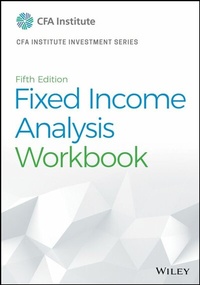
Fixed Income Analysis Workbook
Description

Fixed Income Analysis, 5th Edition offers the key component of effective learning--practice. Designed for both students and professionals, this companion workbook aligns with the latest Fixed Income Analysis text chapter-by-chapter. To improve your comprehension of core concepts, this book includes brief chapter summaries before diving into challenging practice questions and their solutions, while also laying out learning objectives so you can understand the "why" of each exercise.
Fixed Income Analysis Workbook, 5th Edition will help you:
* Synthesize essential material from the main Fixed Income Analysis text using real-world applications.
* Understand the key fundamentals of fixed income securities and portfolio management.
* Work toward specific chapter objectives to internalize important information.
CFA Institute is the world's premier association for investment professionals, and the governing body for the CFA® Program, CIPM® Program, CFA Institute ESG Investing Certificate, and Investment Foundations® Program. Those seeking a deeper understanding of fixed income portfolio management tactics will value the level of expertise CFA Institute brings to the discussion as well as the extra practice delivered in the fifth edition Fixed Income Analysis Workbook based on real scenarios investors face every day.
More details
Other editions
Additional editions
Previous edition

Content
Part I
Learning Objectives, Summary Overview, and Problems
Chapter 1 Fixed-Income Securities: Defining Elements 3
Learning Outcomes 3
Summary Overview 3
Problems 5
Chapter 2 Fixed-Income Markets: Issuance, Trading, and Funding 9
Learning Outcomes 9
Summary Overview 9
Problems 11
Chapter 3 Introduction to Fixed-Income Valuation 15
Learning Outcomes 15
Summary Overview 15
Problems 18
Chapter 4 Introduction to Asset-Backed Securities 25
Learning Outcomes 25
Summary Overview 25
Problems 28
Chapter 5 Understanding Fixed-Income Risk and Return 33
Learning Outcomes 33
Summary Overview 34
Problems 36
Chapter 6 Fundamentals of Credit Analysis 41
Learning Outcomes 41
Summary Overview 41
Problems 45
Chapter 7 The Term Structure and Interest Rate Dynamics 53
Learning Outcomes 53
Summary Overview 53
Problems 54
Chapter 8 The Arbitrage-Free Valuation Framework 65
Learning Outcomes 65
Summary Overview 65
Problems 66
Chapter 9 Valuation and Analysis of Bonds with Embedded Options 75
Learning Outcomes 75
Summary Overview 76
Problems 78
Chapter 10 Credit Analysis Models 89
Learning Outcomes 89
Summary Overview 89
Problems 90
Chapter 11 Credit Default Swaps 99
Learning Outcomes 99
Summary Overview 99
Problems 100
Chapter 12 Overview of Fixed-Income Portfolio Management 105
Learning Outcomes 105
Summary Overview 105
Problems 107
Chapter 13 Liability-Driven and Index-Based Strategies 113
Learning Outcomes 113
Summary Overview 113
Problems 117
Chapter 14 Learning Outcomes 125
Summary Overview 125
Problems 127
Chapter 15 Fixed-Income Active Management: Credit Strategies 133
Learning Outcomes 133
Summary Overview 134
Problems 135
Part II
Solutions
Chapter 1 Fixed-Income Securities: Defining Elements 145
Solutions 145
Chapter 2 Fixed-Income Markets: Issuance, Trading, and Funding 149
Solutions 149
Chapter 3 Introduction to Fixed-Income Valuation 153
Solutions 153
Chapter 4 Introduction to Asset-Backed Securities 167
Solutions 167
Chapter 5 Understanding Fixed-Income Risk and Return 175
Solutions 175
Chapter 6 Fundamentals of Credit Analysis 183
Solutions 183
Chapter 7 The Term Structure and Interest Rate Dynamics 189
Solutions 189
Chapter 8 The Arbitrage-Free Valuation Framework 197
Solutions 197
Chapter 9 Valuation and Analysis of Bonds with Embedded Options 203
Solutions 203
Chapter 10 Credit Analysis Models 211
Solutions 211
Chapter 11 Credit Default Swaps 225
Solutions 225
Chapter 12 Overview of Fixed-Income Portfolio Management 229
Solutions 229
Chapter 13 Liability-Driven and Index-Based Strategies 233
Solutions 233
Chapter 14 Yield Curve Strategies 239
Solutions 239
Chapter 15 Fixed-Income Active Management: Credit Strategies 243
Solutions 243
About the CFA Program 247
CHAPTER 1
FIXED-INCOME SECURITIES: DEFINING ELEMENTS
LEARNING OUTCOMES
The candidate should be able to:
-
describe basic features of a fixed-income security;
-
describe content of a bond indenture;
-
compare affirmative and negative covenants and identify examples of each;
-
describe how legal, regulatory, and tax considerations affect the issuance and trading of fixed-income securities;
-
describe how cash flows of fixed-income securities are structured;
-
describe contingency provisions affecting the timing and/or nature of cash flows of fixed-income securities and whether such provisions benefit the borrower or the lender.
SUMMARY OVERVIEW
This chapter introduces the salient features of fixed-income securities while noting how these features vary among different types of securities. Important points include the following:
-
The three important elements that an investor needs to know when investing in a fixed-income security are: (1) the bond's features, which determine its scheduled cash flows and thus the bondholder's expected and actual return; (2) the legal, regulatory, and tax considerations that apply to the contractual agreement between the issuer and the bondholders; and (3) the contingency provisions that may affect the bond's scheduled cash flows.
-
The basic features of a bond include the issuer, maturity, par value (or principal), coupon rate and frequency, and currency denomination.
-
Issuers of bonds include supranational organizations, sovereign governments, non-sovereign governments, quasi-government entities, and corporate issuers.
-
Bondholders are exposed to credit risk and may use bond credit ratings to assess the credit quality of a bond.
-
A bond's principal is the amount the issuer agrees to pay the bondholder when the bond matures.
-
The coupon rate is the interest rate that the issuer agrees to pay to the bondholder each year. The coupon rate can be a fixed rate or a floating rate. Bonds may offer annual, semi-annual, quarterly, or monthly coupon payments depending on the type of bond and where the bond is issued.
-
Bonds can be issued in any currency. Such bonds as dual-currency bonds and currency option bonds are connected to two currencies.
-
The yield-to-maturity is the discount rate that equates the present value of the bond's future cash flows until maturity to its price. Yield-to-maturity can be considered an estimate of the market's expectation for the bond's return.
-
A plain vanilla bond has a known cash flow pattern. It has a fixed maturity date and pays a fixed rate of interest over the bond's life.
-
The bond indenture or trust deed is the legal contract that describes the form of the bond, the issuer's obligations, and the investor's rights. The indenture is usually held by a financial institution called a trustee, which performs various duties specified in the indenture.
-
The issuer is identified in the indenture by its legal name and is obligated to make timely payments of interest and repayment of principal.
-
For asset-backed securities, the legal obligation to repay bondholders often lies with a separate legal entity-that is, a bankruptcy-remote vehicle that uses the assets as guarantees to back a bond issue.
-
How the issuer intends to service the debt and repay the principal should be described in the indenture. The source of repayment proceeds varies depending on the type of bond.
-
Collateral backing is a way to alleviate credit risk. Secured bonds are backed by assets or financial guarantees pledged to ensure debt payment. Examples of collateral-backed bonds include collateral trust bonds, equipment trust certificates, mortgage-backed securities, and covered bonds.
-
Credit enhancement can be internal or external. Examples of internal credit enhancement include subordination, overcollateralization, and reserve accounts. A bank guarantee, a surety bond, a letter of credit, and a cash collateral account are examples of external credit enhancement.
-
Bond covenants are legally enforceable rules that borrowers and lenders agree on at the time of a new bond issue. Affirmative covenants enumerate what issuers are required to do, whereas negative covenants enumerate what issuers are prohibited from doing.
-
An important consideration for investors is where the bonds are issued and traded, because it affects the laws, regulation, and tax status that apply. Bonds issued in a country in local currency are domestic bonds if they are issued by entities incorporated in the country and foreign bonds if they are issued by entities incorporated in another country. Eurobonds are issued internationally, outside the jurisdiction of any single country and are subject to a lower level of listing, disclosure, and regulatory requirements than domestic or foreign bonds. Global bonds are issued in the Eurobond market and at least one domestic market at the same time.
-
Although some bonds may offer special tax advantages, as a general rule, interest is taxed at the ordinary income tax rate. Some countries also implement a capital gains tax. There may be specific tax provisions for bonds issued at a discount or bought at a premium.
-
An amortizing bond is a bond whose payment schedule requires periodic payment of interest and repayment of principal. This differs from a bullet bond, whose entire payment of principal occurs at maturity. The amortizing bond's outstanding principal amount is reduced to zero by the maturity date for a fully amortized bond, but a balloon payment is required at maturity to retire the bond's outstanding principal amount for a partially amortized bond.
-
Sinking fund agreements provide another approach to the periodic retirement of principal, in which an amount of the bond's principal outstanding amount is usually repaid each year throughout the bond's life or after a specified date.
-
A floating-rate note, or floater, is a bond whose coupon is set based on a market reference rate (MRR) plus a spread. FRNs can be floored, capped, or collared. An inverse FRN is a bond whose coupon has an inverse relationship to the reference rate.
-
Other coupon payment structures include bonds with step-up coupons, which pay coupons that increase by specified amounts on specified dates; bonds with credit-linked coupons, which change when the issuer's credit rating changes; bonds with payment-in-kind coupons, which allow the issuer to pay coupons with additional amounts of the bond issue rather than in cash; and bonds with deferred coupons, which pay no coupons in the early years following the issue but higher coupons thereafter.
-
The payment structures for index-linked bonds vary considerably among countries. A common index-linked bond is an inflation-linked bond, or linker, whose coupon payments and/or principal repayments are linked to a price index. Index-linked payment structures include zero-coupon-indexed bonds, interest-indexed bonds, capital-indexed bonds, and indexed-annuity bonds.
-
Common types of bonds with embedded options include callable bonds, putable bonds, and convertible bonds. These options are "embedded" in the sense that there are provisions provided in the indenture that grant either the issuer or the bondholder certain rights affecting the disposal or redemption of the bond. They are not separately traded securities.
-
Callable bonds give the issuer the right to buy bonds back prior to maturity, thereby raising the reinvestment risk for the bondholder. For this reason, callable bonds have to offer a higher yield and sell at a lower price than otherwise similar non-callable bonds to compensate the bondholders for the value of the call option to the issuer.
-
Putable bonds give the bondholder the right to sell bonds back to the issuer prior to maturity. Putable bonds offer a lower yield and sell at a higher price than otherwise similar non-putable bonds to compensate the issuer for the value of the put option to the bondholders.
-
A convertible bond gives the bondholder the right to convert the bond into common shares of the issuing company. Because this option favors the bondholder, convertible bonds offer a lower yield and sell at a higher price than otherwise similar non-convertible bonds.
PROBLEMS
-
A 10-year bond was issued four years ago. The bond is denominated in US dollars, offers a coupon rate of 10% with interest paid semi-annually, and is currently priced at 102% of par. The bond's:
-
tenor is six years.
-
nominal rate is 5%.
-
redemption value is 102% of the par value.
-
-
A sovereign bond has a maturity of 15 years. The bond is best described as a:
-
perpetual bond.
-
pure discount bond.
-
capital market security.
-
-
A company has issued a floating-rate note with a coupon rate equal to the three-month MRR + 65 bps. Interest payments are made quarterly on 31 March, 30 June, 30 September, and 31 December. On 31 March and 30 June, the three-month MRR is 1.55% and 1.35%, respectively. The coupon rate for the interest payment made on 30 June...
