

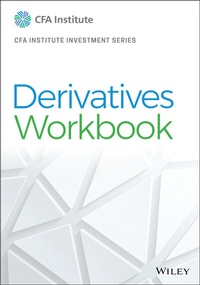
Derivatives Workbook
Description

Derivatives Workbook provides the key component of effective learning--practice. Designed for both students and investment professionals, this companion workbook conveniently aligns with the Derivatives text chapter-by-chapter, offers brief chapter summaries to refresh your memory on key points before you begin working, and explicitly lays out the learning objectives so you understand the "why" of each problem. This workbook helps you:
* Synthesize essential material from the Derivatives text using real-world applications
* Understand the different types of derivatives and their characteristics
* Delve into the various markets and their associated contracts
* Examine the role of derivatives in portfolio management
* Learn why derivatives are increasingly fundamental to risk management
CFA Institute is the world's premier association for investment professionals, and the governing body for CFA¯® Program, CIPM¯® Program, CFA Institute ESG Investing Certificate, and Investment Foundations¯® Program. Those seeking a deeper understanding of the markets, mechanisms, and use of derivatives will value the level of expertise CFA Institute brings to the discussion as well as the extra practice delivered in Derivatives Workbook based on real scenarios investors face every day.
More details
Other editions
Additional editions
Person
CFA Institute is the global association of investment professionals that sets the standard for professional excellence and credentials. The organization is a champion for ethical behavior in investment markets and a respected source of knowledge in the global financial community. The end goal: to create an environment where investors' interests come first, markets function at their best, and economies grow. CFA Institute has more than 170,000 members in 160+ countries and territories, including 163,000 CFA charterholders, and 150+ member societies. For more information, visit www.cfainstitute.org.
Content
PART I Learning Objectives, Summary Overview, and Problems
Chapter 1 Derivative Markets and Instruments 3
Learning Outcomes 3
Summary Overview 3
Problems 5
Chapter 2 Basics of Derivative Pricing and Valuation 11
Learning Outcomes 11
Summary Overview 12
Problems 13
Chapter 3 Pricing and Valuation of Forward Commitments 19
Learning Outcomes 19
Summary Overview 19
Problems 22
Chapter 4 Valuation of Contingent Claims 31
Learning Outcomes 31
Summary Overview 32
Problems 34
Chapter 5 Credit Default Swaps 41
Learning Outcomes 41
Summary Overview 41
Problems 42
Chapter 6 Introduction to Commodities and Commodity Derivatives 47
Learning Outcomes 47
Summary Overview 47
Problems 49
Chapter 7 Currency Management: An Introduction 55
Learning Outcomes 55
Summary Overview 55
Problems 58
Chapter 8 Options Strategies 69
Learning Outcomes 69
Summary Overview 70
Problems 71
Chapter 9 Swaps, Forwards, and Futures Strategies 79
Learning Outcomes 79
Summary Overview 79
Problems 80
Chapter 10 Introduction to Risk Management 89
Learning Outcomes 89
Summary Overview 89
Problems 91
Chapter 11 Measuring and Managing Market Risk 93
Learning Outcomes 93
Summary Overview 94
Problems 96
Chapter 12 Risk Management for Individuals 105
Learning Outcomes 105
Summary Overview 106
Problems 107
Chapter 13 Case Study in Risk Management: Private Wealth 115
Learning Outcomes 115
Summary Overview 115
Problems 116
Chapter 14 Integrated Cases in Risk Management: Institutional 119
Learning Outcomes 119
PART II SOLUTIONS
Chapter 1 Derivative Markets and Instruments 123
Solutions 123
Chapter 2 Basics of Derivative Pricing and Valuation 133
Solutions 133
Chapter 3 Pricing and Valuation of Forward Commitments 139
Solutions 139
Chapter 4 Valuation of Contingent Claims 149
Solutions 149
Chapter 5 Credit Default Swaps 153
Solutions 153
Chapter 6 Introduction to Commodities and Commodity Derivatives 157
Solutions 157
Chapter 7 Currency Management: An Introduction 161
Solutions 161
Chapter 8 Options Strategies 175
Solutions 175
Chapter 9 Swaps, Forwards, and Futures Strategies 181
Solutions 181
Chapter 10 Introduction to Risk Management 189
Solutions 189
Chapter 11 Measuring and Managing Market Risk 191
Solutions 191
Chapter 12 Risk Management for Individuals 197
Solutions 197
Chapter 13 Case Study in Risk Management: Private Wealth 203
Solutions 203
CHAPTER 1
DERIVATIVE MARKETS AND INSTRUMENTS
LEARNING OUTCOMES
The candidate should be able to:
- define a derivative and distinguish between exchange-traded and over-the-counter derivatives;
- contrast forward commitments with contingent claims;
- define forward contracts, futures contracts, options (calls and puts), swaps, and credit derivatives and compare their basic characteristics;
- determine the value at expiration and profit from a long or a short position in a call or put option;
- describe purposes of, and controversies related to, derivative markets;
- explain arbitrage and the role it plays in determining prices and promoting market efficiency.
SUMMARY OVERVIEW
This first reading on derivatives introduces you to the basic characteristics of derivatives, including the following points:
- A derivative is a financial instrument that derives its performance from the performance of an underlying asset.
- The underlying asset, called the underlying, trades in the cash or spot markets and its price is called the cash or spot price.
- Derivatives consist of two general classes: forward commitments and contingent claims.
- Derivatives can be created as standardized instruments on derivatives exchanges or as customized instruments in the over-the-counter market.
- Exchange-traded derivatives are standardized, highly regulated, and transparent transactions that are guaranteed against default through the clearinghouse of the derivatives exchange.
- Over-the-counter derivatives are customized, flexible, and more private and less regulated than exchange-traded derivatives, but are subject to a greater risk of default.
- A forward contract is an over-the-counter derivative contract in which two parties agree that one party, the buyer, will purchase an underlying asset from the other party, the seller, at a later date and at a fixed price they agree upon when the contract is signed.
- A futures contract is similar to a forward contract but is a standardized derivative contract created and traded on a futures exchange. In the contract, two parties agree that one party, the buyer, will purchase an underlying asset from the other party, the seller, at a later date and at a price agreed on by the two parties when the contract is initiated. In addition, there is a daily settling of gains and losses and a credit guarantee by the futures exchange through its clearinghouse.
- A swap is an over-the-counter derivative contract in which two parties agree to exchange a series of cash flows whereby one party pays a variable series that will be determined by an underlying asset or rate and the other party pays either a variable series determined by a different underlying asset or rate or a fixed series.
- An option is a derivative contract in which one party, the buyer, pays a sum of money to the other party, the seller or writer, and receives the right to either buy or sell an underlying asset at a fixed price either on a specific expiration date or at any time prior to the expiration date.
- A call is an option that provides the right to buy the underlying.
- A put is an option that provides the right to sell the underlying.
- Credit derivatives are a class of derivative contracts between two parties, the credit protection buyer and the credit protection seller, in which the latter provides protection to the former against a specific credit loss.
- A credit default swap is the most widely used credit derivative. It is a derivative contract between two parties, a credit protection buyer and a credit protection seller, in which the buyer makes a series of payments to the seller and receives a promise of compensation for credit losses resulting from the default of a third party.
- An asset-backed security is a derivative contract in which a portfolio of debt instruments is assembled and claims are issued on the portfolio in the form of tranches, which have different priorities of claims on the payments made by the debt securities such that prepayments or credit losses are allocated to the most-junior tranches first and the most-senior tranches last.
- Derivatives can be combined with other derivatives or underlying assets to form hybrids.
- Derivatives are issued on equities, fixed-income securities, interest rates, currencies, commodities, credit, and a variety of such diverse underlyings as weather, electricity, and disaster claims.
- Derivatives facilitate the transfer of risk, enable the creation of strategies and payoffs not otherwise possible with spot assets, provide information about the spot market, offer lower transaction costs, reduce the amount of capital required, are easier than the underlyings to go short, and improve the efficiency of spot markets.
- Derivatives are sometimes criticized for being a form of legalized gambling and for leading to destabilizing speculation, although these points can generally be refuted.
- Derivatives are typically priced by forming a hedge involving the underlying asset and a derivative such that the combination must pay the risk-free rate and do so for only one derivative price.
- Derivatives pricing relies heavily on the principle of storage, meaning the ability to hold or store the underlying asset. Storage can incur costs but can also generate cash, such as dividends and interest.
- Arbitrage is the condition that two equivalent assets or derivatives or combinations of assets and derivatives sell for different prices, leading to an opportunity to buy at the low price and sell at the high price, thereby earning a risk-free profit without committing any capital.
- The combined actions of arbitrageurs bring about a convergence of prices. Hence, arbitrage leads to the law of one price: Transactions that produce equivalent results must sell for equivalent prices.
PROBLEMS
- A derivative is best described as a financial instrument that derives its performance by:
- passing through the returns of the underlying.
- replicating the performance of the underlying.
- transforming the performance of the underlying.
- Derivatives are similar to insurance in that both:
- have an indefinite life span.
- allow for the transfer of risk from one party to another.
- allow for the transformation of the underlying risk itself.
- A beneficial opportunity created by the derivatives market is the ability to:
- adjust risk exposures to desired levels.
- generate returns proportional to movements in the underlying.
- simultaneously take long positions in multiple highly liquid fixed-income securities.
- Compared with exchange-traded derivatives, over-the-counter derivatives would most likely be described as:
- standardized.
- less transparent.
- more transparent.
- Exchange-traded derivatives are:
- largely unregulated.
- traded through an informal network.
- guaranteed by a clearinghouse against default.
- The clearing and settlement process of an exchange-traded derivatives market:
- provides a credit guarantee.
- provides transparency and flexibility.
- takes longer than that of most securities exchanges.
- Which of the following statements best portrays the full implementation of post-financial-crisis regulations in the OTC derivatives market?
- Transactions are no longer private.
- Most transactions need to be reported to regulators.
- All transactions must be cleared through central clearing agencies.
- A characteristic of forward commitments is that they:
- provide linear payoffs.
- do not depend on the outcome or payoff of an underlying asset.
- provide one party the right to engage in future transactions on terms agreed on in advance.
- In contrast to contingent claims, forward contracts:
- have their prices chosen by the participants.
- could end in default by either party.
- can be exercised by physical or cash delivery.
- Which of the following statements best describes the payoff from a forward contract?
- The buyer has more to gain going long than the seller has to lose going short.
- The buyer profits if the price of the underlying at expiration exceeds the forward price.
- The gains from owning the underlying versus owning the forward contract are equivalent.
- Which of the following statements regarding the settlement of forward contracts is correct?
- Contract settlement by cash has different economic effects from those of a settlement by delivery.
- Non-deliverable forwards and contracts for differences have distinct settlement procedures.
- At cash settlement, when the long party acquires the asset in the market, it effectively pays the forward price.
- A futures contract is best described as a contract that is:
- standardized.
- subject to credit risk.
- marked to market throughout the trading day.
- Which of the following statements explains a characteristic of futures price limits? Price limits:
- help the clearinghouse manage its credit exposure.
- can typically be expanded intra-day by willing traders.
- establish a band around the final trade of the previous day.
- Which of the following statements describes...
